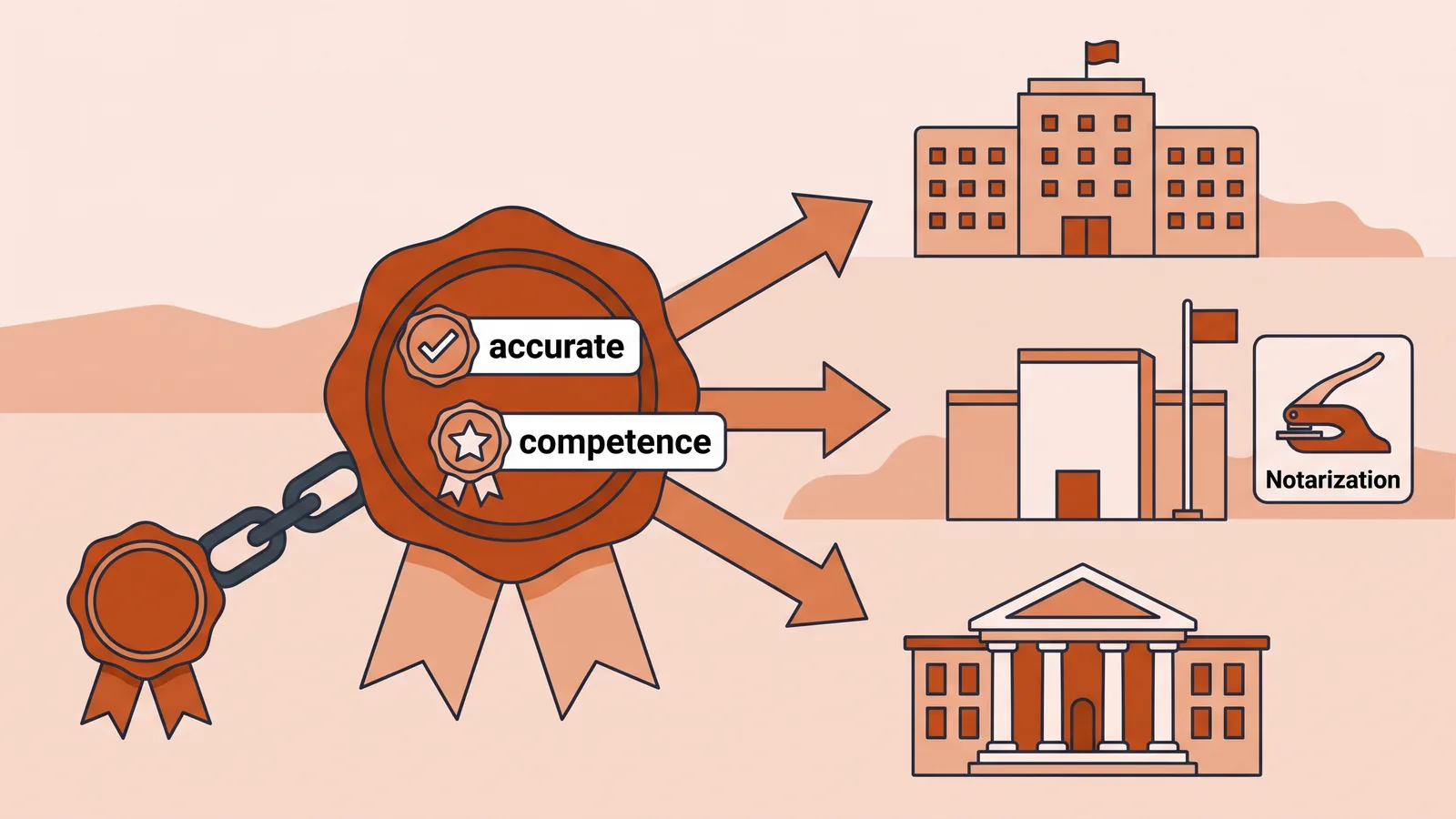
To translate Spanish birth certificate to English for official use, order a certified translation: a complete English version plus the translator’s signed statement of accuracy and competence. USCIS does not require notarization.

Fact level: confirmed
Everything below traces to a source you can open yourself. The federal translation rule for immigration benefit requests sits in 8 CFR 103.2(b)(3). Consular civil-document guidance lives on travel.state.gov, and the two prices quoted here come from vendors’ own published pricing pages.
Both of those prices were checked in January 2026. Price lists change without notice, so treat them as a reference point rather than a quote you can hold anyone to. The legal requirement behind them has been stable far longer than any pricing page.
Nothing here describes a test run by this editorial team. It describes what the regulation text says, what compliant vendors sell, and where filings go wrong in practice.
Jurisdiction matters throughout. These are United States rules, applied by USCIS, by consular posts abroad, and by individual courts, registrars and admissions offices that set their own additional conditions. If the office reading your document is outside the U.S. — a Canadian provincial registry, a British university — the standard is theirs, not Washington’s, and you should ask them in writing before you pay anyone.
What a Spanish birth certificate contains and who asks to see it in English
The name on the document changes with the country. Spain’s Registro Civil issues a certificado literal de nacimiento. Mexico issues an acta de nacimiento; the Dominican Republic, Colombia and much of Central America use acta or partida de nacimiento.
The layout varies. The content almost never does:
- Full name of the registered person, with both surnames in most Spanish-speaking countries
- Date, hour and place of birth (fecha, hora, lugar)
- Parents’ names, nationalities and, in older records, their ages and occupations
- Registry identifiers: libro, tomo, folio, acta, inscripción
- Registrar’s name, signature, official seal and date of issue
- Notas marginales — marginal notes recording recognition, adoption, correction of a name, or a later death
Those marginal notes are the part people skip. A compliant English version reproduces every one of them, including a line that says the record carries none.
The offices that ask for an English version are predictable: USCIS on Form I-130, I-485 or N-400 filings; U.S. consulates processing immigrant visas; family courts handling custody and name changes; Social Security; and university admissions offices evaluating a foreign applicant’s age and identity.
The problem: "certified translation" is a legal term of art
The phrase sounds like a credential. It is not one. In U.S. federal immigration practice there is no government licence for translators, no registry to join, and no stamp that an agency issues — the certification is a statement the translator signs and attaches.
Three misreadings cause most of the trouble.
The first is the notary mix-up. A notary verifies that a person signed something; they do not check Spanish. Notarization is not part of the USCIS translation requirement, according to Rapid Translate’s guide to USCIS translation rules, which notes that a signed certification from the translator is what the agency asks for.
The second is the summary. A half-page English typed rendering of the "important parts" is not a translation of the record, because the seals, registry numbers and marginal annotations are missing.
The third is the one-line certificate. Many templates floating around state only that the translation is accurate, and stop there.
What the rules actually say: USCIS certification versus the State Department standard
The eCFR text of 8 CFR 103.2 adds a second, separate requirement: the translator must also certify that he or she is competent to translate from the foreign language into English. Accuracy alone is not enough — competence is its own clause, and a certification missing it is incomplete.
| USCIS filings (8 CFR 103.2(b)(3)) | Consular and other receivers | |
|---|---|---|
| Who sets the rule | Federal regulation, uniform nationwide | The individual post, court, registrar or university |
| Certification content | Complete and accurate translation and translator competence | Usually the same, sometimes with extra local conditions |
| Notarization | Not part of the requirement | Some posts and courts ask for it anyway |
| Where to confirm | The regulation text | travel.state.gov plus the specific post’s or office’s own page |
The practical rule follows from that table. Build the translation to the federal standard, then check whether the specific receiving office adds anything — a wet signature, a notary block, a sworn translator from a national list.
Spanish-speaking countries differ sharply in what they expect of a translator at home. Spain recognises traductores jurados; Mexico uses peritos traductores appointed by state judiciaries. Neither designation is required by the U.S. regulation, and neither substitutes for the two-part certification.
The solution: how a compliant translation is produced, priced and delivered
RushTranslate lists certified Spanish birth certificate translation at $24.95 per page with turnaround starting at 24 hours (as of January 2026). Pricing is per page because the unit is defined by length, not by sheets of paper: RushTranslate defines a billable page of certified translation as 250 words or less (as of January 2026), so a short Spanish birth certificate usually counts as one page.
A compliant job has a recognisable shape:
- A full English rendering that mirrors the original layout, with bracketed descriptions for seals, stamps and illegible handwriting
- Names transcribed, never translated — José María Fernández Ruiz stays as it is
- A signed certification page naming the translator, stating accuracy and completeness, and stating competence in Spanish and English
- A copy of the Spanish original attached behind the English pages, so the adjudicator can compare
- Digital PDF delivery, with hard copies as an extra for courts that want paper
Example: an applicant types her own English summary of a Mexican acta de nacimiento in a word processor, leaves out the marginal note recording a corrected surname, and attaches no certification. The filing draws a request for evidence. She re-orders the same record as a certified one-page translation, the marginal note appears in brackets, and the next submission goes through on the document. Cost before: nothing, and a lost processing cycle. Cost after: one certified page.
Comparing vendors on the certification wording matters more than comparing logos — a point that also applies when you are weighing translation services against each other for everyday text.

The result: what a correctly certified translation gets you
The measurable outcome is narrow and worth stating plainly: acceptance of the document, not approval of your case. A certified translation removes one specific failure mode — the officer cannot read the record, or cannot confirm who vouched for the English.
RushTranslate markets its certified birth certificate translations as meeting the requirements of USCIS, courts, consulates and universities, which is exactly the acceptance test buyers should apply to any vendor before paying. Ask for that claim in writing on the order page, not in a chat window.
Results expected by design, if the certification is complete:
- USCIS accepts the exhibit without a translation-related request for evidence
- A consular officer at an immigrant visa interview can read the parents’ names against the petition
- A family court clerk accepts the filing as a civil-record exhibit
- An admissions office can verify date of birth against a passport
What it does not do: fix an error in the original record. If the Spanish acta spells a surname wrong, the translation must reproduce the error faithfully, and the correction has to happen at the issuing registry.
Related real cases: published vendor standards and consular guidance
Two named vendors show how far published per-page rates diverge for the same document type. RushTranslate lists certified Spanish birth certificate translation at $24.95 per page (as of January 2026), while Universal Translation Services advertises USCIS birth certificate translation at $20 per page (as of January 2026). Same regulation, different price lists.
The gap is not a quality signal on its own. Read what each page promises about the certification statement, the turnaround, and whether a hard copy costs extra, then decide.
Consular posts are the third case to check, and they are the ones people skip. Before relying on any vendor’s acceptance claim, open the civil-documents page for the specific post handling your case — the U.S. Embassy in the Dominican Republic, for instance — because the receiving post, not the translator, decides what it will take. Readers working with Dominican records often find the everyday vocabulary in those files unfamiliar too, which is a different problem covered in this guide to Dominican Spanish words and their English meanings.
Edge cases and costs to watch: apostilles, names and accents, and when no translation is needed
An apostille authenticates the original foreign record under the Hague Convention. It is issued in the country that holds the registry, it is not a translation, and ordering one from a translation vendor is not possible — you request it from the designated authority abroad. Some receiving offices want the apostille translated as well, which adds a page.
Names and accents cause quiet rejections. Keep the ñ, keep the accents, keep both surnames, and never convert Guillermo into William. If the passport and the acta disagree on spelling, flag it to the attorney rather than letting a translator smooth it over.
Sometimes no translation is needed at all. Certain consular posts in Spanish-speaking countries accept civil documents in Spanish, and if your record comes from Puerto Rico, ask the issuing registry whether it can supply an English-language copy directly — that removes the translation step and its cost.
Machine output is the last trap. Phone apps and handheld translator gadgets are useful for reading a document to yourself, and useless for filing, because no device signs a competence statement. Use them to understand; hire a human to certify.
This article is general information about U.S. federal and consular practice, not legal advice; for your own filing, confirm requirements with the receiving agency or an immigration attorney.
Frequently asked questions
Can I translate my own Spanish birth certificate for USCIS?
The federal regulation describes what the certification must say, not who the translator may be, so it does not expressly bar a relative or the applicant. In practice, officers and consular posts often question impartiality, and using an uninvolved bilingual translator or a vendor removes that argument entirely for the cost of one page.
Does a certified translation have to be notarized?
Not for USCIS. Rapid Translate’s guide to USCIS translation requirements explains that notarization is not part of the agency’s translation requirement, and that a signed certification from the translator is what USCIS asks for. Some state courts and foreign receiving offices still request notarization, so confirm with the office that will read your file.
How much does it cost to translate a Spanish birth certificate?
Published rates differ by vendor: Universal Translation Services advertises USCIS birth certificate translation at $20 per page (as of January 2026). Length is measured in words, not sheets — RushTranslate defines a billable page of certified translation as 250 words or less (as of January 2026), so most single-page records bill as one page.
How fast can I get the English version back?
RushTranslate lists turnaround starting at 24 hours for certified Spanish birth certificate translation (as of January 2026). Build in extra time if you need hard copies mailed, if the record has long marginal notes, or if the receiving court also wants a notarized signature page.
What happens to marginal notes, seals and an apostille?
Everything printed, stamped or handwritten on the record belongs in the English version, including a statement that no marginal notes exist. An apostille authenticates the original document and is issued by the authority in the country of origin; some offices also want that page translated, which adds to the per-page cost.
Sources
- eCFR :: 8 CFR 103.2 — Submission and adjudication of benefit requests
- Certified Spanish birth certificate translation services — RushTranslate
- Certified Birth Certificate Translation — RushTranslate
- Birth Certificate Translation Services for USCIS — Universal Translation Services
- USCIS Translation Requirements: Complete Guide — Rapid Translate
AI tools helped write this guide. The Spanish to English Editorial Team published it after checking every figure against the sources linked above.