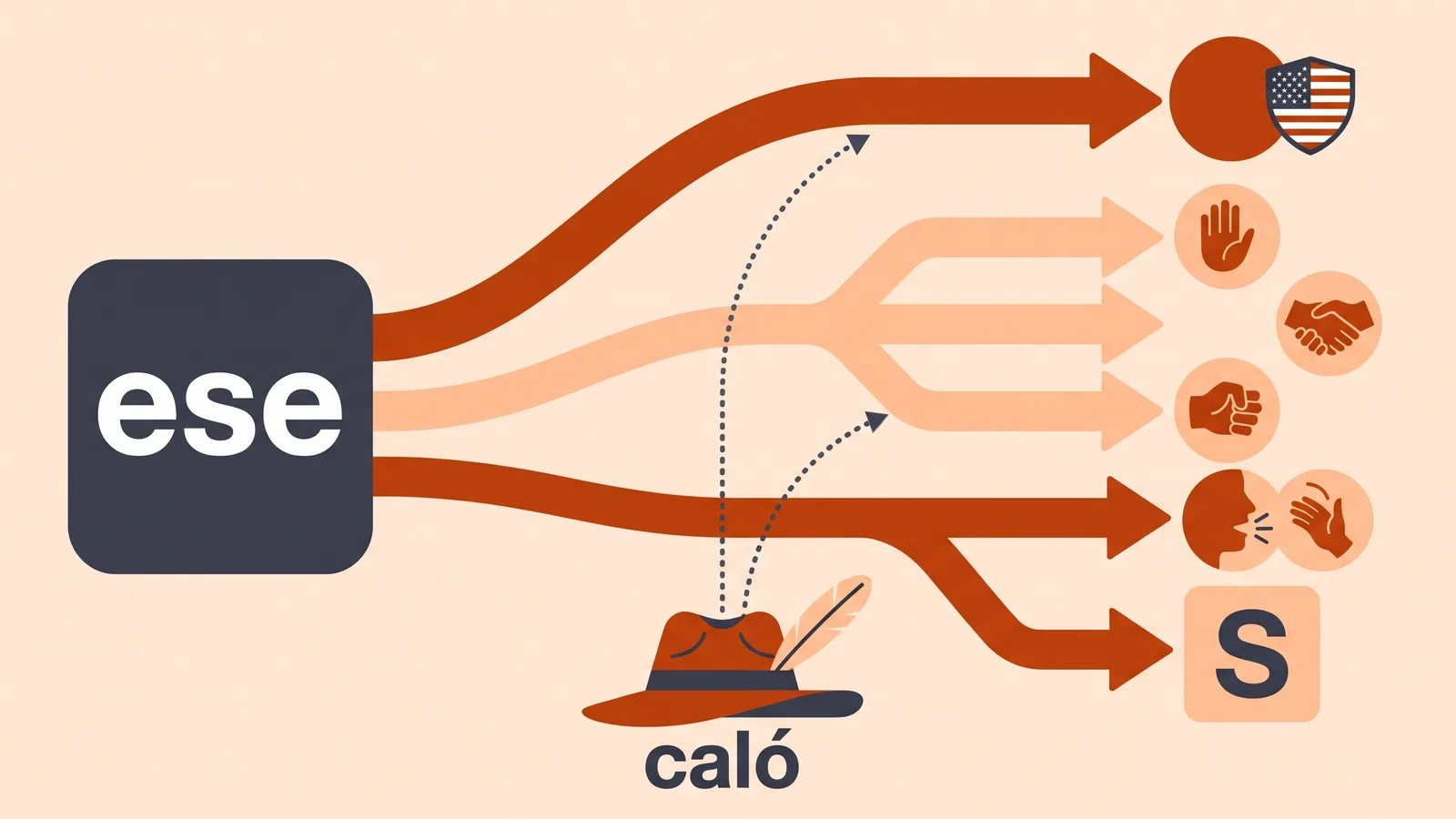
In Mexican and Chicano slang, ese means "dude," "bro," or "man" — a vocative used to address another guy. It grew out of the demonstrative ‘ese’ (‘that one’), likely shortened from ‘ese vato,’ in 1940s pachuco caló.

Why ‘ese’ matters when you’re reading, watching, or listening to Spanish
You almost always hear it hanging off the end of a line, not the front: Órale, ese. That position is your first clue that the word is doing social work rather than grammatical work. A demonstrative pointing at an object would not sit there.
Key takeaways
- As slang, ese is a vocative — a way of addressing a man you are speaking to, close to "dude," "bro," or "homie."
- The same four letters are also an everyday demonstrative ("that," "that one") and the Spanish name of the letter S.
- Its street sense is tied to Mexican and Chicano speech and to 1940s pachuco caló.
- Tone swings hard: warm between friends, confrontational between strangers.
Spanish is spoken at home by about 44.9 million people aged 5 and over in the United States, according to Census Bureau American Community Survey data reported by USAFacts and checked in February 2026. That is the audience behind a steady stream of US film, music, and television carrying unglossed Mexican-American slang.
Subtitles rarely rescue you here. A translator working under time pressure often drops the vocative, so "¿Qué onda, ese?" turns into a flat "What’s up?" and the relationship between the two speakers vanishes. If rapid dialogue is the real obstacle, our walkthrough on catching spoken Spanish when nobody slows down for you handles the listening half of the problem.
What ‘ese’ means: senses, regions, and registers
Four distinct senses share this spelling, and only one of them is street slang.
1. Term of address for a man — Region: Mexican Spanish and Chicano English in the US Southwest. Register: informal, mostly man-to-man, often male-coded even when a woman uses it. English: dude, bro, man, homie.
"¿Qué onda, ese?" → "What’s up, dude?"
Dictionary.com defines ‘ese’ as a Mexican-Spanish slang term of address for a fellow man, roughly equivalent to English "dude," "bro" or "homey."
2. Demonstrative adjective or pronoun — Region: every Spanish-speaking country. Register: neutral, standard. English: that, that one.
"Ese carro no arranca." → "That car won’t start."
3. The name of the letter S — Region: standard across the Spanish-speaking world. Register: neutral. English: "ess."
"Mi apellido lleva dos eses." → "My last name has two s’s."
Wiktionary records this letter-name sense separately, and it is the one English readers trip over most often in spelling bees, phone numbers, and dictation scenes.
4. English noun borrowed from Spanish — Region: US English. Register: slang.
"He showed up with two eses from the old block."
Wiktionary notes that ‘ese’ has entered English as a borrowing from Mexican Spanish ‘ése’ meaning "dude."
Register is the part no word list captures. Wiktionary labels the slang sense as Mexican, Chicano, slang and vocative, glossing it as dude, guy, pal, man or buddy, and notes it can run anywhere from affectionate to pejorative. The same syllable that reads as affection between cousins reads as a challenge across a parking lot.
Where ‘ese’ came from: Latin ipse, ‘ese vato,’ and 1940s pachuco caló
The root is old and entirely unremarkable. Wiktionary traces the Spanish demonstrative ‘ese’ — the source of the slang — back to Latin ipse. Nothing about that ancestry is slangy; it simply means pointing.
The jump from pointing to addressing is where the interesting part sits. According to Dictionary.com, the slang ‘ese’ comes from that ordinary demonstrative meaning "that / that one" and probably developed as a shortening of phrases such as ‘ese vato’ ("that guy"). Call someone "that guy" to his face often enough and the pointing word becomes the name you call him.
Wiktionary dates the spread of the person-referring sense of ‘ése’ to pachuco culture of the 1940s, with an alleged origin in southern Mexico. Dating is approximate by nature with spoken street vocabulary, which is why reference works hedge with "alleged."
Caló, the Chicano street register that carried ‘ese’ into wide use, grew out of zoot-suit pachuco culture of the 1930s and 1940s in US–Mexico border cities and became a symbol of the Chicano Movement in the 1960s and 1970s, according to Wikipedia. That second life matters for reading: by the 1970s the word carried identity and pride, not only neighborhood familiarity.
Real examples: how dictionaries and Chicano media record ‘ese’
Lexicographers treat the word differently depending on which language they are describing, and comparing their entries is the fastest way to see its range.
The Oxford English Dictionary first published its entry for the noun ‘ese’ in March 2014 and last revised it in March 2024, treating it as a single-sense borrowing from Spanish used in US English. One sense, one register, no demonstrative — because the OED is describing English, where only the slang crossed over.
Dictionary.com, writing for an American general audience, frames it as a Mexican-Spanish slang term of address for a fellow man and offers "dude," "bro" and "homey" as equivalents. That three-way gloss is a useful hint that no single English word carries the whole load.
Wiktionary, covering Spanish itself, stacks the labels: Mexican, Chicano, slang, vocative. It also keeps the separate entry for ‘ese’ as the name of the letter S, which a US English dictionary has no reason to record.
Wikipedia’s account of caló supplies the cultural frame those entries leave out — zoot-suit pachucos, border cities, and a register that later became a badge of the Chicano Movement. For more vocabulary from the same speech community, see our roundup of everyday Mexican slang and what each term means in English.
‘Ese’ vs ‘güey’ vs ‘vato’ vs ‘homie’
| Word | Where you hear it | Register | Closest English | Watch for |
|---|---|---|---|---|
| ese | Mexico, Chicano US Southwest | Street, male-to-male, vocative | dude, bro, homie | Can read as a challenge from a stranger |
| güey / wey | Mexico, nationwide | Casual, now near-universal among friends | dude, man | Tone decides how friendly it lands |
| vato | Mexico, Chicano US | Street, noun rather than address | guy, dude | Usually heard as a noun about a guy, not a greeting |
| homie | US English, borrowed back | Casual, hip-hop and barrio English | close friend | English word; not a Spanish translation |
The grammar separates them more cleanly than the dictionaries do. ‘Vato’ is primarily a noun for a guy you are talking about; ‘ese’ is primarily what you call the guy you are talking to. ‘Güey’ does both jobs and has drifted far enough into mainstream Mexican speech that teenagers use it in front of their parents.
Borrowing runs in both directions. In its March 2025 update highlighting US Hispanic English, Oxford Languages said the OED already records more than 2,000 words of Spanish origin, the earliest dating to the 14th century. ‘Ese’ is a recent arrival in a very long line.
If you want another Mexican term whose force depends entirely on delivery, our piece on what ‘neta’ signals in Mexican conversation covers a similar trap.
Common misconceptions and translation mistakes
The acronym myth. A popular online claim says ‘ese’ stands for the initials of a gang name. The published etymologies point elsewhere: Dictionary.com derives it from the demonstrative and the phrase ‘ese vato,’ and Wiktionary traces the demonstrative itself to Latin ipse. Backronyms attach themselves to street vocabulary constantly; treat them as folklore.
The accent rule. Older Spanish style put a written accent on the pronoun — ‘ése’ — to separate it from the adjective ‘ese.’ You will still see both spellings in subtitles and song lyrics for the same word. Wiktionary files the slang sense under ‘ése’, so searching both forms is worth the extra five seconds.
Translating it as "that." A vocative is not a demonstrative. "Cálmate, ese" is "Calm down, man," never "Calm down, that."
Missing the letter S. "Dos eses" in a spelling or name-dictation scene has nothing to do with slang.
Assuming hostility. Wiktionary’s note that the term runs from affectionate to pejorative is the whole story: tone, volume, and who is speaking decide it, not the word.
Pronunciation, plurals, and whether you should say it
Say it EH-seh, with the stress on the first syllable and both vowels short and pure. The initial vowel is the "e" of "bet," never the "ee" of "easy," and the final vowel must not reduce to the English schwa at the end of "sofa." English speakers most often give themselves away by stressing the second syllable or swallowing that last vowel.
The plural follows ordinary Spanish rules: eses, pronounced EH-sess. The word is male-coded in practice, and there is no standard feminine counterpart that carries the same street weight.
Politeness is the practical question. ‘Ese’ belongs to close, casual, in-group speech; it does not belong in a job interview, a clinic, a classroom, or any conversation with someone’s grandmother. Using it with a stranger can land as a challenge rather than a greeting.
For non-Latino English speakers, understanding beats performing. The word carries a specific neighborhood and generational history, and borrowing it secondhand reads as costume more often than camaraderie. Recognize it instantly, translate it accurately, and reach for "man" or "dude" in your own speech — our list of the Spanish slang English speakers hear most often covers which terms travel comfortably and which do not.

Bottom line
‘Ese’ is a vocative before it is anything else: a way of addressing a man, built from a word that originally just meant "that one." Dictionary.com puts it beside "dude," "bro" and "homey," and those three glosses exist because no single English word covers the full range.
The history is short and specific. A pointing word from Latin ipse became ‘ese vato,’ got trimmed to one syllable in 1940s pachuco speech, and traveled with caló out of border cities into Chicano identity and then into American English.
When you meet it on screen, read three things before you translate: who is speaking, how close they stand, and what the tone is doing. Those decide whether the right English is "bro," "man," or something sharper.
Keep the other two senses parked in memory as well. If the sentence is about a car, a book, or a letter of the alphabet, ‘ese’ is not slang at all — it is "that" or it is the letter S, and reaching for "homie" will wreck the line.
Frequently asked questions
How do you pronounce ‘ese’?
Say EH-seh with the stress on the first syllable. The first vowel matches the "e" in "bet," and the final vowel must stay a crisp "eh" rather than reducing to the English schwa at the end of "sofa." Stressing the second syllable is the clearest giveaway of a non-native speaker.
What is the plural of ‘ese’?
The plural is ‘eses,’ pronounced EH-sess, formed with the regular Spanish -s ending for words finishing in a vowel. The identical form also serves as the plural of the letter name S, so "dos eses" usually means "two s’s" in a spelling or dictation context rather than two guys.
Is ‘ese’ friendly or insulting?
Both, depending on delivery. Wiktionary notes the term can run from affectionate to pejorative, which means tone, volume, physical distance and the relationship between speakers carry the meaning. Among friends it works like "bro"; aimed at a stranger across a street, it functions as a challenge.
Should non-Latinos use ‘ese’?
Understanding it is useful; using it rarely is. The word belongs to Mexican and Chicano in-group speech with a specific neighborhood and generational history, so outsiders who adopt it usually sound like they are performing a role. Translate it accurately and say "man" or "dude" in your own conversation.
Does ‘ese’ ever just mean ‘that’?
Constantly, and in every Spanish-speaking country. The demonstrative sense — "ese libro," "that book" — is the standard, neutral meaning, and the slang sense grew out of it through phrases like ‘ese vato.’ Check whether the word sits before a noun (demonstrative) or after a comma at the end of a greeting (slang).
Sources
- ese | Dictionary.com Slang & Emoji Dictionary
- ése – Wiktionary, the free dictionary
- ese – Wiktionary, the free dictionary
- ese, n. meanings, etymology and more | Oxford English Dictionary
- Oxford English Dictionary (OED) Adds US Hispanic Words in Latest Update – Library Journal infoDOCKET
- Caló (Chicano) – Wikipedia
- How many people speak Spanish at home? | USAFacts
AI tools helped write this guide. The Spanish to English Editorial Team published it after checking every figure against the sources linked above.