In Mexico, neta Spanish slang means “the truth”: a noun (la neta), an adverb (neta que sí), and a one-word question, “¿neta?”, that asks “seriously?” or “for real?”

What does ‘neta’ mean in Mexican slang?
Mexican Spanish runs on a short list of words that carry a lot of conversational weight. This is one of them.
Neta — a Mexican slang noun meaning “the truth,” the plain facts. As an adverb it means “really” or “seriously.” On its own, “¿neta?” asks “are you serious?”
The Academia Mexicana de la Lengua’s Diccionario breve de mexicanismos defines neta as a feminine noun meaning “the truth, what is certain,” derived from neta in the sense of clean, pure and clear. One concept, three grammatical jobs.
El Colegio de México’s Diccionario del español de México labels neta as popular register and lists sense 1 as the noun verdad and sense 2 as the adverb en serio, de verdad. That register label matters. It tells you the word is understood everywhere in Mexico but belongs to casual speech, not to a contract or a news anchor’s script.
Three glosses cover most of what you will actually hear:
- la neta — the truth; or, at the front of a sentence, “honestly”
- ¿neta? — seriously? for real?
- neta que sí — honestly, yes; I swear it’s true
Mexican speech gets a lot of exposure abroad through música, streaming and memes, which is why this word probably reached you before most other regional vocabulary. If you want the wider set, there is a rundown of the Mexican slang terms English speakers hear most.
Where ‘neta’ comes from: from ‘neto’ (clean, pure) to ‘the truth’
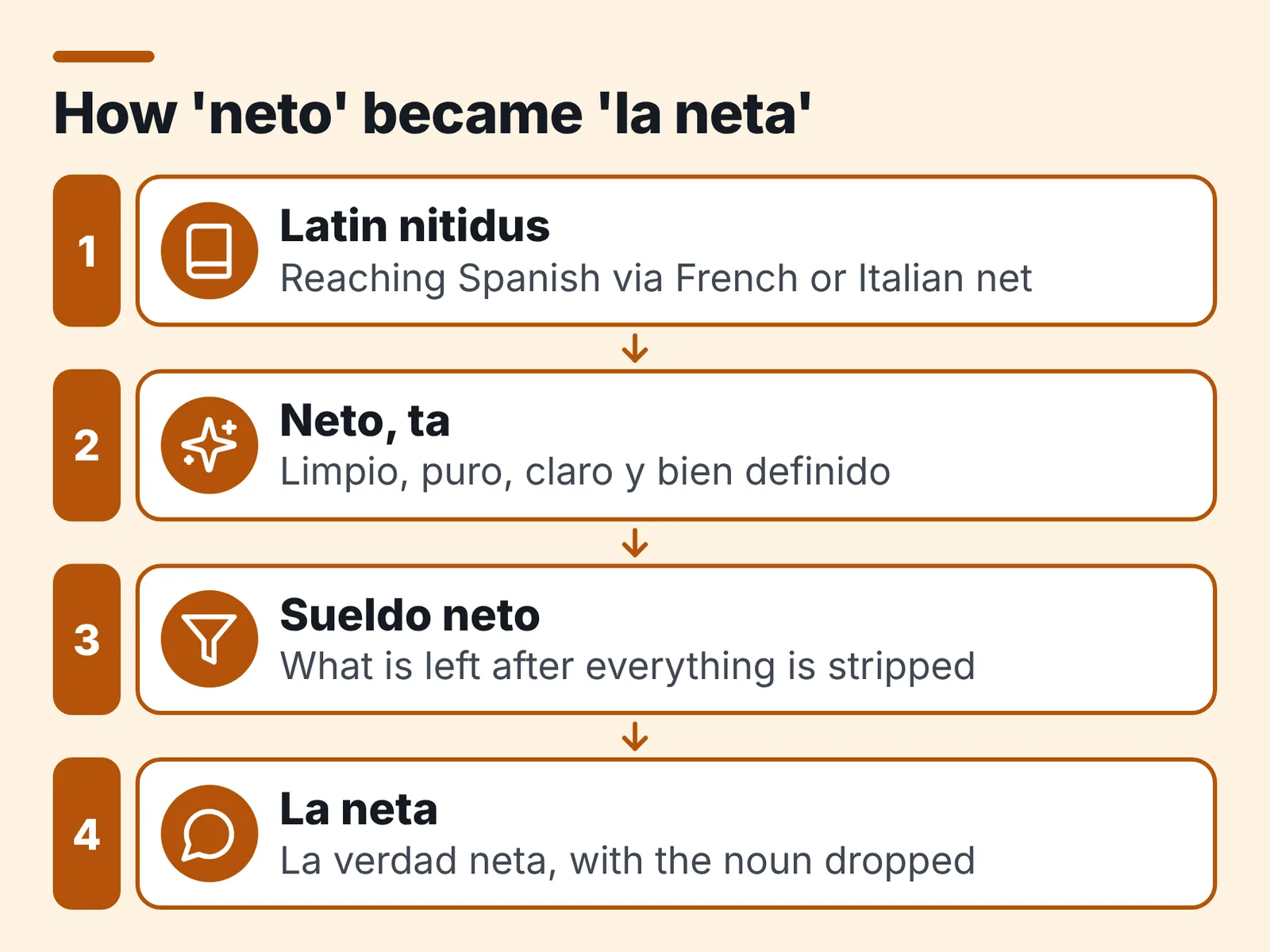
The word did not begin as street slang. The Real Academia Española’s dictionary gives “limpio, puro, claro y bien definido” as sense 1 of neto, ta, tracing the word to Catalan or French net, or Italian netto, from Latin nitidus. Clean. Clear. Nothing stuck to it.
You already know its accounting cousin. A sueldo neto is net pay, the amount left after everything else has been stripped out, and that is exactly the logic behind the slang: the neta is what remains when you remove the spin, the excuses and the polite version.
Mexican outlet Infobae reported in April 2024 that “neta,” colloquially translated as “the truth,” has etymological roots some experts link to French net, meaning pure or clear.
The grammar shift is easy to picture. Speakers used the feminine adjective with an implied noun — la (verdad) neta, the pure truth — then dropped the noun and kept the modifier. English does the same move in “keep it real,” where an adjective quietly does a noun’s work.
That history explains the flavor of the word. Neta is not neutral truth in the abstract; it is the unvarnished version, the one you were not being told a minute ago.
How ‘neta’ works in a sentence: noun, adverb, and the question ‘¿neta?’
There are three slots, and almost every real sentence you meet will use one of them.
| Role | Spanish | Natural English |
|---|---|---|
| Noun (object) | Dime la neta. | Tell me the truth. / Give it to me straight. |
| Noun (sentence opener) | La neta, no quiero ir. | Honestly, I don’t want to go. |
| Adverb | Neta que estuvo increíble. | It really was amazing. |
| Question | —Me corrieron. —¿Neta? | —I got fired. —Seriously? |
The noun takes the article: la neta, never el neta. The adverb usually arrives with que attached — neta que sí, neta que no, neta que no sabía — and that little que is your signal that the speaker is swearing to something rather than naming it.
The one-word question carries the most emotion. Said with rising intonation and wide eyes, “¿neta?” is disbelief; said flat, it is a challenge, closer to “are you serious right now?”
Pairing it with another verb is common in texts: ¿neta que te vas? — “you’re seriously leaving?” If the imperative dime in “dime la neta” is new to you, the full breakdown of what dime means and when Mexicans use it covers that half of the phrase.
‘La neta’ vs. ‘la verdad’: what changes when you add the article
Both phrases mean “the truth.” The difference is social, not semantic, and getting it wrong is the fastest way to sound like someone reading slang off a flashcard.
| la verdad | la neta | |
|---|---|---|
| Register | Neutral; works anywhere | Informal, popular register |
| Geography | All Spanish-speaking countries | Mexico, Guatemala and El Salvador; youth speech in Ecuador and Chile |
| In writing | Essays, email, news copy | Texts, captions, dialogue |
| With strangers | Always safe | Depends on age and setting |
| Emotional heat | Low | Higher; signals confidence |
As sentence openers they are interchangeable in grammar: la verdad, no sé and la neta, no sé both mean “honestly, I don’t know.” What changes is who you sound like. The first sounds like anyone; the second sounds like a Mexican friend being blunt with you on purpose.
Dropping the article changes what the word is doing. Without la, one common reading is the adverb El Colegio de México lists as sense 2 — neta que estuvo increíble, “it really was amazing.” Another is the adjective: the Asociación de Academias de la Lengua Española’s Diccionario de americanismos records the Mexican adjective neto, -a as describing a person who speaks with complete sincerity. Context, not the word itself, tells you which one you are hearing.
When you are unsure, default to la verdad. It never sounds wrong.
‘Neta’ vs. ‘en serio’, ‘¿de veras?’ and other Mexican truth words
Mexican Spanish gives you several ways to ask “really?”, and they are not equally casual.
| Expression | Strength | Who says it |
|---|---|---|
| ¿Neta? | Strong, very informal | Mexicans, in casual speech |
| ¿En serio? | Neutral | Everyone, everywhere |
| ¿De veras? / ¿De verdad? | Neutral, slightly softer | All countries, all registers |
| ¿A poco? | Playful disbelief | Mexico, very colloquial |
The Asociación de Academias de la Lengua Española’s Diccionario de americanismos records “neta” meaning truth or purity for Mexico, Guatemala and El Salvador, and as youth speech in Ecuador and Chile — five countries in a single entry. That spread is narrower than it sounds. In Ecuador and Chile the word reads as young, borrowed and media-driven rather than native.
Substitution has a cost. Replacing ¿neta? with ¿en serio? loses no meaning, only texture; replacing ¿en serio? with ¿neta? in a Madrid office would land as an odd foreign import.
Treat ¿a poco? as neta’s lighter sibling. It questions a claim with amusement, while ¿neta? demands confirmation.
Set phrases built on neta: ‘la neta del planeta’, ‘ser la neta’, ‘neta que sí’
A handful of fixed expressions do the real work in conversation, and each one shifts the meaning.
La neta del planeta. The Diccionario de americanismos registers this Mexican phrase as meaning indisputable, clear, untwisted truth. The rhyme is the point — planeta echoes neta — and English has no equivalent that rhymes, so “the absolute truth” or “the honest-to-God truth” is as close as you get.
Ser la neta. The Diccionario del español de México gives a third sense, “ser la neta,” meaning to be the best or the greatest, with examples about a teacher and tacos de canasta. Esa maestra es la neta means that teacher is the best, not that she is truthful.
Neta que sí / neta que no. An oath, roughly “I swear it is” or “I swear it isn’t.” Used to shut down doubt after someone has already questioned you once.
Decir la neta. To come clean, to say the thing nobody wants to say out loud.
Memorize ser la neta separately. It is the one phrase where translating neta as “truth” produces nonsense.
How to translate ‘neta’ into natural English in subtitles, texts and conversation
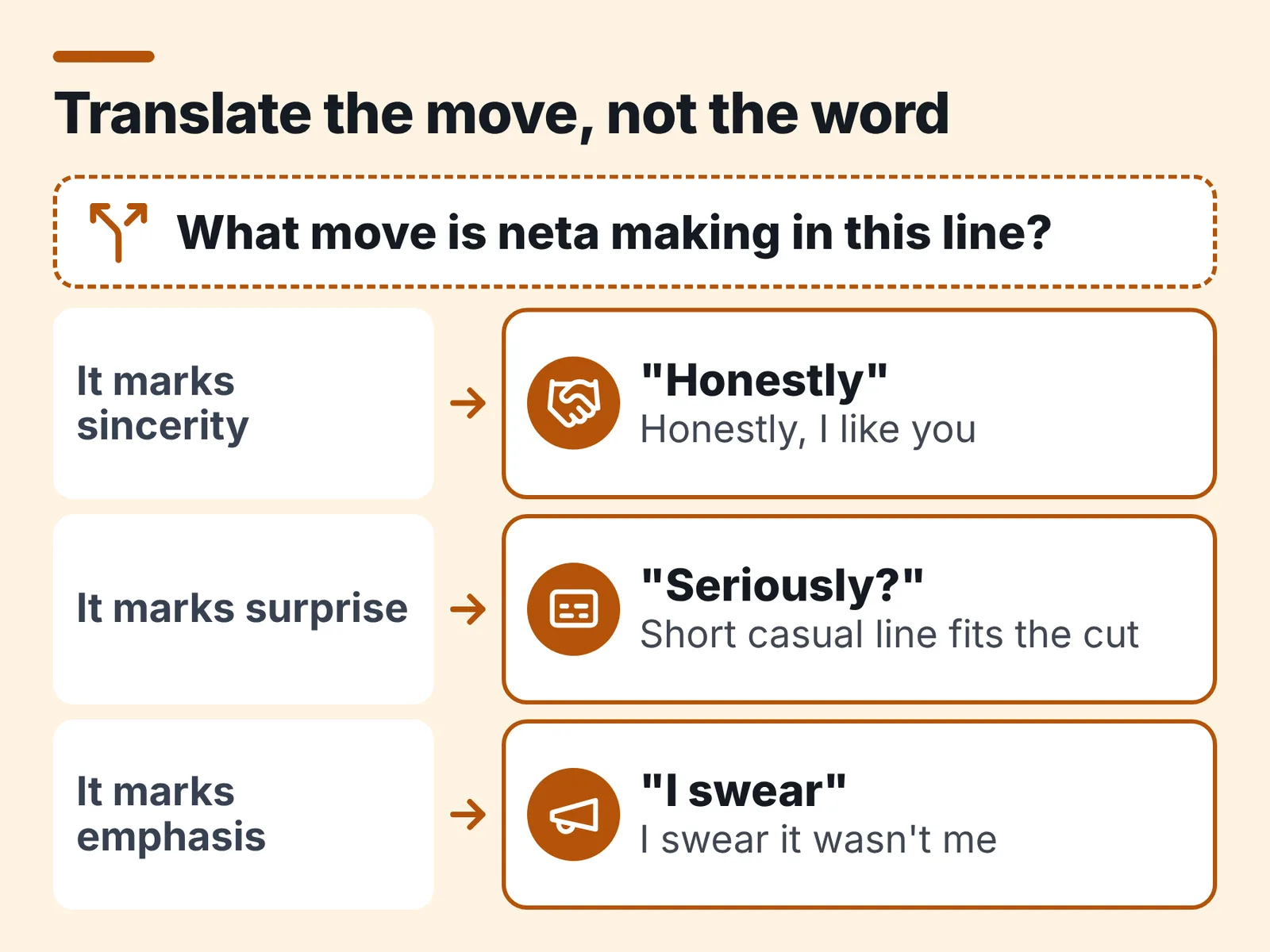
The trap is translating the word instead of the move. Neta rarely means “truth” as a dictionary noun; it usually marks sincerity, surprise or emphasis, and English does those with different words each time.
| Spanish | Weak literal version | Natural English |
|---|---|---|
| La neta, me caes bien. | The truth, you fall well to me. | Honestly, I like you. |
| ¿Neta? | The truth? | Seriously? / No way. |
| Neta que no fui yo. | Truth that it wasn’t me. | I swear it wasn’t me. |
| Es la neta del planeta. | It’s the truth of the planet. | It’s the honest truth. |
| Ese güey es la neta. | That guy is the truth. | That guy’s the best. |
For subtitles, keep the register casual and the line short. A single reaction shot of “¿neta?” almost always works better as “Seriously?” than as anything longer, and the line should stay short enough for the viewer to read before the cut.
For texts, match your friend’s tone rather than their vocabulary. Answering ¿neta? with “yeah, for real” is better English than forcing neta back into your own reply.
If you are captioning whole clips rather than single lines, the step-by-step guide to turning Spanish video into English subtitles covers timing and line length in detail.
Who says ‘neta’, where, and when you should avoid it
Mexico is the country with the largest number of Spanish speakers in the world, more than 120 million, and 11 language families coexist there, according to the Instituto Cervantes’ 2024 yearbook. Neta belongs to the Spanish side of that picture, and it is heard across the country rather than in one region.
Say it freely with friends your age, with coworkers you already joke with, in group chats, and in reply to gossip. It reads as warm and direct, not aggressive.
Hold it back in four situations:
- A job interview, a visa appointment or any government office
- Written business email, a cover letter, or anything a lawyer will read
- Speaking to an older stranger for the first time
- Conversations with Spanish speakers outside Mexico and Central America, where it may simply not register
Non-native speakers get a short grace period. Using neta correctly once lands well; sprinkling it into every third sentence sounds like imitation, and native speakers notice the difference quickly.
The safe substitution never fails: swap in la verdad and the sentence still works in every country, every register. For more words that trip up English speakers reading Mexican dialogue, see the Mexican Spanish terms that confuse learners most.
Frequently asked questions
Is ‘neta’ a bad word or rude?
No. El Colegio de México’s Diccionario del español de México labels it popular register, meaning informal rather than vulgar. You can say it in front of friends and most coworkers, but it still sounds out of place in a job interview, a legal document or a formal email.
What does it mean when someone just texts ‘¿neta?’
It means “seriously?” or “for real?” — a one-word request for confirmation after surprising news. Reply with “neta que sí” if it’s true, “es broma” if you were joking, or “sí, neta” to double down on what you said.
Is ‘neta’ used outside Mexico?
Somewhat. The Asociación de Academias de la Lengua Española’s Diccionario de americanismos records it for Mexico, Guatemala and El Salvador, and as youth speech in Ecuador and Chile — five countries total. In Spain, Argentina or Colombia, expect blank looks and use “la verdad” instead.
What is the difference between ‘la neta’ and ‘la verdad’?
They mean the same thing, but register separates them. “La verdad” is neutral and works in every Spanish-speaking country and every setting; “la neta” is casual Mexican speech that signals closeness and bluntness, which is why it fits chats and dialogue but not formal writing.
Why does ‘neta’ sometimes mean ‘the best’?
The Diccionario del español de México lists “ser la neta” as a third sense meaning to be the best or the greatest, with examples about a teacher and tacos de canasta. In that construction, translating neta as “truth” produces nonsense — use “the best” or “amazing.”
Sources
- neta. — Diccionario breve de mexicanismos de Guido Gómez de Silva, Academia Mexicana de la Lengua
- neto, ta | Diccionario de la lengua española (RAE)
- neta | Diccionario de americanismos (ASALE)
- neto, neta | Diccionario de americanismos (ASALE)
- neta | Diccionario del español de México (El Colegio de México)
- CVC. Anuario 2024. Presentación. Carmen Pastor Villalba — Instituto Cervantes
- Informe 2024: El español, lengua para el mundo — Observatorio Global del Español, Instituto Cervantes
- ¿De dónde viene la palabra ‘neta’ que usamos en México y cuál es su significado? — Infobae
AI tools helped write this guide. The Spanish to English Editorial Team published it after checking every figure against the sources linked above.