The Mexican words that confuse English speakers most are ¿mande?, güey, ahorita, chido, padre, neta, fresa, no manches and órale — because each one’s real meaning comes from tone and register, not from its dictionary entry.
What "Mexican Spanish to English" Actually Means (And Why a Dictionary Alone Fails You)
Definition: Mexican Spanish to English is the work of turning Mexico’s own vocabulary, diminutives and politeness habits into English that keeps the original tone, formality and intent — not word-for-word substitution.
Mexico’s 2020 Population and Housing Census, run by INEGI, recorded a total population of 126,014,024, making Mexico the world’s largest Spanish-speaking country. Most of the Spanish that reaches English speakers through streaming, music and work conversations is Mexican by default. A general bilingual dictionary usually gives you the Peninsular reading first and buries the Mexican sense, if it lists it at all.
Take ahorita. Piece by piece it reads "little now," so you brace for something immediate. In practice it stretches from two minutes to this evening to never, and only tone, verb tense and the speaker’s face narrow it down.
What trips you up is rarely the noun itself. It is register — who may say this word, to whom, and how rude it lands in the room.
A dictionary alone misses three things:
- Register: güey is "dude" between friends and "idiot" when aimed at a stranger.
- Regional default: torta is a sandwich in Guadalajara and a cake in Madrid.
- Social function: ¿Mande? is a polite "sorry, what?", not a request for orders.
The Mexican Words and Phrases That Confuse English Speakers Most: ¿Mande?, Güey, Ahorita, Chido, Padre, Neta, Fresa, No Manches, Órale
| Word | Literal reading | What it usually means in Mexico | Natural English |
|---|---|---|---|
| ¿Mande? | "command (me)" | Polite "what did you say?" or "yes?" when called | "Sorry?" / "Yes?" |
| Güey (wey) | ox | Dude, man; insult if the tone is sharp | "dude" / "idiot" |
| Ahorita | little now | Soon, eventually, or never | "in a bit" / "later" |
| Chido | — | Cool, great | "awesome" |
| Padre / padrísimo | father | Cool / amazing | "great" / "incredible" |
| Neta | net, pure | Truth; "really?"; "the real deal" | "for real?" / "the truth" |
| Fresa | strawberry | Preppy, posh, snobby | "preppy" / "bougie" |
| No manches | "don’t stain" | Disbelief, softer than the vulgar version | "no way" / "you’re kidding" |
| Órale | — | Agreement, encouragement, or surprise | "okay then" / "wow" / "go on" |
¿Mande? catches English speakers off guard because the literal reading sounds servile. Treat it as the Mexican replacement for ¿qué?, used when you did not hear someone or when your name is called from another room.
Órale has no stable English twin. It accepts a plan ("órale, nos vemos"), pushes someone along ("órale, apúrate"), and registers shock ("¡órale, qué grande!") depending entirely on pitch and length.
Neta works as noun, question and compliment. "¿Es neta?" is "are you serious?", while "eres la neta" praises a person as genuinely great.
Fresa is a judgment about class and style, so "strawberry" is never the answer. A chavo fresa speaks with a particular drawl, and the English that lands closest is "preppy" or "posh," with a light sneer attached.
How to Translate a Mexicanismo in Three Stages: Spot It, Read the Context, Pick the English Register
- Spot it. If the literal meaning is absurd in the sentence — a strawberry going to work, someone telling you not to stain something — you are holding a mexicanismo, not a mistake.
- Read the context. Check who is speaking to whom, the age gap, and whether the setting is a kitchen table, a group chat or an office email.
- Pick the English register. Choose the English phrase your speaker would plausibly use at that exact level of politeness, then test it by reading the whole line aloud.
Language Magazine, summarizing the Instituto Cervantes 2024 yearbook, breaks the global Spanish-speaking population into almost 500 million native speakers, around 78 million with limited competence, and more than 24 million students. Those three groups do not share the same slang instincts, which is why context beats memorized glossaries.
Work a real line through the stages: "No manches, el güey llegó bien fresa a la chamba." Stage one flags three mexicanismos. Stage two tells you it is two friends gossiping, not a manager writing a review.
Stage three gives you "No way — the guy showed up to work looking all preppy." Swap the friends for coworkers on a recorded call and you would soften it further: "Seriously, he came in dressed pretty fancy."
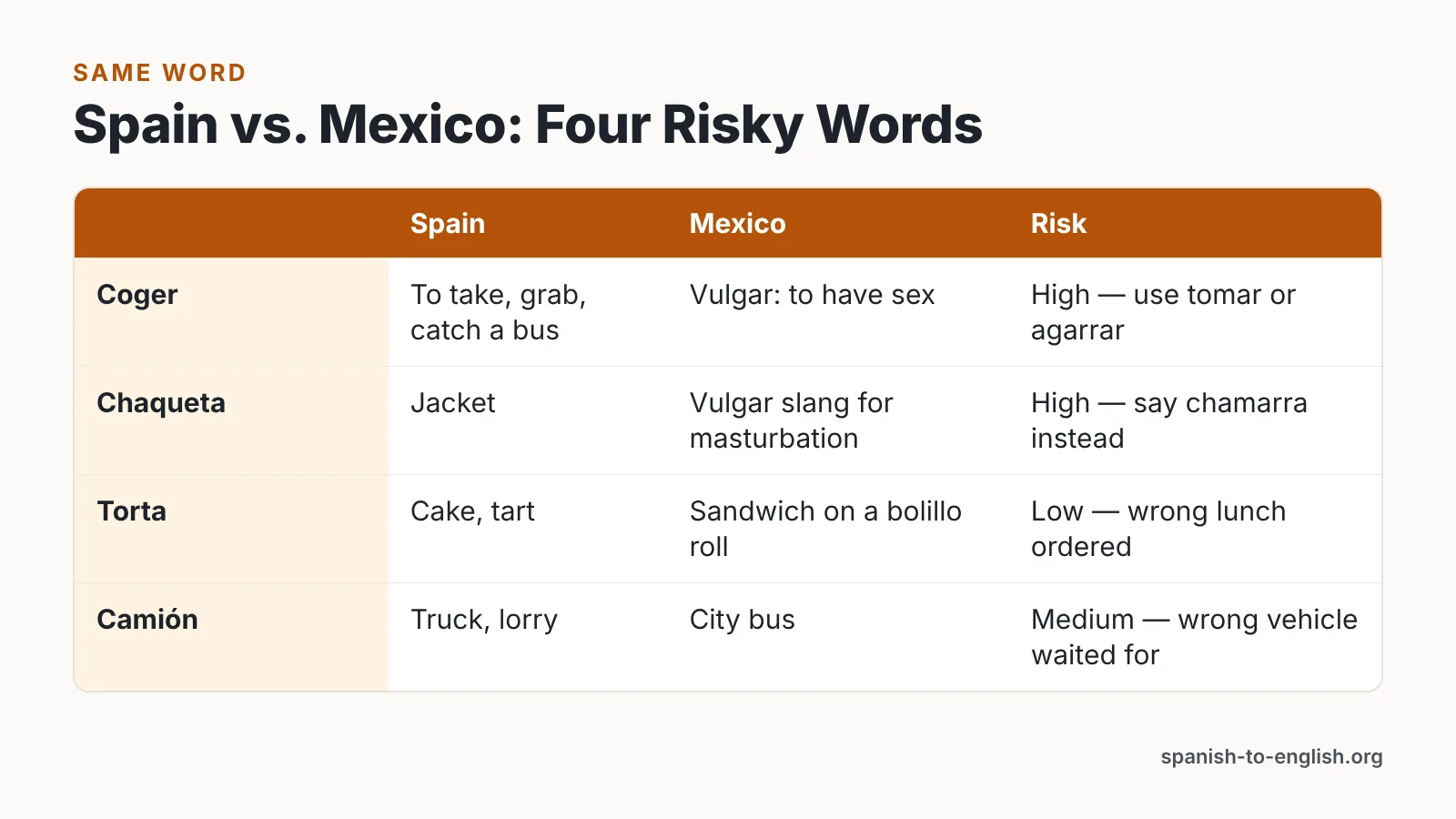
Mexican Spanish vs. Peninsular (Spain) Spanish: Same Word, Different Meaning — Coger, Chaqueta, Torta, Camión
| Word | Spain | Mexico | Risk if you use the wrong default |
|---|---|---|---|
| Coger | to take, to grab, to catch (a bus) | vulgar: to have sex | High — use tomar or agarrar in Mexico |
| Chaqueta | jacket | vulgar slang for masturbation | High — say chamarra for a jacket |
| Torta | cake, tart | a sandwich on a bolillo roll | Low, but you will order the wrong lunch |
| Camión | truck, lorry | city bus (also camioneta for a van/pickup) | Medium — you may wait for the wrong vehicle |
The Instituto Cervantes yearbook reported that in 2024 the number of Spanish speakers worldwide passed 600 million people for the first time, and that single language carries several competing defaults. A translation tool trained mostly on Peninsular text will hand you "jacket" for chaqueta every time, which is correct in Valladolid and awkward in Monterrey.
One more distinction keeps you honest: a mexicanismo is not the same as a regionalism inside Mexico. Chido is national, while bien chilo is northern, morra is heavily norteño, and plenty of Mexico City slang gets labeled chilango by everyone else.
Ask which Mexico you are hearing before you settle on an English line. A Yucatecan grandmother and a Tijuana teenager are not using the same register.
Where the Vocabulary Comes From: Nahuatl Roots, Diminutives, and Indirectness
Mexican Spanish absorbed hundreds of Nahuatl words, and many of them never traveled to Spain. You already know chocolate, tomate and aguacate; the ones that stop English speakers are elote (corn on the cob), popote (drinking straw), tianguis (open-air market), cuate (buddy), escuincle (kid, slightly rude) and papalote (kite).
Diminutives are the second engine. Mexican speakers attach -ito and -ita to soften, hurry, warm up or hedge a statement, so ahorita, cerquita, lueguito, tantito and momentito carry feeling rather than size. In English you render that with words like "just," "a quick," "right over there" — not with "little."
Indirectness ties the two together. Saying no outright is often avoided, so you get "déjame ver", "al rato te digo" or "ahorita lo checo" where an English speaker would expect a flat yes or no.
Read those as polite deferrals and translate the intent. "I’ll look into it" is usually more accurate than "I’ll check it right now."
Which Dictionaries and Tools Actually Cover Mexican Spanish (DEM, Diccionario de mexicanismos, Diccionario de americanismos)
- Diccionario del Español de México (DEM) — built at El Colegio de México from a corpus of Mexican usage; the first stop for everyday words, with Mexican example sentences rather than Peninsular ones.
- Diccionario de mexicanismos (Academia Mexicana de la Lengua) — focused on what is distinctively Mexican, including vulgar and humorous entries that school dictionaries skip.
- Diccionario de americanismos (ASALE/RAE) — pan-American, so it tells you whether a word is Mexican only or shared with Colombia, Peru or Argentina.
According to Vanguardia, the Real Academia Española’s Diccionario de americanismos, a 10-year project, formally recorded Mexican narco-slang such as levantón, plomear, ejecutar and pase as a new semantic field. That matters if you watch Mexican crime series, where those words appear in dialogue long before general dictionaries catch up.
Machine translation still helps, provided you use it as a draft rather than a verdict. Paste the full sentence, never the isolated word, and compare the output against a Mexican dictionary entry when the result reads oddly flat.
Crowd-sourced sites are useful for recency and unreliable for nuance. Check at least one academic source before you repeat anything vulgar.

Putting It to Work: Understanding Mexican Films, Reggaetón and Corridos, WhatsApp Messages, and Workplace Spanish
USAFacts, citing US Census Bureau American Community Survey data, reports that 44.9 million people in the United States spoke Spanish at home as of 2024, and more than half of them live in California, Texas or Florida. That is why Mexican usage shows up in American workplaces, clinics and school pickup lines, not only on screen.
Films and series give you register for free. Watch Roma, Amores perros or Nosotros los Nobles with Spanish subtitles on, and you will hear güey, órale and no manches placed by class and setting rather than by dictionary definition.
Music runs faster and dirtier. Corridos tumbados from artists like Natanael Cano and Peso Pluma lean on compa, morra, plebada, jalar and trokas, much of it northern Mexican rather than national.
WhatsApp has its own shorthand: va and sale both mean "okay, deal," ya mero means "almost there," and q onda is a clipped ¿qué onda?. Workplace Spanish is politer and still Mexican — chamba for job, checar for to check, platicar instead of hablar, and "¿me regalas tu número?", which asks for your number and has nothing to do with gifts.
Common Mistakes English Speakers Make — and Quick Reference Cheat Sheet
In the 2024 Duolingo Language Report, Spanish was the most-studied language in 33 countries, ranking second only to English, which led in 135 countries. Plenty of those students learn Peninsular forms and then meet Mexican speech, which produces a predictable set of errors.
The five mistakes that cost you most:
- Using coger the Spanish way in Mexico.
- Taking ahorita as a promise about the next five minutes.
- Calling an older person or a stranger güey.
- Reading ¿mande? as submissive instead of polite.
- Translating slang into equally strong English without checking the speaker’s age and setting.
| You hear | Do not read it as | Say in English |
|---|---|---|
| ¿Mande? | "Command me" | "Sorry, what?" |
| Ahorita vengo | "Back in a second" | "Back in a bit" |
| Está padrísimo | "Very fatherly" | "It’s amazing" |
| ¿Es neta? | "Is it net?" | "Are you serious?" |
| Me da un camión | "Give me a truck" | "Take a bus" |
| ¿Me regalas un café? | "Give me a free coffee" | "Could I get a coffee?" |
| Ya merito | "Already little" | "Almost there" |
Keep the sheet next to whatever you are watching, and add your own rows as you hear them. Slang moves faster than dictionaries, and your ear is the part that improves.
Frequently asked questions
What does ahorita really mean in Mexican Spanish?
Ahorita is a diminutive of ahora, but in Mexico it covers anything from two minutes to this evening to never. Read the verb tense and tone: "ahorita vengo" usually means "back in a bit," while "ahorita lo checo" is often a polite deferral rather than an immediate action.
Is güey rude in Mexican Spanish?
Between friends of similar age, güey works like "dude" and appears several times per sentence. Aimed at a stranger, an older person or a boss, it reads as "idiot" and is genuinely rude, so keep it out of workplace messages and any conversation using usted.
Why can’t Google Translate handle Mexican slang well?
General machine translation defaults to the most common written sense of a word, which is often the Peninsular one, so chaqueta comes back as "jacket" and torta as "cake." Paste full sentences rather than single words, then check the result against a Mexican dictionary such as the DEM.
Which dictionary is best for Mexican Spanish to English?
Start with the Diccionario del Español de México from El Colegio de México for everyday usage, add the Academia Mexicana de la Lengua’s Diccionario de mexicanismos for slang, and use the Diccionario de americanismos to check whether a word is Mexico-only or shared across Latin America.
How many people speak Spanish, and how much of that is Mexican?
The Instituto Cervantes yearbook reported that in 2024 the number of Spanish speakers worldwide passed 600 million for the first time, and Mexico’s 2020 INEGI census recorded 126,014,024 people, making it the largest Spanish-speaking country and the dominant source of the Spanish most English speakers encounter.
Sources
- El español supera por primera vez los 600 millones de hablantes — Instituto Cervantes
- Spanish to Exceed 600M Speakers This Year — Language Magazine
- How many people speak Spanish at home? — USAFacts (US Census Bureau ACS data)
- 2020 Mexican census (INEGI, Censo de Población y Vivienda 2020)
- La jerga del narco mexicano, en el Diccionario de Americanismos de la Real Academia — Vanguardia
- The 2024 Duolingo Language Report Presents Global Learning Trends
AI tools helped write this guide. The Spanish to English Editorial Team published it after checking every figure against the sources linked above.