Dime means "tell me" — the informal tú command of decir with the pronoun me attached, used to invite someone to speak, to say "go ahead," and in Spain to answer the phone.
What does ‘dime’ mean in Spanish? The short answer
A Spanish speaker answers your long voice note with one word — dime — and you sit there deciding whether that was warm or curt. It was warm.
Dime (say it DEE-meh): a one-word Spanish command meaning "tell me." It hands the floor to the other person and carries no impatience on its own.
SpanishDict’s entry for dime translates it as "tell me" and notes that it is the informal (tú) command, whose formal counterpart is dígame.
Three things separate it from the English phrase a dictionary gives you. It is an order, grammatically speaking, not a statement. It already contains the word "me" baked into its second syllable. And most of the time it works as a conversational green light rather than a real request for information.
Typical uses you will hear within a day of listening to Spanish:
- Dime qué pasó. — Tell me what happened.
- Dime una cosa… — Let me ask you something.
- —¿Tienes un minuto? —Dime. — "Got a minute?" "Go ahead."
Pitch decides everything else. Flat and falling, dime is neutral attention; rising at the end, it is closer to "yes? what’s up?"
Where ‘dime’ comes from: decir → di → dime in three steps
The word is assembled, not memorized, and once you see the assembly you can build a dozen more like it.
- Start with the verb decir — "to say" or "to tell." It is one of the most irregular verbs in the language, which is why its command form looks so short.
- Make the informal command: di. Spanish has a small club of one-syllable tú imperatives — di, haz, ve, pon, sal, sé, ten, ven — and di belongs to it.
- Stick the pronoun on the end: di + me = dime. The pronoun does not go in front; it fuses to the verb and the two are written as a single word.
Pronouns glued to the back of a verb are called enclitics. Castellano Actual, quoting the Nueva gramática de la lengua española (2009, §4.4j), explains that finite verb forms today take enclitic pronouns only in literary language, with the imperative as the standard-Spanish exception.
Negation flips the order back. No me digas puts the pronoun in front again — and doubles as the idiom English speakers know as "you don’t say."
Dime vs. dígame: the tú command against the usted version
Same meaning, different social distance. Picking the wrong one is the single most common mistake learners make with this word.
| Form | Who you are speaking to | Register | Usual English |
|---|---|---|---|
| dime | tú — friend, sibling, classmate, colleague you joke with | informal | "tell me," "go ahead" |
| dígame | usted — a stranger, an official, an older customer | formal | "tell me," "yes?," "how can I help you?" |
| decime | vos — Argentina, Uruguay, much of Central America | informal | "tell me" |
| dime a ver | tú, with Caribbean emphasis | informal, coaxing | "so tell me," "come on, tell me" |
Say dime to a judge, a bank manager or a customer three decades older than you and it lands as brusque, the way "talk" lands in English where "go ahead" would have been fine. Say dígame to a close friend and you sound either stiff or sarcastic, which is exactly why friends use it as a joke.
The safe default with a stranger is dígame, and you can drop to dime the moment they use tú with you.
What ‘dime’ actually does in conversation: ‘tell me’, ‘go ahead’, ‘hello?’
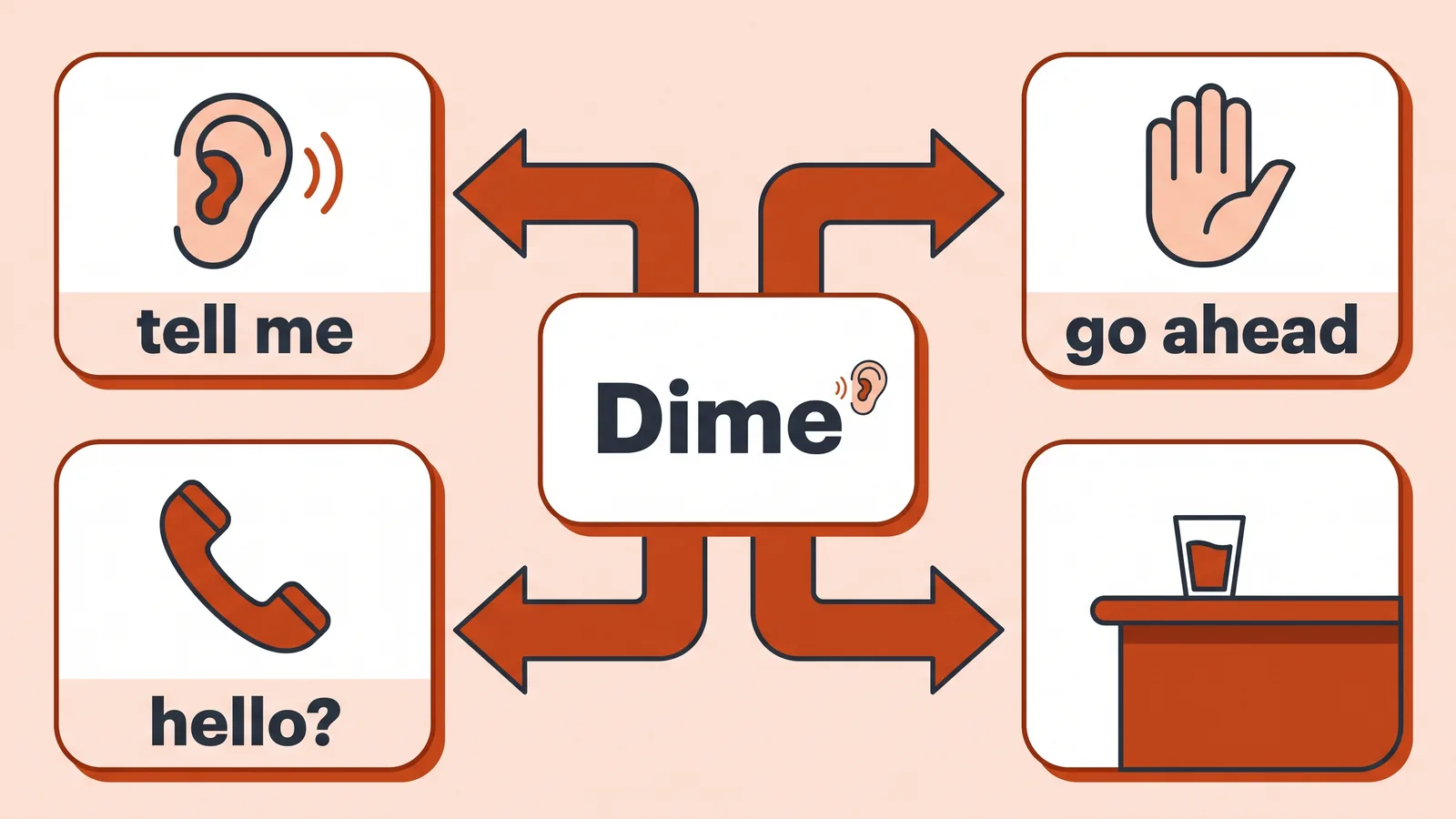
Four distinct jobs hide behind one word, and the English you choose depends entirely on which job is running.
- A real request. Dime tu número de teléfono. — "Give me your phone number." Literal, informational.
- A green light. Someone opens with ¿Te puedo preguntar algo? and the answer Dime means "go ahead, I’m listening."
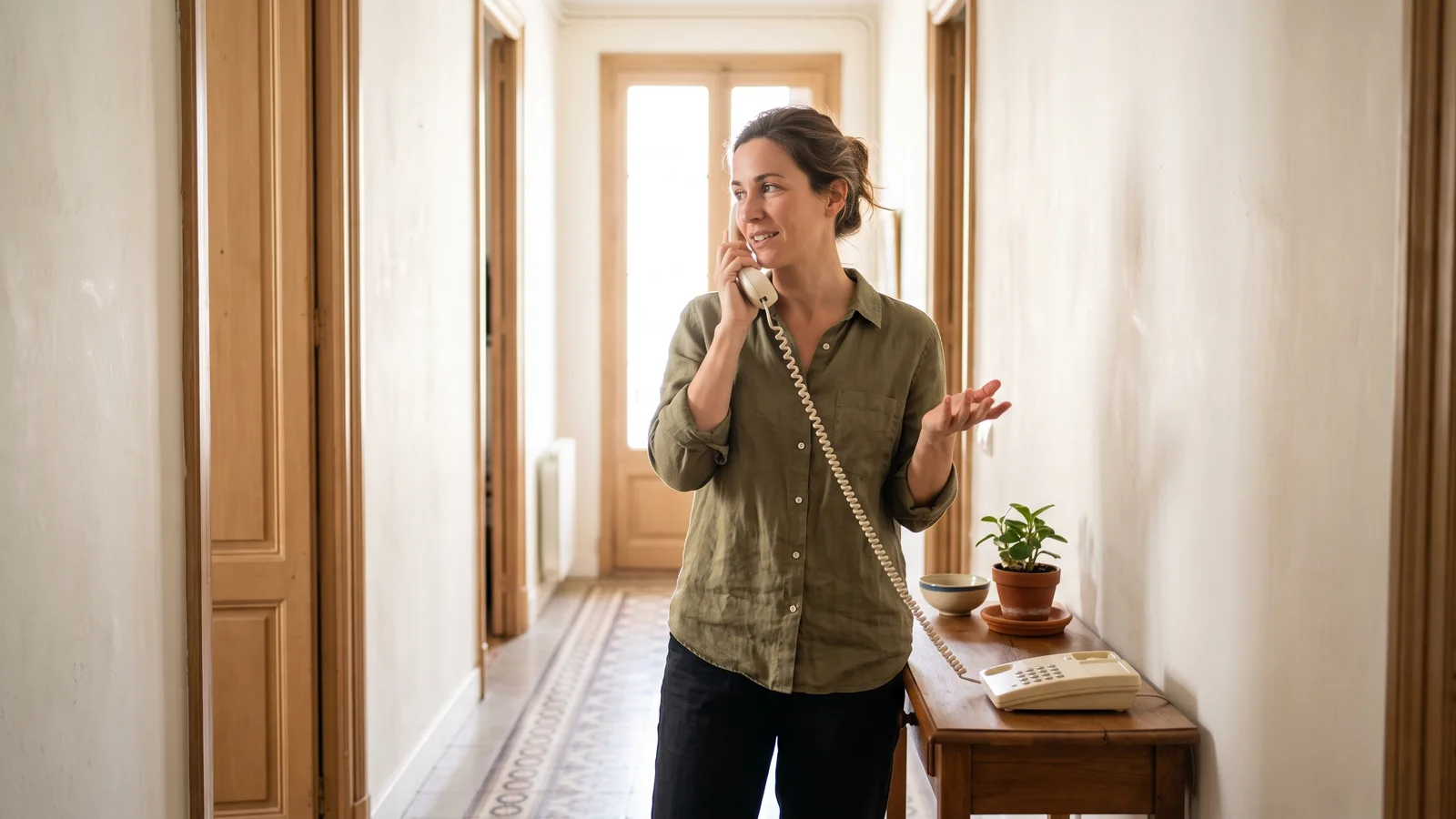
- A phone greeting. SpanishDict records a second, Spain-specific sense of dime, used to answer the telephone and best rendered in English as "hello?"
- A counter prompt. The person behind the bar or the pharmacy counter says Dime and means "what can I get you?"
A fifth, softer use shows up before hard questions: Dime la verdad asks for honesty, not data.
Tone and context carry more weight than the dictionary gloss here, which is also true of another short Spanish word whose meaning swings with intonation. Treat dime as a slot in the conversation rather than a phrase with one fixed translation, and your English will stop sounding translated.
Writing it right: dime, dímelo and the RAE’s accent rules
Spelling trips people up more than meaning. Three rules cover almost every case:
- dime — one word, no accent. Two syllables, stress on the first, ending in a vowel.
- dímelo — one word, accent required on the í once a second pronoun is attached.
- di me or dí me — always wrong. The pronoun is never separated, and di alone never takes an accent.
The RAE’s Diccionario panhispánico de dudas uses dímelo as its model example of enclitic pronouns and states that enclitics are always written joined to the verb.
Stacking pronouns pushes the stress unusually far back. According to the RAE, the only Spanish words stressed before the antepenultimate syllable — the sobresdrújulas — are verb forms carrying two or three enclitic pronouns, such as cómetelo.
The RAE reports that update 23.8 of the Diccionario de la lengua española incorporated 4,074 additions, amendments and deletions. Core grammar like this one does not move; vocabulary does.
Regional flavours: Spain’s phone ‘dime’, Mexico, and Caribbean ‘dime a ver’
The word travels, and it picks up local habits as it goes.
Spain. Answering a call with ¿Dime? among friends is routine, and businesses answer with ¿Dígame? Nobody waits for "hola" first.
Mexico. Dime is standard at counters and in service exchanges, often padded: A ver, dime or Dime, dime from someone who is listening while walking.
Caribbean. In the Dominican Republic dime a ver works as a greeting closer to "what’s good?" than to "tell me," and dime, loco or dime, manito follows the same pattern. A literal English rendering of those misses the point completely — the same hazard runs through much of the everyday Dominican vocabulary that confuses outsiders.
Río de la Plata. Buenos Aires and Montevideo use decime, the voseo form, so dime there marks you as a foreigner or a dubbed cartoon.
Dime in songs, subtitles and chat: how translators handle it
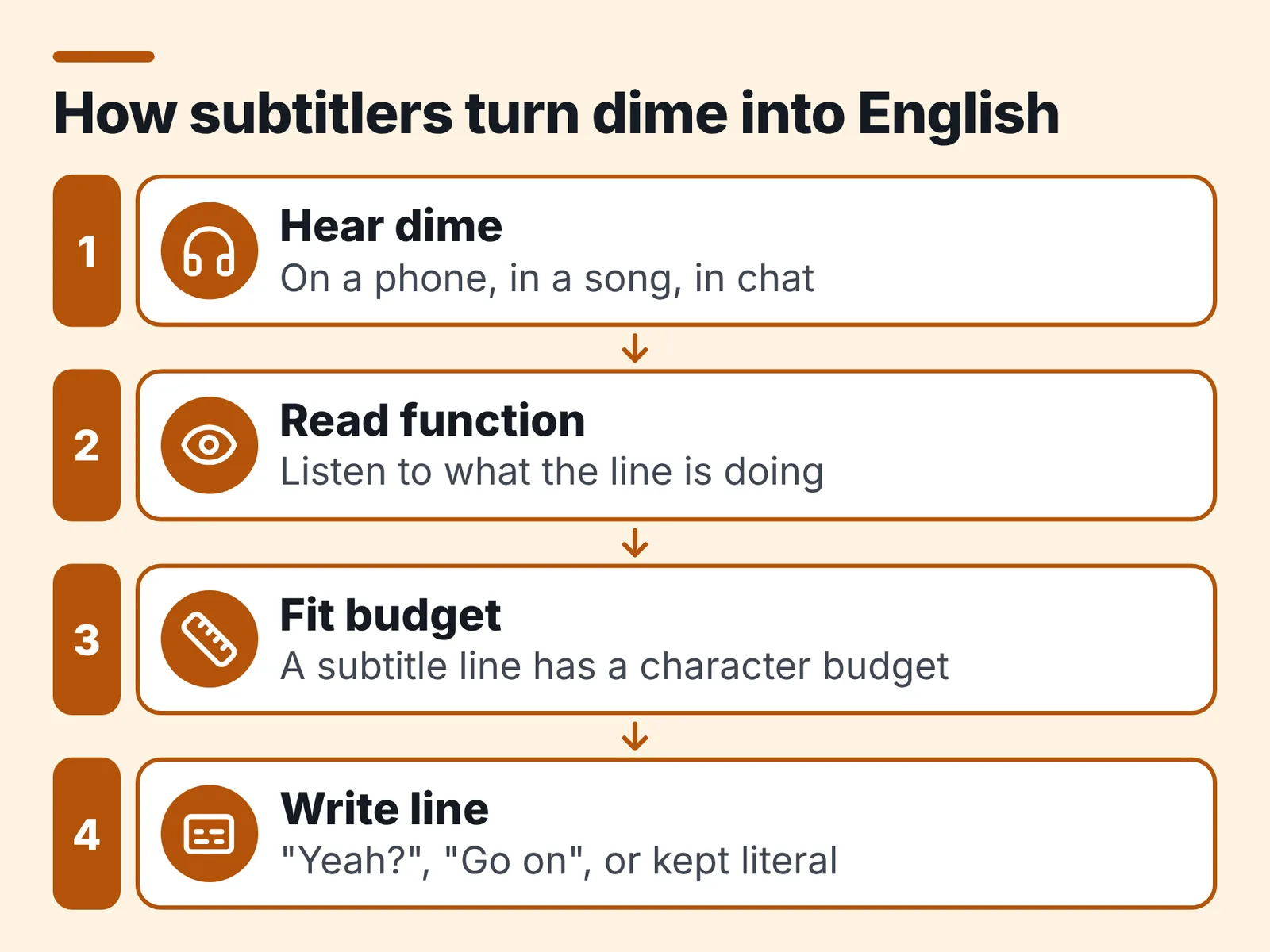
Professional subtitlers rarely write "tell me" for dime, because a line of subtitle has a character budget and a dramatic function. The working method comes down to four steps:
- Hear dime. Catch the delivery first — flat, rising, clipped, drawn out — along with what the speaker is doing while saying it.
- Read function. Decide which job the word is doing in that moment: real request, green light, phone greeting or counter prompt.
- Fit budget. Check the characters and reading time the line allows. A two-frame interjection cannot carry "tell me what happened."
- Write line. Pick the English that performs the same job inside that budget, not the one that matches the dictionary entry.
Run the steps and the usual results look like this:
- Character picks up a ringing phone, says Dime → "Yeah?" or "Hello?"
- Character stops walking, turns and says Dime → "Go on."
- Reggaeton or bachata hook, dime qué quieres → "tell me what you want" kept literal, because the song is built on the plea.
- WhatsApp reply consisting of dime alone → "what’s up?" or "go ahead"
When you are captioning your own footage, work in the same order: listen to what the line is doing before you reach for the dictionary meaning. It is the same instinct that keeps English subtitles on a Spanish video from reading like machine output.
One last trap: Spanish ‘dime’ is not the English ten-cent dime
Two unrelated words, one spelling. English dime is the name of a coin; Spanish dime is a verb plus a pronoun. Nothing links them beyond four letters.
Pronunciation keeps them apart in speech: the coin is /daɪm/, one syllable; the Spanish word is DEE-meh, two syllables.
The U.S. Mint’s product page for its 2026 Semiquincentennial Dime rolls and bags specifies that the coin weighs 2.268 grams and measures 0.705 inch (17.91 mm) in diameter.
The trap runs in both directions. A Spanish speaker reading "drop a dime," "dime a dozen" or "dime store" should not hear "tell me" anywhere in them, and an English speaker meeting dime in a chat window should not reach for coins. Machine translators mostly get this right from context, though isolated one-word messages are exactly where they slip.
If money is genuinely the subject, Spanish has its own rich stock of terms for it, and the words for cash change from one country to the next.
Frequently asked questions
Is it rude to answer someone with just ‘dime’?
Not among people who use tú with each other — it reads as "go ahead, I’m listening." It sounds abrupt only when the situation calls for usted, where dígame is the expected form with a stranger, an official or an older customer.
What is the difference between dime and dígame?
Both mean "tell me." SpanishDict’s entry for dime notes it is the informal tú command whose formal counterpart is dígame, so dime goes to friends and peers while dígame goes to strangers, clients and anyone you address as usted.
Does dime need an accent mark?
No. Dime is two syllables, stressed on the first and ending in a vowel, so it follows the normal rule and stays bare. Add a second pronoun and the accent appears: the RAE’s Diccionario panhispánico de dudas uses dímelo as its model example of enclitic pronouns.
How should I reply when a Spanish speaker says ‘dime’?
Just start talking — the word is an invitation, not a question needing an answer. On a phone call in Spain, SpanishDict records that dime is used to answer the telephone and is best rendered as "hello?", so state who you are and why you are calling.
Is Spanish dime related to the American ten-cent dime?
No, they are unrelated words that happen to share a spelling. The U.S. Mint’s page for its 2026 Semiquincentennial Dime rolls and bags specifies that the coin weighs 2.268 grams and measures 0.705 inch (17.91 mm) across; the Spanish word is a verb plus a pronoun.
Sources
- Dime | Spanish to English Translation – SpanishDict
- acento | Diccionario panhispánico de dudas | RAE
- Duda resuelta: Pronombres enclíticos – Castellano Actual, Universidad de Piura
- La RAE presenta las novedades del Diccionario de la lengua española en su actualización 23.8 (nota de prensa, RAE)
- El español supera por primera vez los 600 millones de hablantes – Instituto Cervantes (30 October 2024)
- CVC. Anuario 2024. Presentación – Centro Virtual Cervantes
- Semiquincentennial Dime 2026 Rolls and Bags – Emerging Liberty | U.S. Mint
AI tools helped write this guide. The Spanish to English Editorial Team published it after checking every figure against the sources linked above.