Learning how to understand spanish is an ear problem before it is a vocabulary problem: Spanish fits more syllables into each second and glues words together, so train rhythm, word boundaries and the few hundred words that carry real talk.
Quick Steps
Five habits, in order, each small enough to start today.
- Replay one 60-second clip four times before you look at any transcript — ear first, text second.
- Shadow the rhythm, not the meaning: say a sentence out loud at the speaker’s speed, even if half of it comes out as mush.
- Drill the connective words — que, pero, ya, entonces, oye, claro, o sea — until they land without translation.
- Watch with Spanish subtitles, never English ones, and pause only on a word you heard but could not identify.
- Choose one accent and stay with it for a month before adding a second.
Every step below lists a daily time and what you need. A phone, a pair of headphones and a notes file cover all five; nothing here requires a paid course. Sequence matters more than total hours, because rhythm training makes vocabulary stick, and vocabulary makes accents comparable. Skip to the checklist at the end if you already know which habit you are missing.
Why Spoken Spanish Feels Impossible (And What’s Actually Happening)
You can read a menu, pass a grammar quiz, and still catch nothing in a WhatsApp voice note. That gap is normal, and it has three mechanical causes rather than one vague one.
The first is raw speed. A study published in the journal Language measured speech rates across eight languages and found Spanish averages 7.82 syllables per second versus 6.19 for English. Your ear is being asked to segment roughly a quarter more syllables in the same second.
The second is rhythm type. English is stress-timed: you lean on stressed syllables and swallow the rest, which gives you reliable landmarks. Spanish gives each syllable close to equal weight, so the landmarks you grew up using are not there.
The third is vowels. Spanish uses five clean vowel sounds that barely change in unstressed positions, while English reduces unstressed vowels to a neutral uh. Spanish keeps the vowel but loses the boundary between words — the opposite trade.
None of this means Spanish is harder as a language. It means your segmentation strategy is wrong for the signal, and segmentation is trainable in weeks.
Step 1 — Retrain Your Ear for Spanish Syllable Timing, Not Vocabulary
Time: 10 minutes a day for two weeks. You need: one 60-second clip of natural speech, headphones, and a transcript you keep closed until the end.
Play the clip and tap the beat with a finger, one tap per syllable, ignoring meaning entirely. You will lose the beat around second ten at first. Restart and keep tapping until you can hold the pulse through a whole sentence.
Then shadow: speak along half a second behind the voice, matching speed and melody even where you produce nonsense syllables. Shadowing forces your mouth to accept a tempo your ear has been rejecting.
Speed panic eases once you accept that fast does not mean dense. The Science Advances study by Coupé, Oh, Dediu and Pellegrino concluded that human languages transmit information at a similar average rate of about 39 bits per second, regardless of how fast they sound. More syllables per second carry less information per syllable, which is why you can afford to miss a few.
Only on day fourteen should you open the transcript. Compare what you tapped with what was written, and note which syllables you heard as one block.
Step 2 — Learn Where Words End: Linking, Elision and Dropped Consonants
Time: 15 minutes a day for three weeks. You need: a short transcript, a pencil, and the audio that matches it line for line.
Spanish speakers link across word boundaries the way English speakers link an apple. Mark the links on paper with a curved line, then listen again:
- ¿Cómo estás? arrives as co-moes-tás — one melody, not two words. That everyday greeting hides several rules at once, and what the question word ¿Cómo? actually does in conversation is worth checking before you drill it.
- los amigos arrives as lo-sa-mi-gos; the final -s jumps to the next word.
- para el collapses to pal in fast speech across most of Latin America.
- cansado and pescado lose the intervocalic d: cansao, pescao.
- ¿Qué es eso? becomes a single stretched que-se-so.
In Caribbean and much of Andalusian speech, syllable-final -s turns into a breath or disappears: estás becomes e-tá, las casas becomes la casa. You are not missing vocabulary there; the consonant genuinely is not in the signal.
Spanish is not an outlier in how much it packs in. In the original 2011 Language paper by Pellegrino, Coupé and Marsico, Spanish did not stand out on information rate: five of the seven languages studied, Spanish included, clustered together.
Write out five linked phrases from your own clip each session, then say them as single words. Boundaries stop being a problem once you expect them to move.
Step 3 — Lock In the 300 Words That Carry Real Conversations
Time: 10 minutes a day, ongoing. You need: a flashcard app or a plain notes file with audio you recorded yourself.
Conversation runs on glue words, not on nouns. Aim for roughly 300 items in these buckets:
- Connectors: pero, porque, aunque, entonces, así que, ya que
- Fillers and markers: o sea, pues, bueno, este, digamos, ¿sabes?
- High-frequency verbs in present and preterite: ser, estar, tener, hacer, ir, decir, poder, querer
- Reaction words: claro, vale, dale, órale, qué va, ni modo
- Question words plus their fast forms: qué, quién, cuándo, dónde, cómo, por qué
Reaction words change meaning across borders, which is why one word can mean agreement in Buenos Aires and hurry up in Miami — how dale shifts country by country shows the range.
The timeline is shorter than most people assume. The US Foreign Service Institute places Spanish in Category I, needing roughly 24–30 weeks or 600–750 class hours for an English speaker to reach S-3/R-3 professional proficiency. Listening comprehension alone moves faster than that full-skill benchmark.
Record yourself saying each word at natural speed and add that audio to the card. A word you have only ever read will not be recognized when it arrives at 7.82 syllables per second.
Step 4 — Use Spanish Subtitles, Podcasts and Music in the Right Order
Time: 30 minutes a day. You need: a streaming account or YouTube, one podcast app, and the subtitle setting switched to Spanish.
Order the media by how much support each one gives your ear:
| Stage | Format | Why it comes here |
|---|---|---|
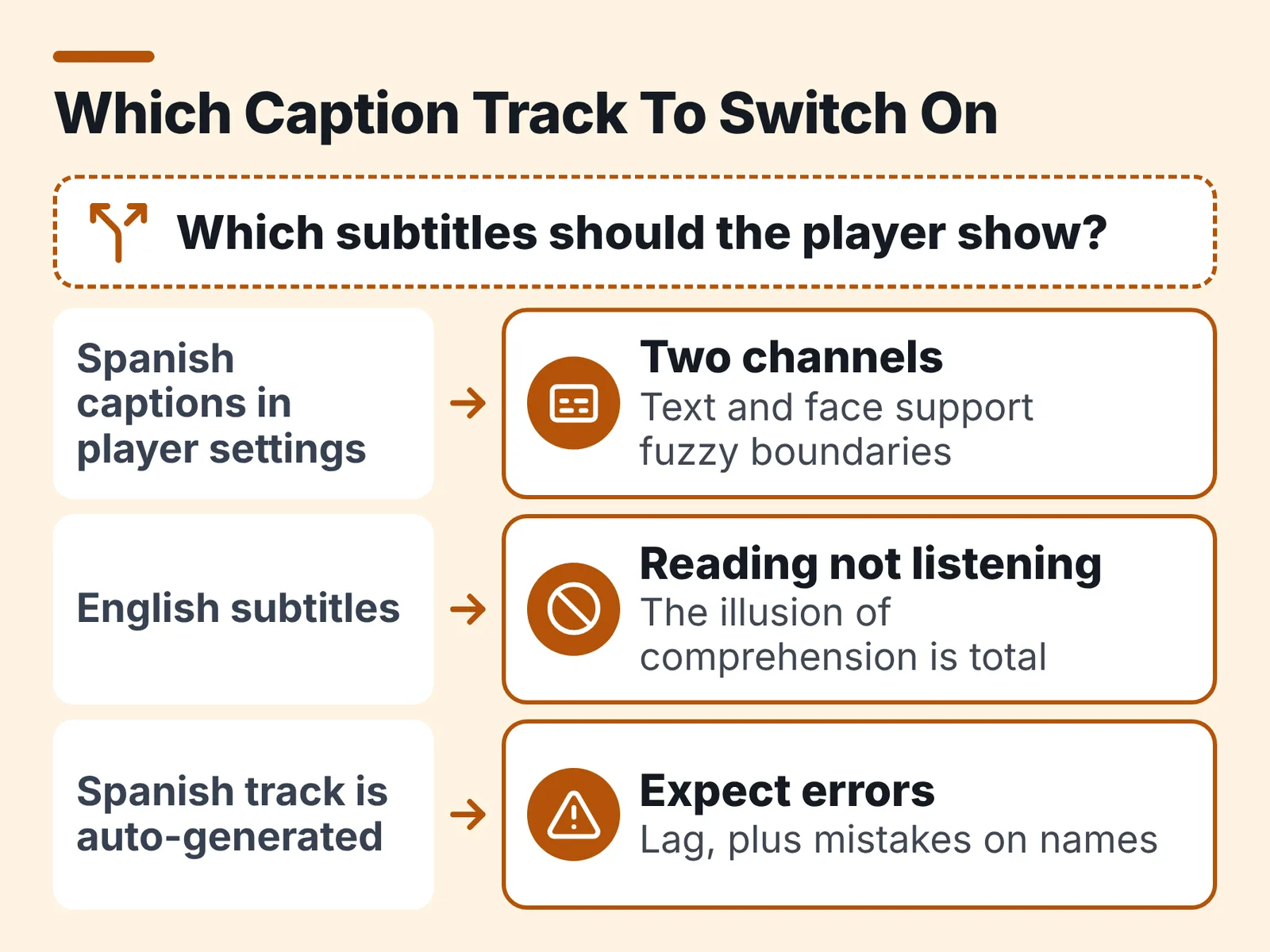
| 1 | Video with Spanish subtitles | Text and face give you two extra channels while boundaries are still fuzzy |
| 2 | Learner podcast at slow speed | Removes visual support, keeps clear articulation |
| 3 | Native podcast or radio | Full speed, overlapping speakers, real fillers |
| 4 | Music | Melody stretches and distorts syllables, so it trains least |
Switch captions to Spanish in the player settings, never English — English subtitles let your brain read instead of listen, and the illusion of comprehension is total. If a Spanish caption track is auto-generated, expect lag and errors on names.
When you need an English version of a clip for checking, the workflow for turning Spanish video into English subtitles keeps that as a verification step rather than a crutch.
If you also produce video and want a Spanish-language version to study against, AI Studios, DeepBrain AI’s cloud platform for AI avatar videos and video translation, offers text-to-speech voiceovers in 150+ languages and accents on paid plans and 30+ languages on the Free plan. Synthetic audio is cleaner than real speech, so treat it as stage one material, not stage three.
Step 5 — Master One Accent First, Then Widen to Others
Time: one month per accent. You need: three sources — a news anchor, a podcast host and a casual vlogger — all from the same country.
Pick the accent you will actually hear: the neighborhood, the in-laws, the client, the telenovela. Mexican and Colombian highland speech are the usual first choices, because syllable-final -s stays audible and consonants are fully articulated.
After a month, add a contrasting one. Caribbean speech — Cuban, Dominican, Puerto Rican — aspirates or drops final -s, trims final consonants and runs fast, which is exactly why it feels like a different language at first; the vocabulary side of Dominican speech is a separate challenge from the sound side. Rioplatense also aspirates final -s and turns ll and y into a sh sound, so calle lands as ca-she. Castilian Spanish splits c/z from s, giving the th sound English speakers often mistake for a lisp.
The spread is wider than any one country suggests. The Instituto Cervantes 2024 yearbook reports that close to 100 million Spanish speakers live outside the Spanish-speaking countries, largely through migration, so the accent you meet may not match the map.
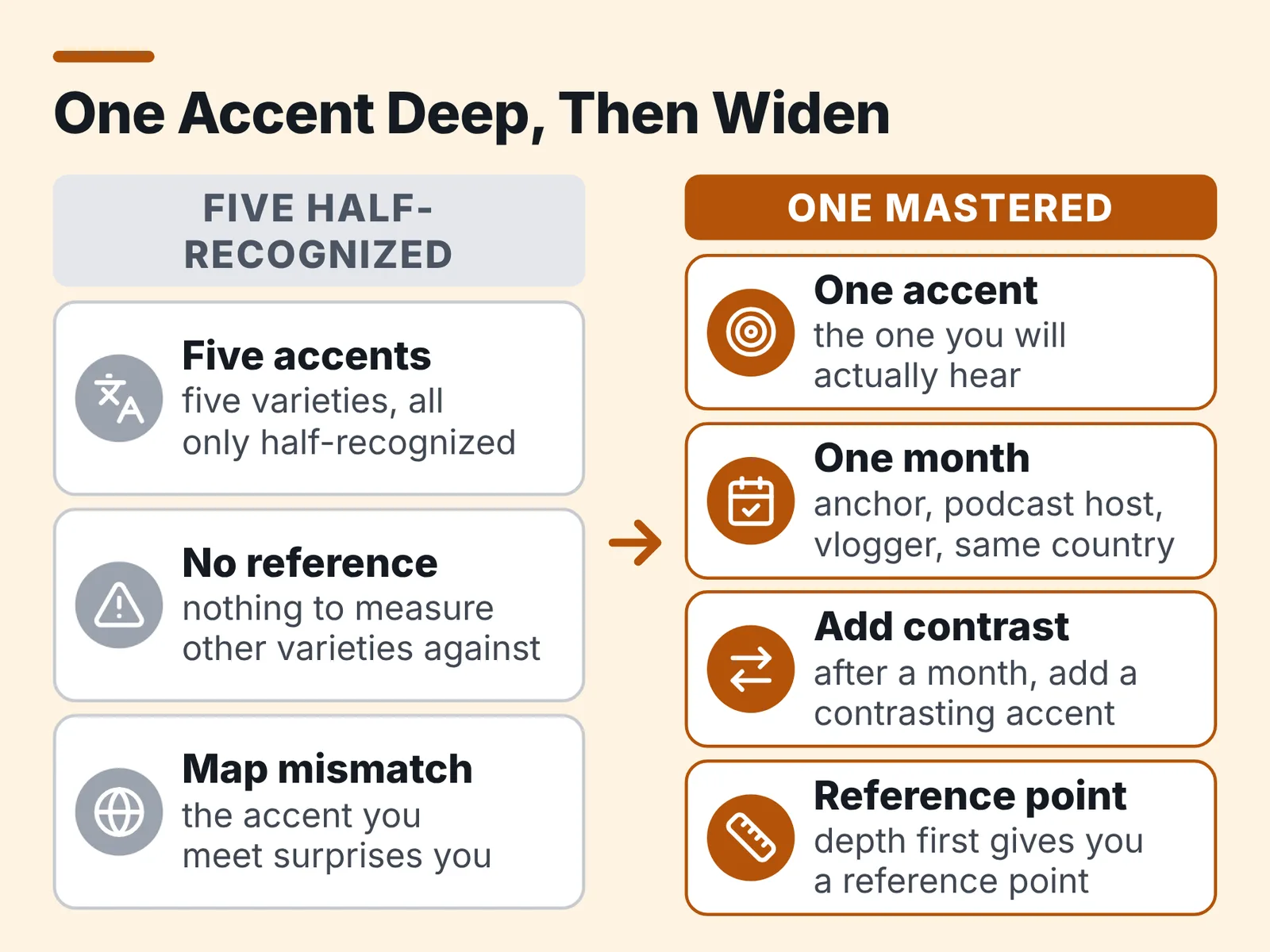
One accent mastered beats five half-recognized. Depth first gives you a reference point to measure every other variety against.
Your Weekly Listening Checklist
Run this as a seven-day loop. It totals under an hour a day and keeps all five steps alive at once, which matters because rhythm decays faster than vocabulary.
- ☐ Five tapping or shadowing sessions, 10 minutes each, on clips you have not transcribed yet
- ☐ One linking page: write five phrases as they actually sound, not as they are spelled
- ☐ Twenty new glue words added with your own recorded audio, reviewed three times
- ☐ Two episodes with Spanish captions on, English captions off for the whole week
- ☐ One native-speed podcast listened to twice — once cold, once with the transcript
- ☐ One 60-second clip from your chosen accent, replayed until you can write it from memory
- ☐ One honest score: what percentage of the last cold listen did you follow?
Log the score weekly in the same file. Movement from catching the first three words of a sentence to catching the shape of the whole sentence is real progress, even when individual words still escape you.
If a week collapses, protect the shadowing and drop the rest. The rhythm work is the piece that cannot be made up later.
Common Mistakes That Keep English Speakers Stuck
The big one: watching with English subtitles and counting it as listening practice. Your eyes win every time, your ear does no work, and after fifty hours of telenovelas you still cannot follow a phone call. Fix it by switching the caption track to Spanish on day one and accepting a worse first week in exchange for a better second month.
Pausing on every unknown word. Each pause breaks the rhythm you are supposed to be absorbing. Let the clip run, mark the timestamp, and resolve it after.
Hopping between accents weekly. You restart the segmentation work each time and never build a reference. One country for a month, then compare.
Studying nouns while ignoring fillers. Native speech is padded with o sea, pues and este, and those unstressed blocks are where comprehension breaks. Slang varies sharply by region too, so check regional meaning before assuming — the slang words English speakers hear most is a practical starting list.
Expecting comprehension to climb smoothly. It arrives in jumps, usually after a week where nothing seemed to work.
Frequently asked questions
How long does it take to understand spoken Spanish?
Listening comprehension improves in weeks, not years, if you train rhythm daily. For context on full proficiency, the US Foreign Service Institute places Spanish in Category I, needing roughly 24–30 weeks or 600–750 class hours for an English speaker to reach S-3/R-3 professional proficiency.
Why does Spanish sound so much faster than English?
Because it is, measurably. A study published in the journal Language measured speech rates across eight languages and found Spanish averages 7.82 syllables per second versus 6.19 for English. Each syllable carries less information, so missing a few costs you less than you fear.
Should I use Spanish or English subtitles while learning?
Spanish, almost always. English subtitles let your eyes do the work and give you the feeling of comprehension without the training. Use Spanish captions during the episode and check an English version afterward only to confirm what you already guessed.
Which Spanish accent should I learn to understand first?
Choose the one you will actually hear from family, coworkers or local media. Mexican and Colombian highland speech are common first picks because final -s stays audible. The Instituto Cervantes 2024 yearbook reports that close to 100 million Spanish speakers live outside the Spanish-speaking countries, largely through migration, so your local accent may not match the map.
Is Spanish really denser with information than English?
No. In the original 2011 Language paper by Pellegrino, Coupé and Marsico, Spanish did not stand out on information rate: five of the seven languages studied, Spanish included, clustered together. Fast delivery and high information density are not the same thing.
Sources
- 7 Steps to Getting Used to the Speech Rate of Spanish Language — italki
- Different languages, similar encoding efficiency: Comparable information rates across the human communicative niche (Science Advances, 2019)
- A Cross-Language Perspective on Speech Information Rate — Pellegrino, Coupé & Marsico, Language (2011)
- FSI Language Difficulty Ranking
- CVC. Anuario 2024. El español: lengua para el mundo 2024. 20 claves del español en el mundo
AI tools helped write this guide. The Spanish to English Editorial Team published it after checking every figure against the sources linked above.