Dominican Spanish slang is the informal vocabulary of the Dominican Republic: klk means "what’s up," vaina means "thing," tíguere means a street-smart guy, dique means "supposedly," and un chin means "a little bit."
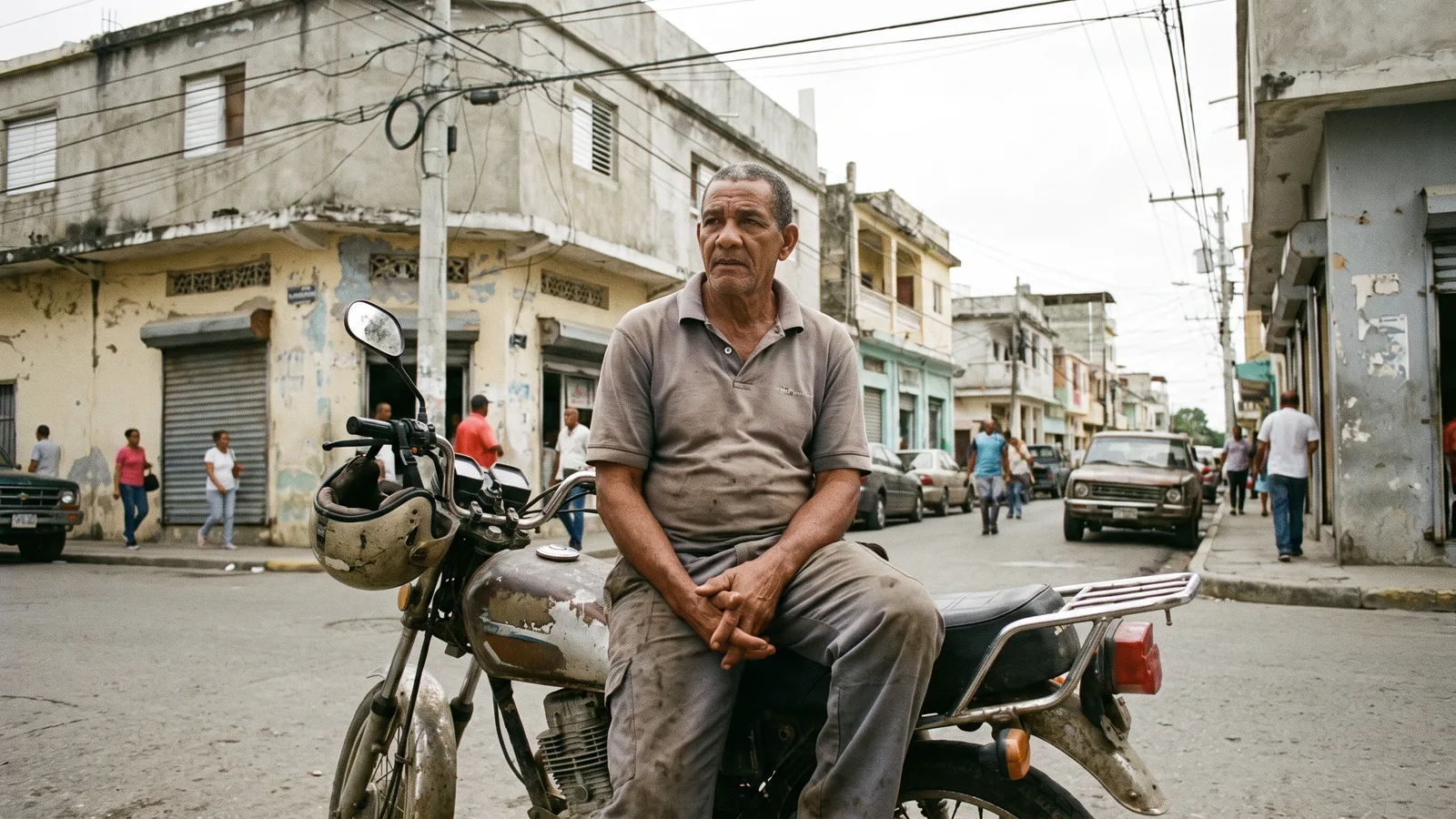
What Is Dominican Spanish Slang? A Plain-English Definition
Definition: The informal word stock of the Dominican Republic — greetings, nicknames, intensifiers and everyday verbs — sitting on top of standard Spanish and shaped by Caribbean pronunciation, Taíno roots and constant contact with English.
Dominicans do not treat these words as broken Spanish. They are the normal register for friends, family, music and the street, while formal Spanish runs the courtroom, the classroom and the evening news. Telling the two apart is most of the work for a learner.
Pew Research Center counts roughly 2.4 million Hispanics of Dominican origin living in the US as of 2021, so this slang turns up in Washington Heights, Paterson and Lawrence as much as in Santiago de los Caballeros.
Reading a Dominican phrase in three steps
- Restore the missing sounds. Tá to’ is está todo, pa’ is para, lo’ muchacho’ is los muchachos.
- Spot the slang item. One or two words usually carry the local meaning; the grammar around them is ordinary Spanish.
- Check the register. Decide whether the word is neutral (un chin), affectionate (mi loco), or insulting (pariguayo) before you repeat it.
Slang vs. accent: not the same thing
Accent is how words sound; slang is which words get chosen. Cansao for cansado is accent. Estoy en olla for "I’m broke" is slang. Mixing the two up makes learners think they need new vocabulary when they only need new ears.
Common Dominican Slang Words and Their English Meanings
Start with the terms that appear in conversation within the first hour of landing. The table below gives the closest English equivalent plus a tone note, because the tone is what mistranslation usually destroys.
| Dominican term | English meaning | Tone / note |
|---|---|---|
| ¿Qué lo que? / klk | What’s up? | Default greeting, written klk in texts |
| Tá to’ | All good, we’re set | Casual agreement or sign-off |
| Vaina | Thing, stuff, situation | Extremely frequent; mildly coarse in formal settings |
| Dique | Supposedly, allegedly | From dizque; signals doubt |
| Un chin | A little bit | Neutral, usable with anyone |
| Tíguere | Street-smart guy, operator | Praise or insult depending on delivery |
| Pariguayo | Sucker, wallflower, loser | Insulting |
| Coro / teteo | A hangout, a party | Teteo suggests a loud night out |
| Jevi | Cool, great | Borrowed from English "heavy" |
| Jevo / jeva | Boyfriend / girlfriend | Informal, not rude |
| Quillarse | To get angry | Toy quillao = I’m pissed off |
| En olla | Flat broke | Self-deprecating, very common |
| Chepa | Fluke, luck | De chepa = by chance |
| Fuñir | To annoy, to bother | Fuñío = annoying or broke |
| Bulto | Bluff, empty talk | Also literally a backpack |
| Mera | Hey, listen | Clipped from mira |
| Manso | Chill, calm down | Said to defuse tension |
| Colmado | Corner store | Not slang abroad, central in DR life |
| Motoconcho | Motorcycle taxi | Practical travel word |
| Guapo | Angry | Not "handsome" here |
The last row is the one that embarrasses people. Call a Dominican man guapo expecting a compliment and you may be telling him he looks furious. If you have worked through a glossary of Mexican slang terms and their English meanings, expect the overlap to be minimal: a few items such as chulo travel widely, but most of each list stays local.
How Dominican Slang Is Built: Sound Changes, Borrowings, and Metaphor
Three forces do most of the work, and once you can name them, unfamiliar words stop feeling random.
Sound changes
Syllable-final /s/ weakens or disappears: los dos becomes lo’ do’. Intervocalic /d/ drops in participles: pescado becomes pescao. In the Cibao region around Santiago, final /r/ and /l/ often turn into a vowel, so comer sounds like comei and porque like poique. Written slang copies the speech, which is why song titles and captions look misspelled to a textbook reader.
Borrowings
Taíno words survived in daily vocabulary long after the language itself was lost — casabe, conuco, batey, hamaca. UNESCO lists five Dominican elements on its intangible heritage lists, the most recent being the knowledge and practices around cassava bread, inscribed in 2024, and casabe is itself a Taíno word still used at every lunch table. English contributes too: yipeta, an SUV, from "Jeep," and jevi, meaning "cool" or "great," from "heavy" — both reshaped by Dominican pronunciation and by decades of migration back and forth.
Metaphor
Much of the rest is imagery. En olla puts you inside a cooking pot with nothing left. Dar banda means to cut someone loose. Tirar un cocotazo is a knock on the head with the knuckles.
Dominican Slang vs. Puerto Rican and Cuban Caribbean Spanish
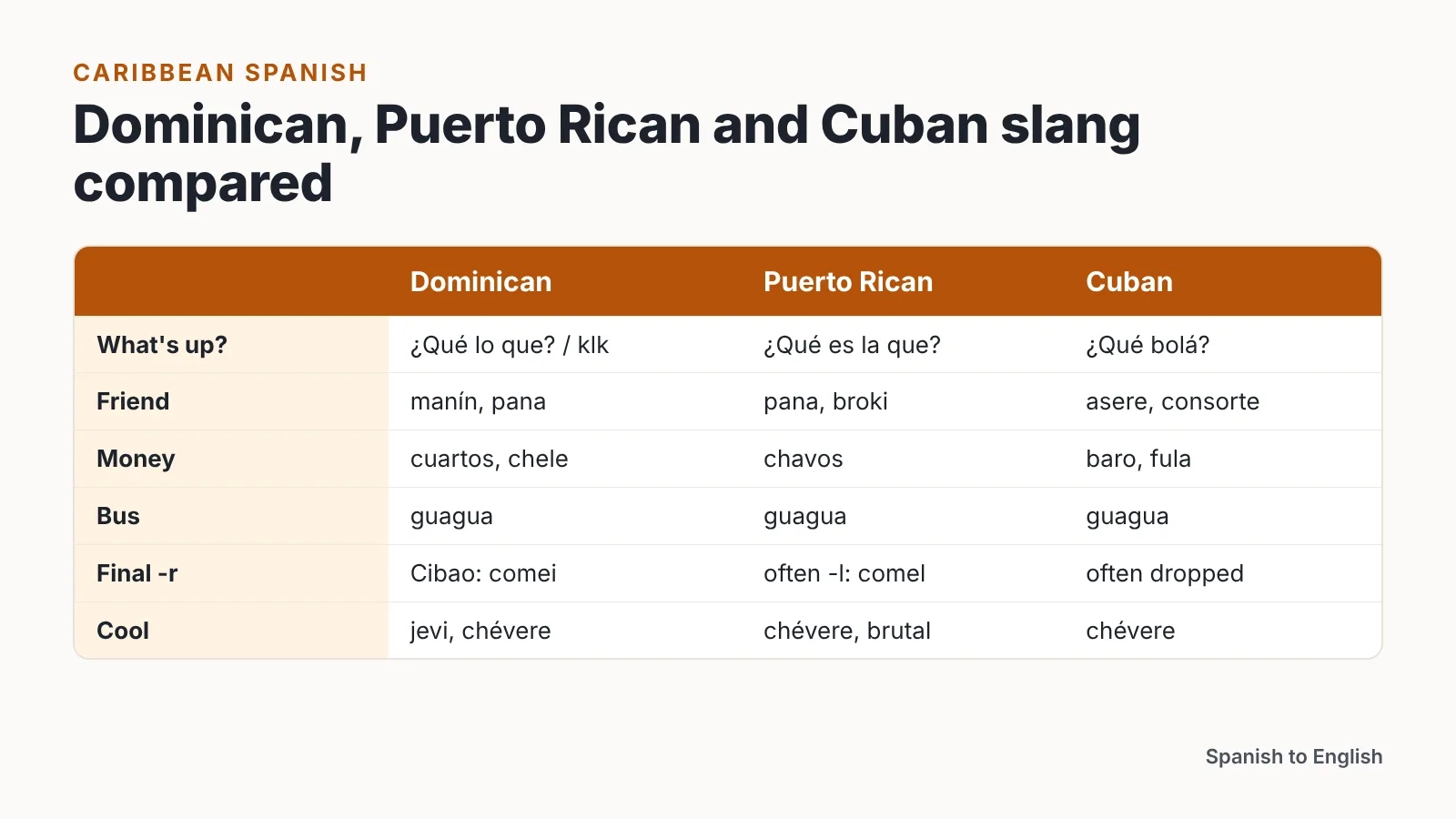
The three islands share grammar and a lot of pronunciation, then split hard on vocabulary. Use this as a quick orientation rather than a rulebook, since speakers mix terms constantly.
| Function | Dominican | Puerto Rican | Cuban |
|---|---|---|---|
| "What’s up?" | ¿Qué lo que? / klk | ¿Qué es la que? | ¿Qué bolá? |
| Friend | manín, pana | pana, broki | asere, consorte |
| Money | cuartos, chele | chavos | baro, fula |
| Bus | guagua | guagua | guagua |
| Final -r | Cibao: comei | often -l: comel | often dropped or assimilated |
| Cool | jevi, chévere | chévere, brutal | chévere, bárbaro |
Shared words still carry local weight. Dale works in all three places but lands differently in each, as the breakdown of what dale means country by country shows. Guessing wrong rarely offends; it simply marks you as someone who learned the word from a song.
Where You’ll Hear It: Dembow, Bachata, Merengue, and Social Media
Dembow is the fastest route into current Dominican slang, because the lyrics are built from street phrases and the slang changes faster than dictionaries track it. Teteo, coro, fiebrú and klk all reached wide audiences through dembow tracks and the comment sections under them.
UNESCO inscribed the music and dance of Dominican bachata on its Representative List in 2019 and Dominican merengue in 2016, and both genres carry everyday vocabulary in their lyrics. Bachata leans on relationship words — jevo, jeva, dar banda, quillarse. Merengue carries older regional terms and place names.
Social media is where spelling gets decided. Captions write klk, tato, q lo q, toy, and auto-captions on short video often transcribe them as nonsense. Reading a few hundred comments teaches you more about current usage than any word list, including which terms have aged out.
How to Verify a Dominican Word: The Diccionario del Español Dominicano and the RAE
Two references settle most arguments, and they answer different questions.
The second edition of the Diccionario del español dominicano, the reference dictionary for Dominican Spanish, was published on 18 September 2024, eleven years after the first edition, according to a review in PUCMM’s Cuaderno de Pedagogía Universitaria. Use it when you need to know whether a word is genuinely Dominican and what its local senses are.
The Real Academia Española reports that update 23.8 of the Diccionario de la lengua española, presented on 10 December, incorporated 4074 novelties, including new terms, senses, amendments and deletions. Use the RAE dictionary to check whether a word has entered the pan-Hispanic standard and which countries carry each labeled sense — and note the presentation date, since slang moves faster than any update cycle.
A workable verification routine
- Look the word up in the RAE dictionary and read the regional labels, especially R. Dom.
- If it is absent or the sense does not match, check the Diccionario del español dominicano.
- Search the term on Dominican social media and read ten real uses in context.
- If all three disagree, treat the word as slang in flux and translate the intent, not the term.
Register, Rudeness, and Mistranslation: Words to Handle Carefully
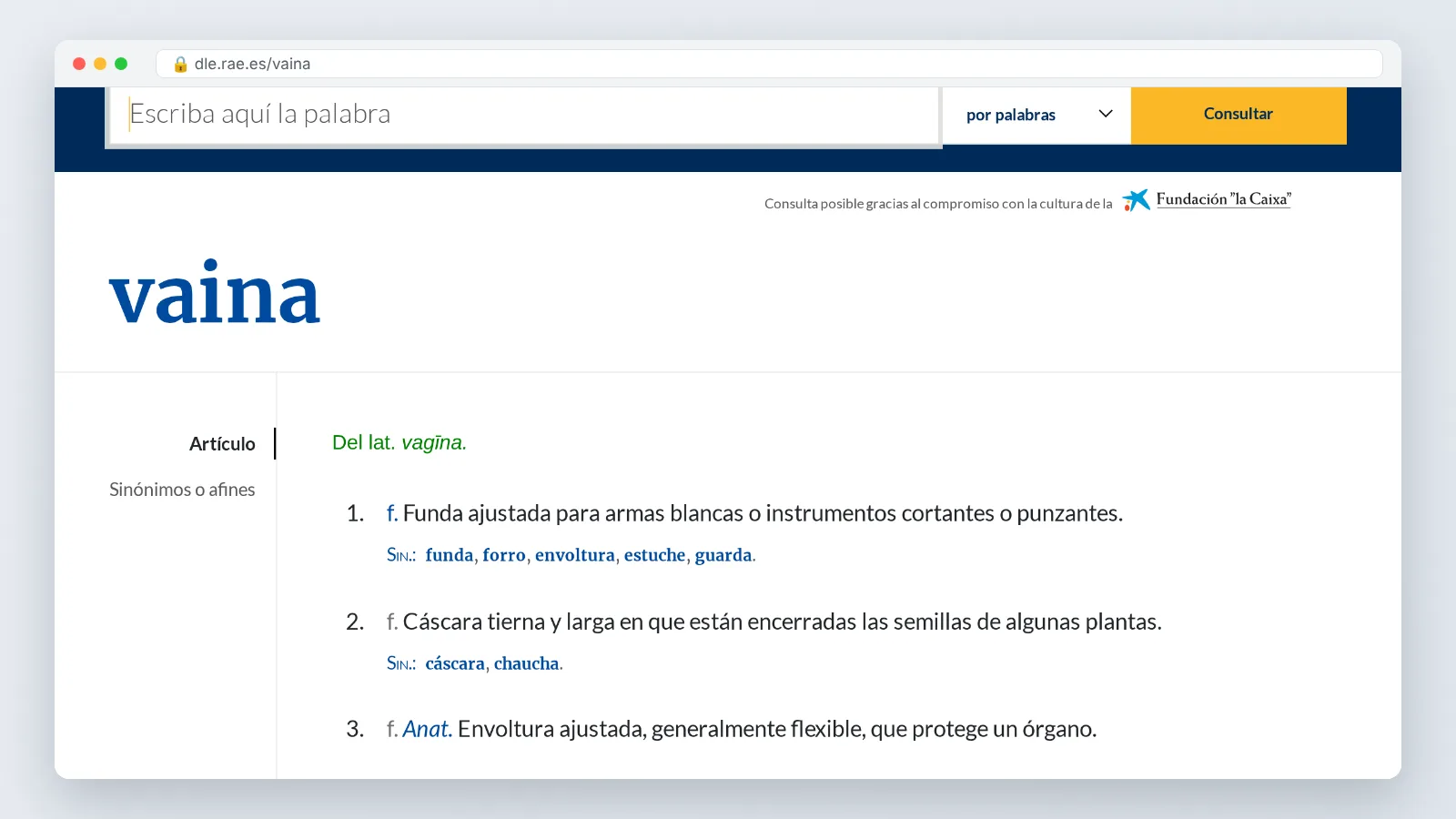
Some words are safe at a colmado and wrong in an interview. Vaina is the clearest case: it is constant in casual speech, and still out of place in a legal filing or a condolence message.
Others are insults wearing friendly clothes. Tíguere can mean "sharp operator" between friends and "con artist" from a stranger. Pariguayo has no friendly reading — it calls someone a clueless hanger-on.
The nastiest traps are cross-dialect. Coger is ordinary in the Dominican Republic and vulgar in parts of Mexico and the Southern Cone; bicho is harmless in Spain and obscene in Puerto Rico. Anatomy words behave the same way, which is why the explainer on what punta means in Spanish to English is worth reading before you repeat something you heard in a song.
Machine translation flattens all of this. A phrase like esa vaina tá fuñía comes back as something bland and wrong, because the engine has no register model for Dominican speech.
Putting It to Use: A Cheat Sheet for Travelers, Students, and Translators
Travelers need maybe eight words. Learn klk, tá to’, un chin, colmado, motoconcho, guagua, manso and gracias, mi hermano, and you can handle a market, a ride and a greeting without sounding rehearsed.
Students should build a two-column notebook: the slang form on the left, the restored standard Spanish on the right. Writing pa’ lante next to para adelante trains the sound rules instead of forcing you to memorize isolated items. Reviewing a broader list of Spanish slang words English speakers hear most helps you see which Dominican terms are local and which are pan-Caribbean.
Translators should do three things on every Dominican job. Mark every slang item in the source before translating. Decide a single register for the whole piece — street English, neutral English, or subtitled English with a gloss. Keep names for food, transport and music untranslated with a short note, since casabe, motoconcho and dembow lose more than they gain in English.
One honest warning: slang dates fast. A dembow phrase from last year can already read as nostalgic, so check recent usage before you commit a term to print.
Frequently asked questions
What does "klk" mean in English?
Klk is written shorthand for ¿Qué lo que?, the standard Dominican greeting, and it translates as "what’s up" or "what’s going on." It works as a hello, a check-in and a text opener among friends, but it is too casual for email to a stranger or any formal request.
Is "vaina" a bad word in Dominican Spanish?
Vaina is not a strong obscenity in the Dominican Republic; it means "thing," "stuff" or "situation" and appears in ordinary conversation constantly. It still reads as coarse in writing, job interviews or official documents, so translate it as "thing" or "mess" and avoid using it in formal Spanish yourself.
What is the difference between a tíguere and a pariguayo?
A tíguere is a street-smart operator — admiring from a friend, accusing from a stranger, roughly "hustler" or "slick guy" in English. A pariguayo is the opposite and is always an insult: a clueless bystander, a sucker, someone who watches the party instead of joining it.
Where can I check whether a word is really Dominican?
Use two references. The second edition of the Diccionario del español dominicano was published on 18 September 2024, eleven years after the first, according to a review in PUCMM’s Cuaderno de Pedagogía Universitaria, and the Real Academia Española reports that its update 23.8 of the Diccionario de la lengua española added 4074 novelties with regional labels you can read.
Why does machine translation struggle with Dominican slang?
Engines are trained mostly on written standard Spanish, so dropped consonants, Cibao vowel shifts and spellings like tá to’ or q lo q fall outside their patterns. They also lack a register model, which means an affectionate tíguere and an accusing tíguere come back as the same flat English word.
Sources
- Reseña de la segunda edición del Diccionario del español dominicano — Cuaderno de Pedagogía Universitaria (PUCMM)
- La RAE presenta las novedades del «Diccionario de la lengua española» («DLE») en su actualización 23.8 — Real Academia Española
- Facts on Hispanics of Dominican origin in the United States, 2021 — Pew Research Center
- Dominican Republic — UNESCO Intangible Cultural Heritage
AI tools helped write this guide. The Spanish to English Editorial Team published it after checking every figure against the sources linked above.