Spanish slang words are informal, region-bound terms like tío, wey, chévere, parce, guay, chido and bacán — two meanings dominate, "dude/friend" and "cool," plus a handful of high-frequency extras such as vale ("okay") and no manches ("no way") — and their meaning flips by country.

What Are Spanish Slang Words? A Plain-English Definition
Definition: Spanish slang words are informal terms used in casual speech and online — words a standard dictionary may mark coloquial, tie to a single country, or leave out entirely.
Slang sits on the bottom rung of a register ladder. Above it you find neutral everyday Spanish, then careful written Spanish, then legal and academic prose. Chamba means a job in the first tier only; empleo works in all four.
Three traits mark a word as slang rather than ordinary vocabulary:
- Informal. You hear it between friends, not in a court transcript.
- Group-bound. A country, a city, a generation, or a music scene owns it.
- Unstable. The meaning drifts, and the word can die within a decade.
Geography drives most of the confusion English speakers run into. Spanish passed 600 million speakers worldwide for the first time in 2024, according to the Instituto Cervantes yearbook «El español en el mundo 2024». A language spread across twenty-plus national standards does not share one slang vocabulary, and it never has.
One more wrinkle: a word can be slang in Lima and neutral in Bogotá. Plata for money sounds casual in Spain and completely ordinary across much of South America.
The Spanish Slang Words English Speakers Hear Most — And What They Actually Mean
Mexican and Caribbean slang reach English speakers in the United States first, because that is where the contact is densest. About 44.9 million people aged 5 and over speak Spanish at home in the United States — roughly one in every seven people in that age group — according to USAFacts, drawing on American Community Survey data.
The list below covers the terms that surface most often in songs, group chats, dubbed series and street conversation.
| Slang word | Origin or literal sense | What it actually means | Mainly heard in |
|---|---|---|---|
| tío / tía | uncle / aunt | dude, mate, girl | Spain |
| guay | — | cool, great | Spain |
| vale | from valer, to be worth | okay, got it | Spain |
| flipar | from English "to flip" | to be amazed, to freak out | Spain |
| currar | — | to work, to grind | Spain |
| wey / güey | from buey, ox | dude, man | Mexico |
| no manches | "don’t stain" | no way, you’re kidding | Mexico |
| chido | — | cool, great | Mexico |
| órale | — | wow / go ahead / let’s go | Mexico |
| ¿qué onda? | "what wave?" | what’s up? | Mexico, Central America |
| fresa | strawberry | preppy, posh, snobby | Mexico |
| chévere | — | great, cool, nice | Venezuela, Colombia, Caribbean |
| parce / parcero | from aparcero, partner | buddy, bro | Colombia |
| pana | — | close friend | Venezuela, Dominican Republic, Ecuador |
| bacán | — | cool, awesome | Chile, Peru, Cuba |
| copado | — | cool, fun | Argentina |
| che | — | hey, you | Argentina, Uruguay |
| chamba | — | work, a gig | Mexico, Peru |
| tranqui | short for tranquilo | chill, no worries | nearly everywhere |
| mano / manito | short for hermano | bro | Caribbean, Mexico |
Two meanings dominate that whole list — "dude/friend" and "cool" — with a handful of high-frequency extras, such as vale for "okay" and no manches for "no way." Learn those slots and you can decode most casual Spanish you overhear, even when the specific word is new to you.
How Spanish Slang Travels: From Street Talk to Streaming to the Dictionary (3 Stages)
Stage 1 — A group coins or repurposes a word
Slang almost never arrives from nowhere. A group shortens something (tranqui from tranquilo), borrows from English (janguear from "to hang out"), or flips a plain noun into a metaphor (fresa for a posh kid). The word stays local while it is still a membership badge.
Stage 2 — Media carries it across borders
Reggaeton, regional Mexican, Argentine trap, dubbed series and short-form video move a word out of its home city within months. A Puerto Rican lyric reaches Madrid and Buenos Aires the same week it drops. Learner demand follows the same channels: Spanish was the most-studied language on Duolingo in 26 countries in 2025, second only to English, which led in 154 countries, according to the 2025 Duolingo Language Report.
Stage 3 — Reference works catch up
Lexicographers wait for durable evidence before they print a definition. Years can pass between a word’s peak on social media and its first dictionary entry, and plenty of slang dies in between. That lag explains why searching a term and finding nothing in the RAE dictionary does not mean you misheard it.
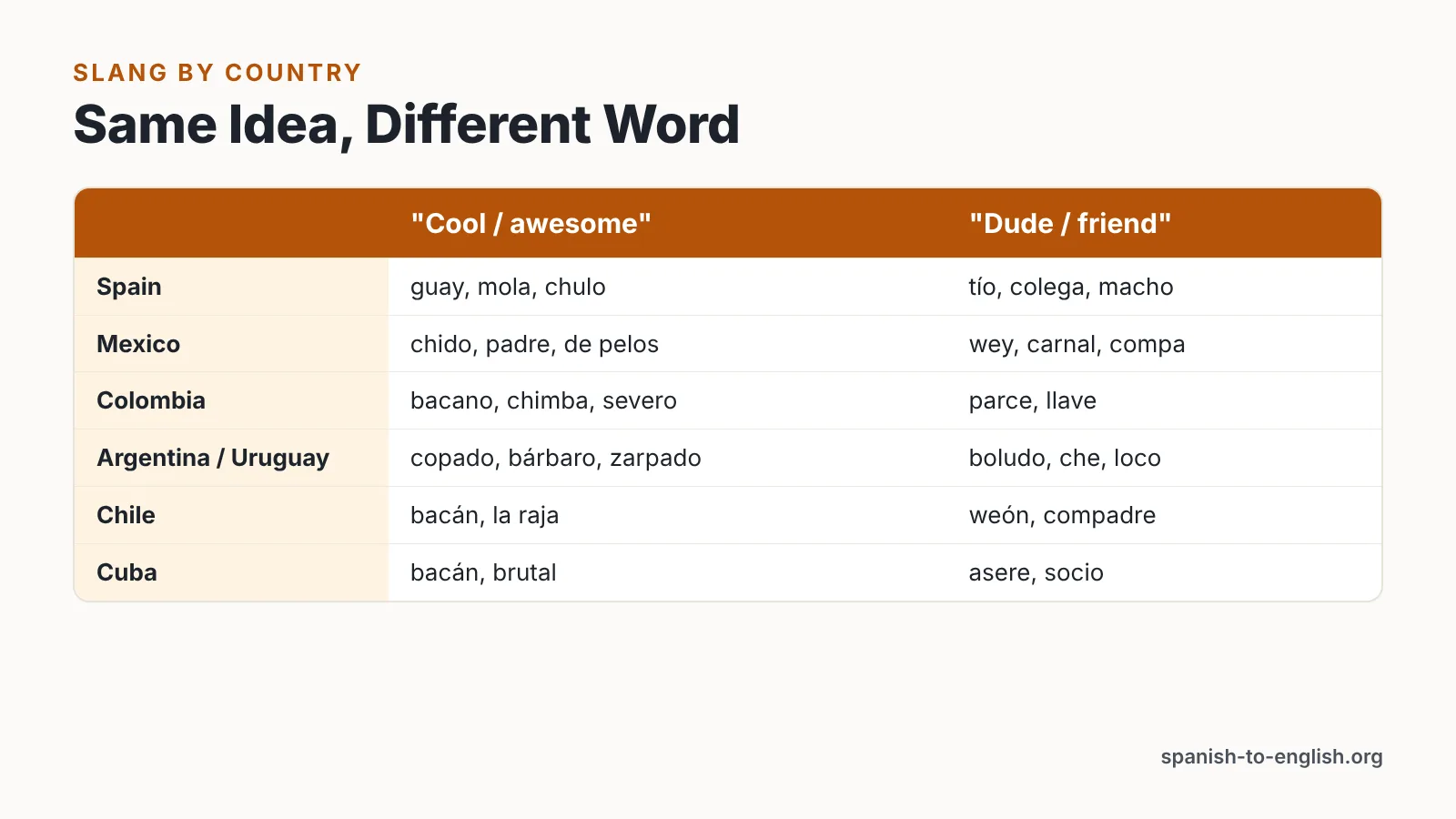
Why ‘Guay,’ ‘Chido,’ ‘Bacán’ and ‘Copado’ All Mean ‘Cool’: Slang by Country
Each Spanish-speaking country built its casual vocabulary separately, from different substrates and different youth cultures, so the same everyday idea collects a dozen unrelated labels.
| Country or region | "Cool / awesome" | "Dude / friend" |
|---|---|---|
| Spain | guay, mola, chulo | tío, colega, macho |
| Mexico | chido, padre, de pelos | wey, carnal, compa |
| Colombia | bacano, chimba, severo | parce, llave |
| Venezuela | chévere, fino | pana, chamo |
| Argentina / Uruguay | copado, bárbaro, zarpado | boludo, che, loco |
| Chile | bacán, la raja | weón, compadre |
| Peru | bacán, chévere | causa, pata |
| Costa Rica | tuanis, pura vida | mae |
| Cuba | bacán, brutal | asere, socio |
| Dominican Republic | brutal, en fuego | manín, tíguere |
Two practical lessons come out of that table. First, chévere and bacán travel widely enough that nobody will blink if you use them outside their home turf. Second, the "friend" column is the dangerous one, because several of those words double as insults depending on tone.
If you only want to be understood, genial and qué bueno work in every country and sound like a polite adult anywhere.
Spanish Slang vs. Idioms and Spanglish: How to Tell Them Apart
English speakers lump these three together, then guess wrong about which one they can safely copy. The distinction is mechanical, not stylistic.
| Type | What it is | Example | Can you translate it word by word? |
|---|---|---|---|
| Slang word | A single informal word with a group-bound meaning | chido = cool | Yes, once you know the meaning |
| Idiom | A fixed phrase whose meaning is not the sum of its parts | estar en las nubes = to be daydreaming | No — "to be in the clouds" misleads |
| Spanglish | English material reshaped by Spanish grammar | parquear el carro, textear | Partly, if you already know English |
| Regionalism | A neutral word used only in certain countries | computadora vs ordenador | Yes — it is not informal at all |
The fastest test: ask whether the word is informal, and ask whether the phrase survives literal translation. Flipar is slang and translates fine as a concept. No tener pelos en la lengua is an idiom, and "to have no hairs on the tongue" tells you nothing about speaking bluntly.
Spanglish deserves its own caution. Terms such as la carpeta for carpet or vacunar la carpeta are perfectly normal in bilingual US communities and will confuse a monolingual listener in Valladolid.
Spotting Slang in Real Media: Song Lyrics, Subtitles and Social Posts
Music is where most English speakers meet Spanish slang first. Latin music accounted for 8.44% of all U.S. audio streaming in the first quarter of 2025, the top share-growth genre that quarter, according to Luminate, whose summary specifies on-demand audio streaming. Music in Spanish ranked as the No. 5 core genre in the United States, with on-demand audio streams up 7.8% year over year in the first half of 2025, Billboard reported from the Luminate mid-year report.
Subtitles are the weak link. English subtitlers usually flatten slang into neutral wording, so no manches, wey becomes "come on, man" and the regional signal disappears. Turning on Spanish subtitles alongside Spanish audio shows you the actual word.
Three habits that speed up recognition:
- Shadow the chorus, not the verse. Choruses repeat the slang and rhyme it, which fixes the pronunciation.
- Read the comment section. Native speakers correct each other’s slang there constantly, and arguments tell you which country owns a word.
- Note the artist’s nationality before you copy a word. A Bad Bunny line is Puerto Rican; a Peso Pluma line is Mexican; the vocabularies barely overlap.
Watch for spelling that mimics speech, too: pa’ for para, to’ for todo, na’ for nada. Those are pronunciation spellings, not new words.
Using Spanish Slang Without Causing Offense: Register, Region and Red Flags
Understanding slang and using it are separate skills, and the second one carries risk. A safe rule: let a native speaker use a word with you twice before you use it back.
These terms shift from friendly to offensive across borders, so check before you repeat them:
- coger — "to take, to grab" in Spain; vulgar sexual slang in Mexico, Argentina and much of Latin America.
- boludo — affectionate between Argentine friends; a straight insult from a stranger.
- pendejo — "idiot" in Mexico; a coward or a kid elsewhere; crude in most contexts.
- concha — a seashell in Spain and Peru; obscene in Argentina, Chile and Uruguay.
- pinche — a kitchen hand in Spain; an all-purpose intensifier close to "damn" in Mexico.
- chucha / chingar — vulgar across several countries with different targets.
Register rules are simpler than they look. Keep slang out of job interviews, emails to a landlord, medical appointments and anything written to someone older than you. Mirror what the other person uses, and drop back to neutral Spanish the moment the conversation turns official.
Slang tied to ethnicity, nationality or skin color stays off limits regardless of who you heard it from.
Where to Check a Slang Word: Dictionaries, Corpora and Reference Tools
Reference works do record slang — they just label it carefully. The Real Academia Española’s 23.8 update to the Diccionario de la lengua española, presented on 10 December 2024, introduced 4,074 changes, including new words, new senses, amendments and deletions, according to the RAE.
Five steps that settle almost any slang question:
- Search the RAE’s Diccionario de la lengua española and read the marks: coloq. for colloquial, malson. for offensive, plus country tags such as Mex. or Arg.
- Check the Diccionario de americanismos, published by the Asociación de Academias de la Lengua Española, for senses specific to the Americas.
- Query a corpus such as CORPES XXI or CREA to see dated, real sentences rather than invented examples.
- Read a usage authority like Fundéu for guidance on newer borrowings and spellings.
- Ask a speaker from the right country — the single most reliable check for tone, because dictionaries record meaning, not social temperature.
Crowdsourced slang sites are useful for a first guess and unreliable for a final answer; entries are unvetted and often reflect one person’s city. Treat them as a lead, then confirm in steps 1 through 3 above.
When a word appears nowhere, assume it is either very new, very local, or a pronunciation spelling of something you already know.

Frequently asked questions
Which Spanish slang word for "dude" should I learn first?
Learn the one from the country you hear most. Wey (or güey) covers Mexico and much of the US Southwest, tío covers Spain, parce covers Colombia, pana covers Venezuela and the Caribbean, and boludo covers Argentina — though that last one insults strangers.
Is "güey" rude in Mexican Spanish?
Between friends it functions like "dude" and passes unnoticed. Said to a boss, an older relative or a stranger, it reads as disrespectful. The same applies to weón in Chile and boludo in Argentina, where tone and relationship decide everything.
Does the Real Academia Española include slang words?
Yes, with labels such as coloq. and country tags. The RAE’s 23.8 update to the Diccionario de la lengua española, presented on 10 December 2024, introduced 4,074 changes covering new words, new senses, amendments and deletions, according to the RAE.
What’s the difference between a Spanish slang word and an idiom?
A slang word is one informal term with a group-bound meaning, like chido for cool. An idiom is a fixed phrase whose meaning ignores its parts — estar en las nubes means daydreaming, not standing in clouds. Slang survives literal translation; idioms do not.
Where can I hear real Spanish slang to train my ear?
Music in Spanish is the easiest source: Billboard reported from the Luminate mid-year report that it ranked as the No. 5 core genre in the United States, with on-demand audio streams up 7.8% year over year in the first half of 2025. Pair lyrics with Spanish subtitles rather than English ones.
Sources
- El español supera por primera vez los 600 millones de hablantes — Instituto Cervantes (nota de prensa, 30 de octubre de 2024)
- How many people speak Spanish at home? — USAFacts (American Community Survey data)
- La RAE presenta las novedades del «Diccionario de la lengua española» («DLE») en su actualización 23.8 — Real Academia Española
- 2025 Duolingo Language Report — Duolingo Blog
- Latin Music Grows the Most Among Genres in Q1 — Luminate
- Latin Music Continues to Grow In the U.S., Fueled by Regional Mexican: Luminate Mid-Year Report — Billboard
AI tools helped write this guide. The Spanish to English Editorial Team published it after checking every figure against the sources linked above.