Unaccented "como" is a connector meaning like, as, since or about; accented "¿cómo?" is the question and exclamation word "how." In speech, the stressed cómo is the one doing the asking.
What does "como" mean in English? The short answer
Definition: Como without an accent links two ideas — like, as, since, about. Cómo with an accent and spoken stress is the interrogative and exclamative "how," used in direct questions, indirect questions and exclamations.
Spanish learners meet this word in the first week and keep meeting it forever. It turns up in reggaetón lyrics, in subtitles, in a coworker’s voice note, and it rarely does the same job twice in a row. A published corpus frequency table of Spanish on Wikipedia ranks como 22nd overall with 773,465 occurrences, glossed in English as "like, as."
Four English translations cover most of what you will hear:
- like — Canta como un ángel. → "She sings like an angel."
- as — Trabaja como mesero. → "He works as a waiter."
- since / because — Como llegaste tarde, empezamos sin ti. → "Since you arrived late, we started without you."
- about / around — Hay como veinte personas. → "There are about twenty people."
The accented version is a separate animal. ¿Cómo se dice "spreadsheet" en español? means "How do you say ‘spreadsheet’ in Spanish?" Same four letters, different grammatical job, different translation.
Como vs. cómo: how the accent and the question marks change the meaning
Spanish uses a written accent that does not change the vowel sound at all. Its job is to separate two words that are spelled identically. The RAE’s Diccionario panhispánico de dudas states that words such as cómo/como are stressed and carry the diacritic accent when they are interrogative or exclamative.
That rule is narrow and worth memorizing. According to the RAE, the Spanish diacritic accent applies only to a restricted group of monosyllables (section 3.1) plus interrogatives, exclamatives and relatives (section 3.2), the group that includes cómo/como.
Compare these pairs out loud:
- Hazlo como quieras. → "Do it however you like." (no accent, no stress)
- ¿Cómo lo hago? → "How do I do it?" (accent, stressed)
- Me miró como si no me conociera. → "He looked at me as if he didn’t know me."
- ¡Cómo me miró! → "The way he looked at me!"
Punctuation gives you a second signal in writing. Spanish opens questions with ¿ and exclamations with ¡, so ¿Cómo…? and ¡Cómo…! are flagged twice — once by the accent, once by the marks. Chat messages drop both constantly, which is exactly why the spoken stress matters.

How to decode any "como" in three steps: hear the stress, check the accent, find the clause
You do not need to memorize every dictionary sense. Run three checks in order and you will land on the right English word almost every time.
Step 1 — Hear the stress. In audio, an accented cómo gets a clear punch on the first syllable: ¿CÓ-mo? The unaccented connector leans on whatever follows it and slides by almost unnoticed.
Step 2 — Check the accent mark. In writing, the tilde settles it instantly. Accented means a question or an exclamation, including one buried inside a longer sentence, such as No sé cómo lo hizo.
Step 3 — Read the clause that follows. Unaccented como plus a noun usually means "like" or "as" (duro como una piedra). Placed at the head of a sentence with a full clause behind it, it usually means "since" (Como no contestabas, me fui). Sitting in front of a number or a quantity, it means "about."
Run the steps in that order. Stress tells you the category, the accent confirms it, and the clause picks the exact English word.

The main English translations of unaccented "como": like, as, since, about
Unaccented como has one broad function — it compares, equates or explains — and English splits that function across four or five words.
Comparison ("like"). Nadie cocina como mi abuela → "Nobody cooks like my grandmother." This is the default reading when a noun follows.
Role or capacity ("as"). Como presidenta, firmó el acuerdo → "As president, she signed the agreement." English speakers often reach for "like" here, which flattens the meaning.
Cause ("since," "because," "as"). Front position plus a comma is the tell: Como ya era tarde, pedimos un taxi.
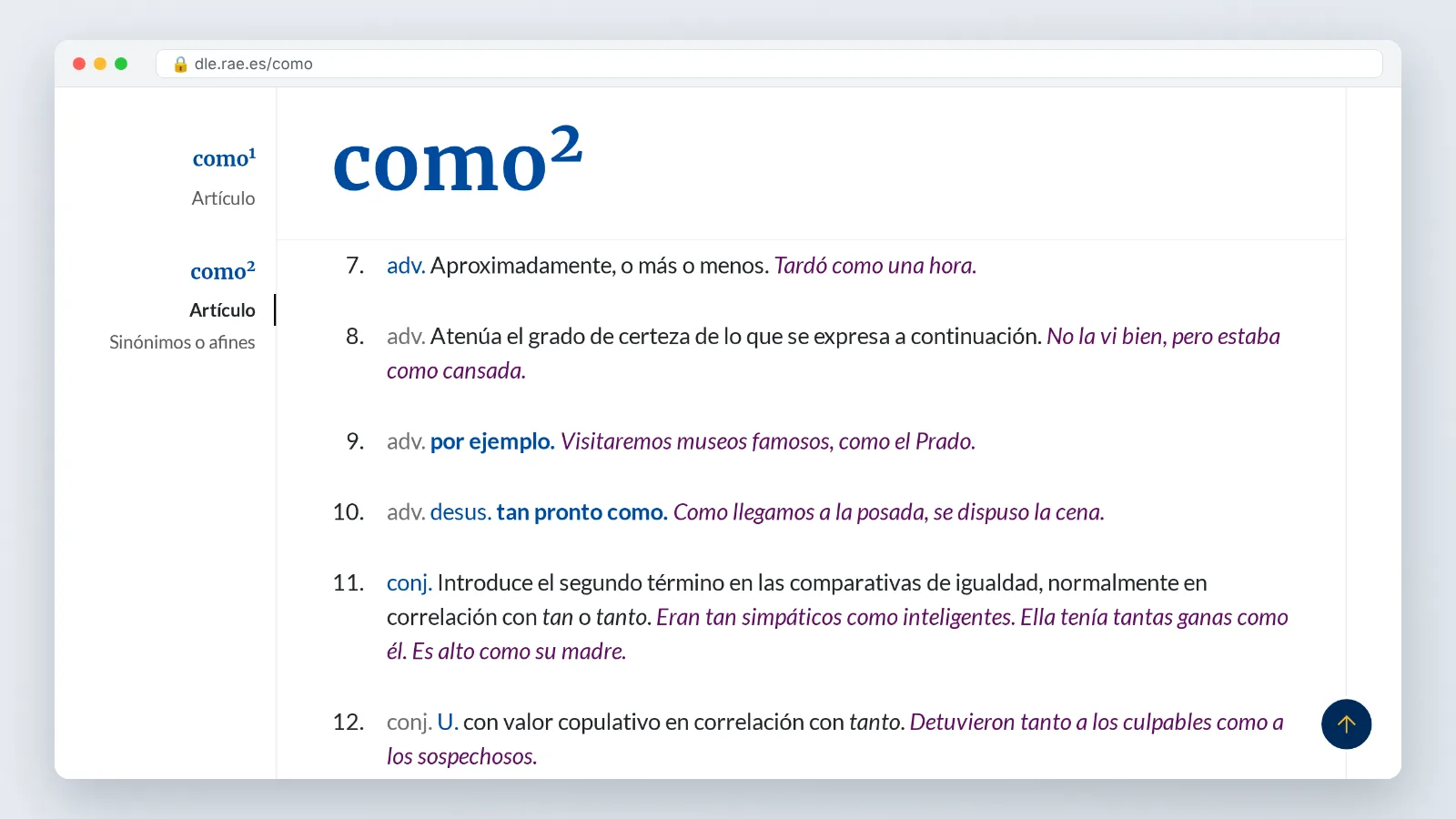
Approximation ("about," "around"). The Real Academia Española’s Diccionario de la lengua española lists the approximate use of unaccented como as sense 7, defined as "approximately, or more or less," with the example Tardó como una hora ("it took about an hour").
Manner after manera, modo or forma. Sense 1 of como in the RAE dictionary is a relative adverb meaning "in which," typically used after the nouns manera, modo or forma — as in la manera como lo explicó, "the way in which he explained it."
"¿Cómo?" in questions, indirect questions and exclamations
Accented cómo asks about manner, method, condition or state. The plain translation is "how," but three everyday uses translate differently.
Direct questions. ¿Cómo llegaste? → "How did you get here?" ¿Cómo está tu mamá? → "How is your mom?"
"Pardon?" / "What?" A standalone ¿Cómo? is what a Spanish speaker says when they did not catch you. It is closer to "Sorry?" than to "How?" and it is neutral in most of Latin America and Spain, though ¿Mande? is the common substitute in Mexico.
Indirect questions. The accent survives inside a statement: Explícame cómo funciona → "Explain to me how it works." Nadie sabe cómo lo consiguió → "Nobody knows how he pulled it off." Subtitles often render this as a simple "how," and the question marks never appear.
Exclamations. ¡Cómo come ese niño! → "That kid can really eat!" The English usually needs a rewrite rather than the word "how."
Pushback. ¿Cómo que no viniste? → "What do you mean you didn’t come?" This one is everywhere in telenovela arguments.
Como vs. the words English speakers confuse it with: que, cual, and "yo como" from comer
Three lookalikes cause most of the mistranslations.
Como vs. que in comparisons. Equality uses como: tan alto como su padre, "as tall as his father." Inequality uses que: más alto que su padre, "taller than his father." Swapping them produces sentences that native speakers instantly flag.
Cómo vs. cuál. Cómo asks about manner; cuál asks about choice from a set. ¿Cómo es tu casa? asks what your house is like; ¿Cuál es tu casa? asks which one is yours. English "what" covers both, which is why the pair trips people up.
Yo como, from comer. Como is also the first-person present of comer, "to eat." Yo como a las dos means "I eat at two," not "I like at two." A subject pronoun, a time expression or a food noun nearby usually settles it.
Regional habits matter too, since the Instituto Cervantes 2024 yearbook reports more than 600 million Spanish speakers worldwide, of whom almost 500 million are native speakers. The grammar of como holds across all of them; the set phrases built on it vary by country.
Everyday phrases you’ll meet in Spanish media
These fixed expressions appear in dialogue far more often than textbook examples, and several do not translate word for word.
- ¿Cómo estás? / ¿Cómo está usted? → "How are you?" The usted form is the polite one.
- ¿Cómo te llamas? → "What’s your name?" Literally "how do you call yourself."
- Cómo no → "Of course" or "Sure thing," very common in Colombia, Mexico and Argentina.
- Tal como → "just as," "exactly as": tal como lo dijiste.
- Así como → "as well as" or "just like."
- Como sea → "whatever," "any way you like."
- Como mínimo → "at the very least."
Two of these carry a grammar warning. In the RAE dictionary entry, sense 4 of como covers the combinations como si and como que, which mark the following clause as hypothetical, apparent or supposed — so como si fuera fácil means "as if it were easy," with the subjunctive attached.
You will hear all of this close to home. Based on the US Census Bureau’s 2024 American Community Survey, about 44.9 million people aged five and over speak Spanish at home in the United States — one in seven, as reported by USAFacts.
Quick-reference table and the mistakes English speakers make most
| Form | Spoken stress | Usual English | Example |
|---|---|---|---|
| como + noun | unstressed | like | duro como una piedra |
| como + role | unstressed | as | trabaja como guía |
| Como + clause (sentence start) | unstressed | since, because | Como llovía, no salimos. |
| como + number | unstressed | about, around | como veinte minutos |
| como si | unstressed | as if | como si nada |
| ¿Cómo…? | stressed | how | ¿Cómo funciona? |
| ¿Cómo? (alone) | stressed | Pardon? Sorry? | —¿Cómo? No te oí. |
| ¡Cómo…! | stressed | wow / the way… | ¡Cómo canta! |
| yo como (verb) | unstressed | I eat | Como a las dos. |
The four errors that cost the most meaning: translating role-*como* as "like" instead of "as"; missing cause-*como* at the start of a sentence and writing "as" when "since" is clearer; dropping the accent in indirect questions such as no sé cómo; and reading yo como as a comparison instead of the verb comer.
When a sentence still resists, check the dictionary entry itself rather than guessing. The RAE announced the online dictionary update version 23.8.1 on 15 December, the edition of the DLE in which the current como/cómo entry can be consulted.
Frequently asked questions
Does "como" mean "how" or "like"?
Both, depending on the accent. Unaccented como means like, as, since or about, while accented cómo means how. A corpus frequency table on Wikipedia glosses como as "like, as" and ranks it 22nd in Spanish with 773,465 occurrences.
Why does "cómo" sometimes have an accent and sometimes not?
The RAE’s Diccionario panhispánico de dudas states that words such as cómo/como are stressed and carry the diacritic accent when they are interrogative or exclamative. Statements and comparisons use the plain form, including indirect questions, which keep the accent even without question marks.
What does "¿cómo?" mean when someone says it on its own?
It means "Pardon?" or "Sorry, what?" — the speaker did not hear you and wants a repeat. It is polite and neutral across most of the Spanish-speaking world, though in Mexico you will often hear ¿Mande? instead.
How do I translate "como si" into English?
Use "as if" or "as though," and expect the Spanish verb in the subjunctive: como si fuera fácil, "as if it were easy." In the RAE dictionary, sense 4 of como covers como si and como que, which mark the clause as hypothetical or supposed.
Is "como" also a verb form?
Yes. Como is the first-person singular present of comer, so Yo como tacos los martes means "I eat tacos on Tuesdays." Look for a subject pronoun, a food word or a time expression nearby, and the verb reading becomes obvious.
Sources
- como, cómo | Diccionario de la lengua española (RAE)
- tilde | Diccionario panhispánico de dudas (RAE)
- La RAE presenta las novedades del «Diccionario de la lengua española» en su versión 23.8.1
- CVC. Anuario 2024. Presentación. Carmen Pastor Villalba — Instituto Cervantes
- How many people are Spanish speakers at home? — USAFacts (US Census ACS data)
- Most common words in Spanish — Wikipedia
AI tools helped write this guide. The Spanish to English Editorial Team published it after checking every figure against the sources linked above.