To translate Spanish songs to English, work in three passes: a literal gloss, an idiomatic rewrite that carries slang and double meanings, and — only if it will be sung — a singable version matched to syllables and stress.

Quick steps
- Get a Spanish transcript you trust, then fix the line breaks by ear against the audio.
- Write a word-for-word gloss under each line and mark every slang term, regionalism and possible double meaning.
- Rewrite line by line for sense, matching the singer’s register instead of dictionary English.
- Count syllables and stressed beats only if a person has to sing your English.
- Read both versions aloud back to back, then check each flagged line with a speaker of that country’s Spanish.
Those five actions are the whole method. Steps 1–4 below cover the first four; the fifth is the quality check at the end. Each section explains what you need in front of you and where translations usually break.
The short answer: three passes, not one
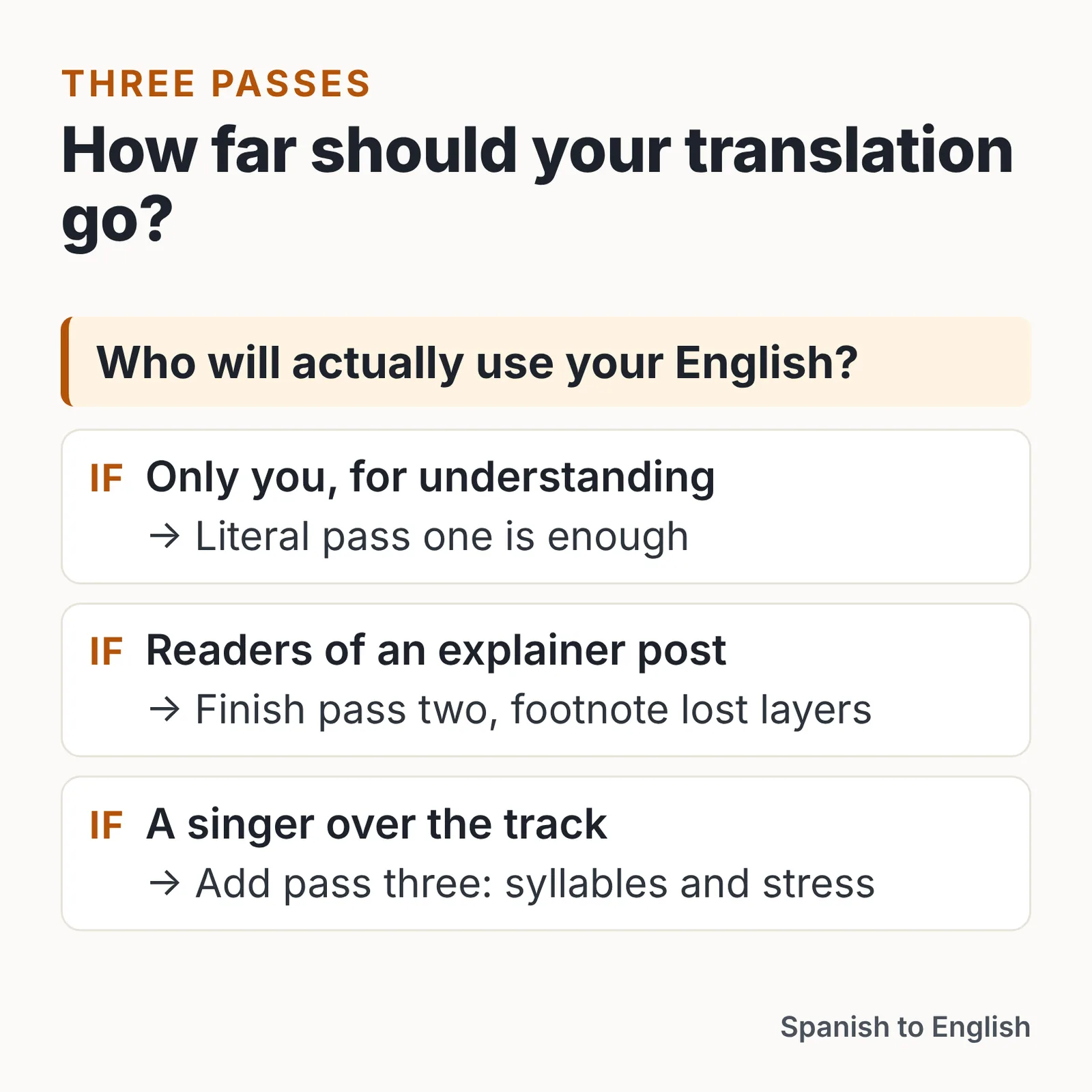
One pass produces either stiff English or invented English. Three passes keep the two problems separate, so you never guess at meaning and phrasing at the same time. The numbered steps map onto that directly: Step 1 is transcript prep, and Steps 2, 3 and 4 are the three passes.
Pass one is literal. You write the clumsiest possible English under each Spanish line, including the words you suspect are slang, because you need to see what is actually on the page before you improve it.
Pass two is idiomatic. Here you decide what an idiom, a nickname or a buried second meaning should become in English, and you accept that a few lines will lose a layer.
Pass three is singable, and most people never need it. Reach for it only when someone will perform your English over the original melody, because it forces you to trade exact meaning for syllable count and stress.
Apple Newsroom reports that Apple announced Lyrics Translation and Lyrics Pronunciation for Apple Music in its June 2025 services update, so listeners can read a translation of a song’s words inside the player. That built-in output gives you most of pass one and a little of pass two. Jokes, regional insults and sexual double meanings are still yours to solve.
What to decide first: your goal, your tools and their limits
Your goal decides how much freedom you have. A study gloss should stay awkward and close; a cover lyric has to breathe. Pick one before you start, or you will drift between them line by line.
Accuracy matters more than hobbyists expect. According to the Census Bureau’s 2024 American Community Survey, about 44.9 million US residents aged 5 and over speak Spanish at home, 13.9% of that population — a lot of people who will spot a mistranslated line in your comments.
| Your goal | Prioritize | What fits | Main limit |
|---|---|---|---|
| Understanding a song for yourself | Plain sense | In-player lyric translation, a machine translator | Flattens slang and wordplay |
| Subtitles for a video | Readability, timing | Transcript plus manual gloss | Line length and reading speed |
| A lyric explainer post | Meaning plus notes | Gloss with short quoted phrases | Reposting full lyrics is restricted |
| A singable cover | Syllables, stress, rhyme | Pen, paper, the instrumental on loop | Real meaning loss is unavoidable |
| Language study | Grammar visibility | Side-by-side literal columns | Reads badly as English |
One caution on publishing. In the United States, song lyrics are protected by copyright, and reproducing a full lyric or a full translation without permission is a rights-holder matter rather than a style choice; rules differ in other countries, and short quoted phrases with commentary sit on safer ground than a complete reprint. This is general information, not legal advice.
Step 1 — Lock down an accurate Spanish transcript and line breaks
You need: the audio, headphones, and a plain-text editor you can type into while the track loops.
Start from a time-synced lyric view if the song has one. Music Ally reports that Spotify’s real-time lyrics feature first launched in 2020 in 26 countries before going global the following year, which is why most mainstream Latin releases now have a scrollable sheet attached.
Treat that sheet as a draft. Crowd-sourced transcripts routinely drop ad-libs, mishear elided syllables and collapse a repeated chorus into one printed block, and every one of those gaps becomes a hole in your English.
Listen through twice with the text in front of you. Restore the contractions as they are actually sung — pa’ for para, na’ for nada, dropped final -s in Caribbean delivery — because those forms tell you the register before any dictionary does. Fast, consonant-dropping verses are their own skill; a guide to catching Spanish that is sung or spoken at speed helps more than slowing the track to half speed.
Set the line breaks yourself, by breath and by rhyme. Where the singer breathes is where your English line should end.
Step 2 — Build a literal gloss and flag slang, regionalisms and double meanings
You need: a two-column document, a Spanish-English dictionary, and a slang reference for the artist’s country.
Put the Spanish in the left column and a word-for-word English gloss in the right. Keep it ugly. The point is to expose every word you cannot defend, not to produce readable prose.
Machine output is useful raw material at this stage, with a ceiling. ToolRadar’s DeepL pricing page, verified September 2026, reports that DeepL’s free tier is capped at 50,000 characters per month, which covers dozens of lyric sheets before you hit the limit.
Then flag. Mark each suspect word with a tag so you can sort them later:
- [S] Slang — a word the dictionary gives a neutral meaning for, but the street does not.
- [R] Regional — same spelling, different sense in Mexico, Colombia, the Dominican Republic or Spain.
- [2] Double meaning — the line reads clean and also does not.
- [N] Name or reference — a neighborhood, a brand, a telenovela, a saint, a soccer club.
- [G] Grammar load — subjunctive, diminutives, vos, a tense that shifts the emotion.
Address terms deserve their own pass, since a single vocative sets the whole tone of a verse; what ese carries and where it came from is a good example of a word no dictionary entry handles. Money words are the other reliable trap, because the slang for cash changes from country to country and a wrong guess dates the song to the wrong place.
Step 3 — Rewrite for sense: idioms, albur, metaphor and cultural references
Work down your flag list before you touch the clean lines. Each flagged item gets one of four decisions, and writing the decision down keeps you consistent across verses.
- Swap for an English idiom that carries the same force and the same social class.
- State the plain sense in the lyric and park the lost layer in a footnote.
- Keep the Spanish word and gloss it once, which works for names, dances and foods.
- Compensate — drop the pun here, plant an equivalent one two lines down where English allows it.
Example: a chorus line built on dale can mean "go ahead," "hit it," "come on" or a flat sexual invitation depending on who is singing and where. How dale shifts country by country is the kind of check that changes a chorus from generic to accurate.
Albur — Mexican double entendre, usually sexual, usually built on an innocent noun — almost never survives word for word. Pick the layer the song actually lives on, render that cleanly, and note the second reading underneath rather than forcing a pun English cannot hold.
Register is the last call. A reggaetón hook translated into polite newsroom English is a mistranslation even when every word is correct, so match the vocabulary a speaker of that age and city would use in English.
Step 4 — Make it singable: syllable count, stress and rhyme
You need: the instrumental on loop, a pencil, and your idiomatic version from step three.
Count the Spanish syllables per line first, out loud, the way they are sung. Spanish runs vowels together across word boundaries, so a line that looks like eleven syllables on paper often lands as nine in the mouth.
Match the stressed beats, not the syllable total. Your English stresses have to fall where the melody’s strong beats fall, and an English line one syllable short is fixable while a line that stresses the wrong word is not.
Rhyme is where you give ground. Spanish leans on assonance — matching vowels only — which is far easier than English full rhyme, so chase vowel echoes and near rhymes instead of forcing exact pairs that bend the meaning.
Sing every candidate line aloud over the track. If you cannot sing it without rushing, cut a word; adjectives go first, verbs stay.

Quality check: how to verify your English version before you publish it
Back-translate first. Put your English back into Spanish, compare it to the original transcript, and look only at the lines that came back different — those are where meaning drifted.
Cross-check your plain-sense reading against a player translation. Apple Support documents the procedure for Apple Music on Apple TV: open the lyrics, select the Translation and Pronunciation button, and choose Show Translation. Disagreements are not proof you are wrong; they mark lines worth a second look.
The most common failure: translating a flagged double meaning literally, so the English line reads as surreal nonsense and the joke disappears. Avoid it by never translating a [2]-tagged line alone — send those lines to a speaker from the artist’s country and ask what they hear, not whether your version is correct.
Run this before you publish:
- ☐ Transcript checked by ear against the audio, including ad-libs and repeats.
- ☐ Every repeated chorus written out, not collapsed into one block.
- ☐ All [S], [R] and [2] tags resolved with a written decision.
- ☐ Proper nouns, places and brands spelled and explained correctly.
- ☐ Register matches the singer’s age, city and attitude.
- ☐ Read aloud end to end, with no line you have to rush.
- ☐ Full-lyric reposting rights considered for your country before you hit publish.
- ☐ One native speaker from the artist’s region has reviewed the flagged lines.
Frequently asked questions
Can I just use the built-in translation in a streaming app?
For personal understanding, yes. Apple Support’s instructions for Apple Music on Apple TV are to open the lyrics, select the Translation and Pronunciation button, then choose Show Translation. Expect plain sense only: regional slang, nicknames and sexual double meanings usually come through flattened or wrong.
How do you translate albur and other double meanings?
Decide which layer the song actually runs on, translate that layer cleanly in the lyric, and explain the second reading in a note underneath. Forcing both meanings into one English line almost always produces a pun that scans badly and means neither thing.
Do I need a singable version?
Only if someone will perform your English over the melody. For a blog post, subtitles or study notes, stop after the idiomatic pass — singable versions trade real meaning for syllable count and stress, and readers notice the loss faster than singers do.
Is it legal to post my English translation of a song?
In the United States, lyrics are copyrighted and a translation is a derivative work, so a full reprint is a rights-holder question; short quoted phrases with commentary sit on safer ground. Rules differ by country. This is general information, not legal advice.
Which translator handles lyrics best?
No engine handles slang reliably, so judge tools by throughput and editing comfort rather than accuracy claims. ToolRadar reports DeepL’s free tier is capped at 50,000 characters per month, which is plenty for lyric sheets, but plan on rewriting every flagged line yourself.
Sources
- Spotify reveals lyrics updates including translation expansion — Music Ally
- Apple services deliver powerful features and intelligent updates to users this fall — Apple Newsroom
- See lyrics in Apple Music on your Apple TV — Apple Support
- Spanish speakers in the U.S. by state: 2024 Census data
- DeepL Pricing 2026 — ToolRadar
AI tools helped write this guide. The Spanish to English Editorial Team published it after checking every figure against the sources linked above.