Primo spanish to english is usually "cousin," but the word also works as a friendly "bro" in direct address, as slang for a gullible mark, and as "first" in fixed phrases like número primo.
What ‘primo’ actually means in Spanish: the short answer
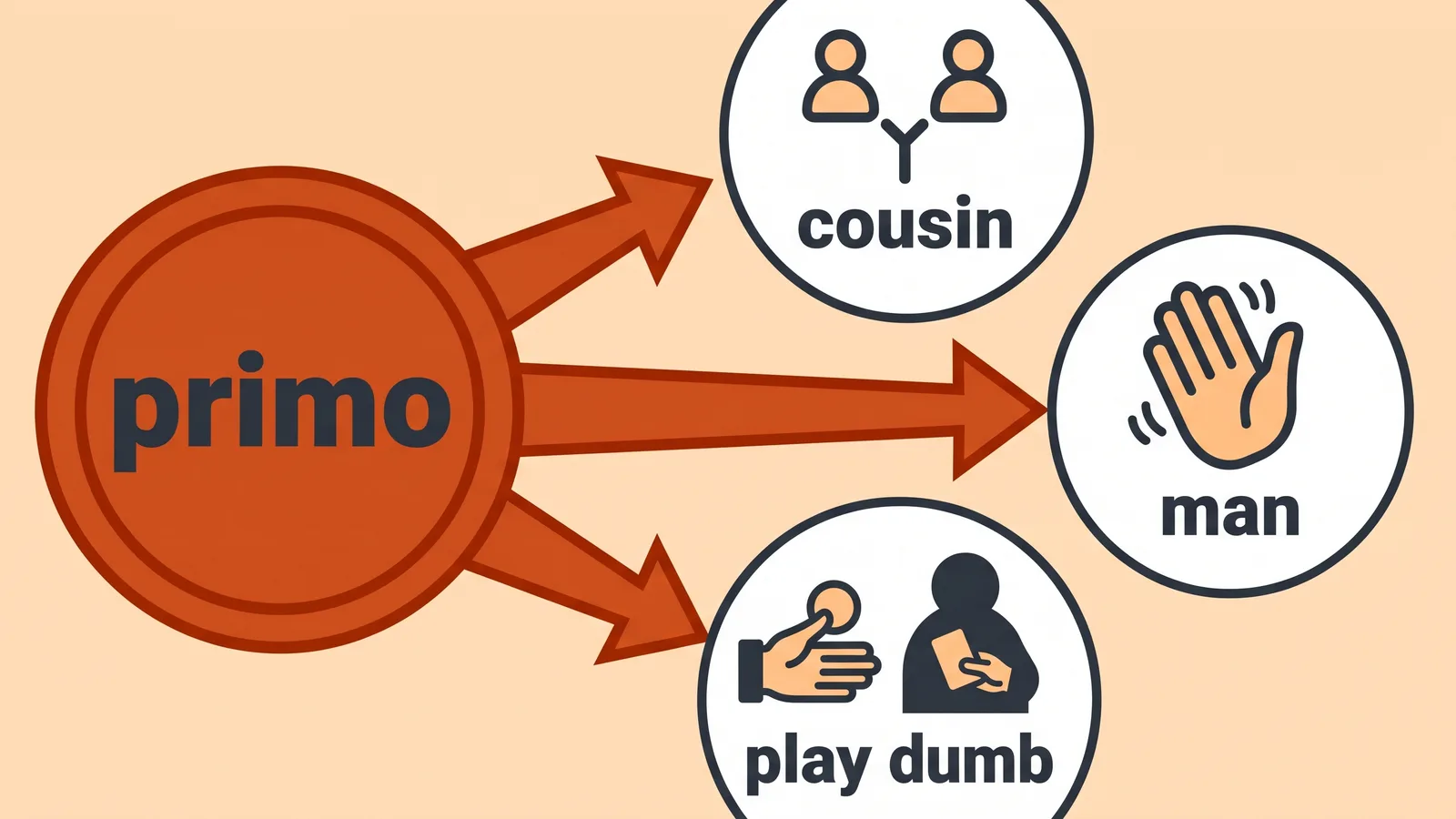
Definition: Primo (masculine) / prima (feminine) — a Spanish word rooted in the idea of "first." In everyday speech it names a cousin, works as a warm form of address between friends, and in slang labels someone easy to fool.
Spanish speakers do not hear three separate words here. They hear one word and let the sentence around it decide, the same way English lets "man" be a relative, a greeting, or a complaint.
The four jobs the word does:
- Kinship noun — mi primo Luis = "my cousin Luis."
- Friendly address — ¿qué onda, primo? = "what’s up, man?"
- Slang insult or warning — no seas primo = "don’t be a sucker."
- Adjective meaning "first" or "raw" — materia prima, número primo.
In the Real Academia Española’s Diccionario de la lengua española, the kinship meaning — the child of a person’s uncle or aunt — is listed as sense 3 of the entry for primo. That placement is not an accident, and the next section explains why.
Where ‘primo’ comes from: Latin primus, ‘first’, and why family came second
The Real Academia Española’s Diccionario de la lengua española traces primo to Latin primus and gives primero ("first") as sense 1 of the entry, ahead of any family meaning.
That ordering preserves the medieval logic. A consobrinus primus was a "first cousin" — the primus did the counting, and over centuries the counting word swallowed the relationship word.
The courtly branch survived in writing. Sense 4 of the RAE entry records that primo was the form of address the Spanish king used for the grandes de España in private letters and official documents.
Knowing the "first" root makes the odd phrases stop looking odd. A prime number is first in the sense of indivisible; raw material is first in the sense of unprocessed; a debut film is first in the sense of earliest.
The insult grew out of the same soil, through the idea of someone who goes first, trusts first, and pays first.
How to read ‘primo’ in three steps: literal cousin, friendly address, figurative ‘sucker’
Run these three checks in order and you will almost never misread the word.
- Is there a possessive or a name attached? Mi primo, su primo, el primo de Ana — that is family, full stop.
- Is it being used to call someone? If primo sits after a greeting, a comma, or a question (oye, primo), it is address, and "bro," "man" or "cuz" is your English.
- Is it the object of a verb like hacer, pasar por or ser? Hacer el primo, me vio cara de primo — now you are in insult territory.
Sense 5 of the RAE entry for primo is colloquial and means a naive person who is easily deceived or exploited. That is the sense that turns a compliment into a jab.
Speed is the real obstacle in conversation, since the vocative primo often gets swallowed into the end of a phrase — the drills in this guide to catching fast spoken Spanish help you hear it at all.
Primo in the family tree: primo hermano, primo segundo and the legal degrees of kinship
Spanish is more precise about cousins than English, and the modifiers carry real weight in paperwork.
| Spanish | English | Who that is |
|---|---|---|
| primo hermano / prima hermana | first cousin | Child of your parent’s sibling |
| primo carnal | first cousin (blood) | Same as above, emphatic |
| primo segundo | second cousin | Child of your parent’s first cousin |
| primo tercero | third cousin | One generation further out |
| primo lejano | distant relative | Vague, often jokey |
| primo político | cousin by marriage | Your spouse’s cousin, or a cousin’s spouse |
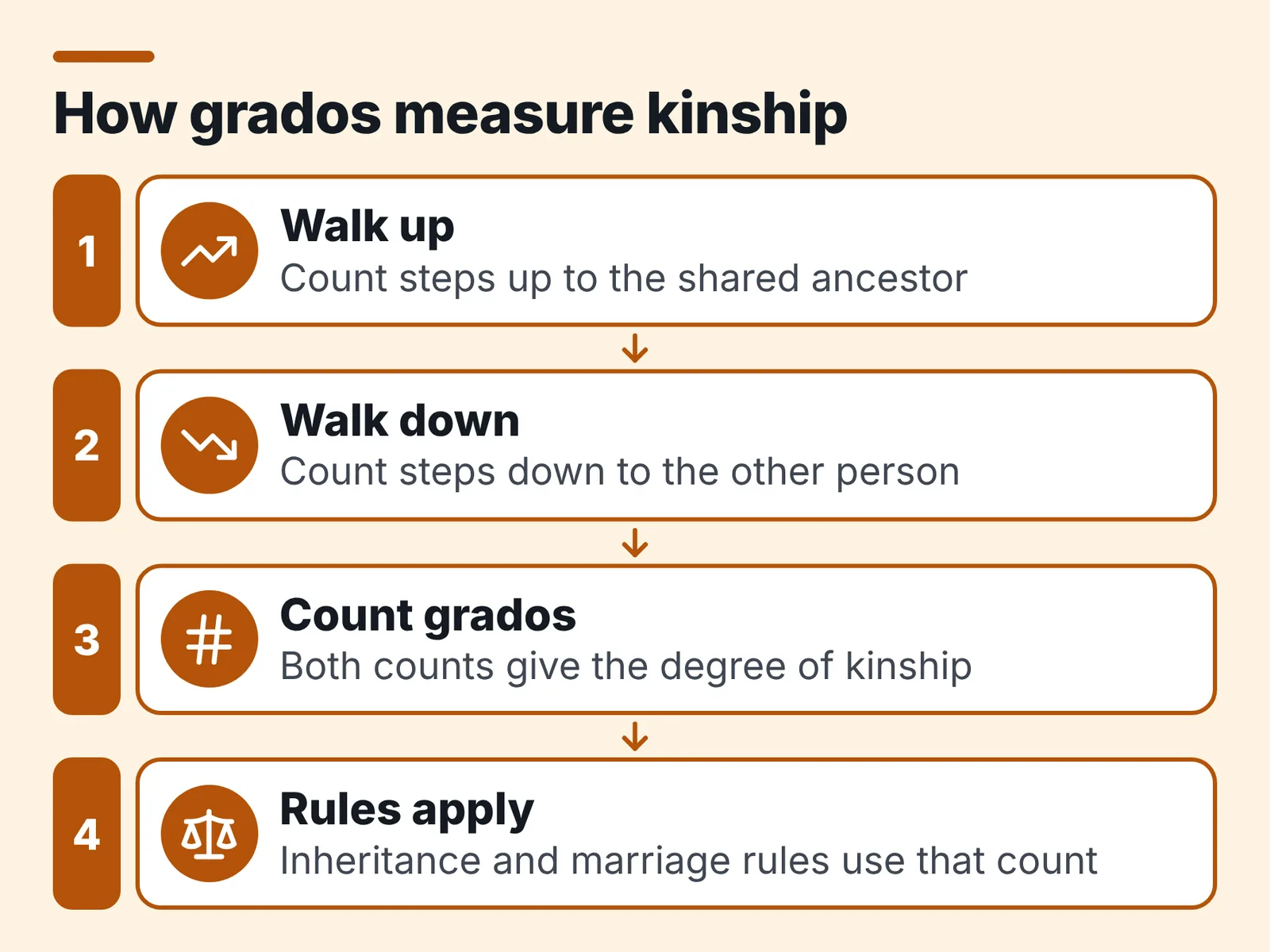
Civil codes across Spain and Latin America count kinship in grados, degrees measured by walking up the family tree to the shared ancestor and back down to the other person. Inheritance rules, marriage restrictions and some public-sector conflict-of-interest rules key off that count.
The degree thresholds differ by country and sometimes by state or province, so check the civil code that actually governs your situation. This is general information, not legal advice.
Primo vs. carnal, compa and güey: choosing the right ‘buddy’ word
All four can land as "bro" in English, but they are not swappable in Spanish.
| Word | Warmth | Who says it | Safe for you to use? |
|---|---|---|---|
| primo | High, familial | Mexico, Caribbean, Central America | Yes, with people you already know |
| carnal | Very high, brotherly | Mexico, Chicano Spanish | Only if the relationship is close |
| compa | Medium, buddy-ish | Mexico, Central America, Andes | Yes, fairly low-risk |
| güey | Neutral to rough | Mexico, mostly under 40 | Risky with strangers or elders |
The difference that matters: primo claims kinship you may not have, while compa only claims companionship. Calling a near-stranger primo can read as presumptuous in some rooms and as generous in others.
If you are mapping Mexican address terms generally, the rundown of everyday Mexican slang and its English meanings covers the neighbors of this word.
Primo without people: número primo, materia prima, ópera prima and the financial prima
Strip the humans out and the "first" sense takes over completely.
- número primo — prime number
- materia prima — raw material, commodity
- ópera prima — debut work, first film or first novel
- obra prima — early or masterwork sense, depending on context
- prima — insurance premium, or a bonus payment in payroll Spanish
The RAE’s electronic DRAE page for primo, prima, which reproduces the 22nd edition of the Diccionario de la lengua española published in 2001, catalogues set phrases including número primo, obra prima and ópera prima.
According to the RAE’s Diccionario del estudiante, sense 4 of the primo, prima entry is purely financial: the prima is the sum an insured party pays the insurer periodically.
Business translation is where this bites. A Colombian payroll line reading prima de servicios has nothing to do with cousins, and treating it as a name will wreck the document.
Where each meaning lives: Mexico, the Caribbean, Central America and the Southern Cone
Geography decides which sense fires first.
- Mexico — cousin plus heavy use as friendly address; primo competes with compa and carnal.
- Dominican Republic, Puerto Rico, Cuba — address use is common in street talk and music lyrics.
- Honduras and eastern Bolivia — the Asociación de Academias de la Lengua Española’s Diccionario de americanismos records primo meaning a close friend or inseparable companion, with no family relationship implied.
- Spain — the family sense dominates, and the insult survives mainly in the fixed phrase hacer el primo.
- Argentina, Uruguay, Chile — primo stays mostly literal; boludo, che and weón take the buddy slot.
Caribbean address terms shift fast and cluster by neighborhood, which is why the guide to Dominican slang and its English equivalents is worth reading alongside this one.
Age matters too. Younger speakers stretch primo to teammates and coworkers; older speakers often keep it for actual relatives.
Translating ‘primo’ into English in practice: worked examples and common mistakes
Work from the function you identified in step 2 above, not from the dictionary gloss.
| Spanish | Weak English | Better English |
|---|---|---|
| Llegó mi primo de Guadalajara. | My primo arrived. | My cousin from Guadalajara got here. |
| ¡Órale, primo! | Hey, cousin! | Hey, man! |
| No te hagas el primo. | Don’t make the cousin. | Don’t play dumb. |
| Lo agarraron de primo. | They grabbed him as a cousin. | They took him for a ride. |
| Es mi prima hermana. | She’s my sister cousin. | She’s my first cousin. |
Three mistakes repeat constantly: translating vocative primo as "cousin" in subtitles, reading prima as a woman’s name in a contract, and flattening primo hermano into plain "cousin" when a will or a visa form needs the precise degree.
Machine translation handles the kinship sense reliably and the vocative sense poorly, so check any line where primo sits next to a comma. The same warning applies to the other filler-adjacent terms in this collection of Spanish slang English speakers hear most.
Frequently asked questions
Does primo always mean cousin in Spanish?
No. The Real Academia Española lists "primero" as sense 1 of the entry, the cousin meaning as sense 3, and a colloquial sense 5 meaning a naive person who is easily deceived or exploited. Context decides which one you are hearing.
What is the difference between primo hermano and primo segundo?
A primo hermano is a first cousin, the child of your parent’s brother or sister. A primo segundo is a second cousin, the child of your parent’s first cousin. Spanish keeps the distinction in speech, while English speakers often blur both into "cousin."
Can I call someone primo if we are not related?
In much of Mexico, the Caribbean and Central America, yes, among people you already know. The ASALE’s Diccionario de americanismos records primo in Honduras and eastern Bolivia as meaning a close friend or inseparable companion, with no family relationship implied.
What does hacer el primo mean?
It means to be taken advantage of — to be the one who pays, waits or believes while everyone else benefits. The phrase draws on the RAE’s colloquial sense 5 of primo, a naive person who is easily deceived, and is most common in Spain.
Why is a prime number called número primo in Spanish?
Because the word’s root is Latin primus, "first," which the RAE gives as sense 1 of the entry. The RAE’s 2001 electronic DRAE page for primo, prima catalogues número primo alongside obra prima and ópera prima as established set phrases.
Sources
AI tools helped write this guide. The Spanish to English Editorial Team published it after checking every figure against the sources linked above.