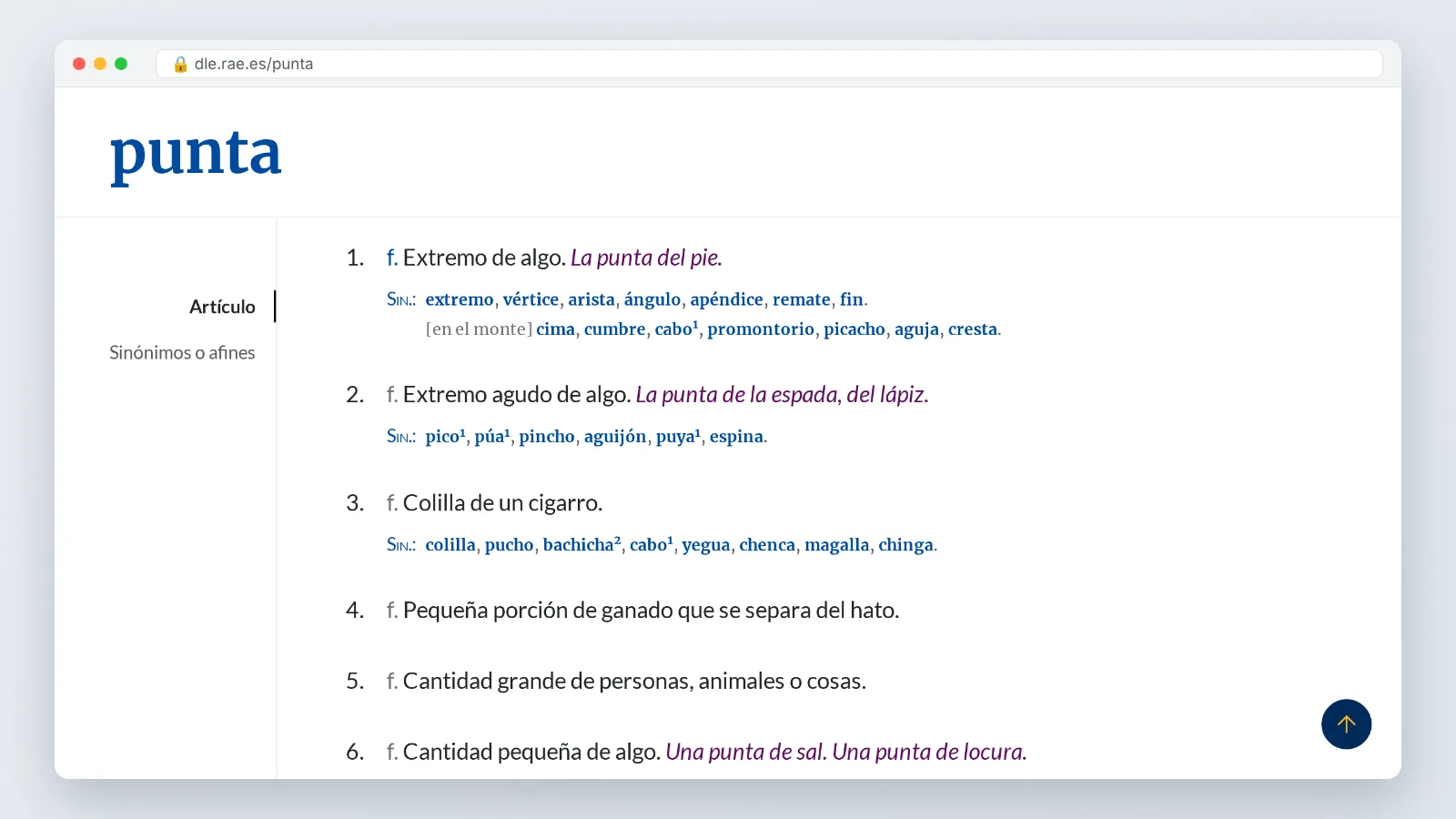
The Real Academia Española lists ‘extremo de algo’ (the end or tip of something) as the first sense of ‘punta’, illustrated with ‘la punta del pie’, the tip of the foot.
What does ‘punta’ mean in Spanish? The short answer
> Definition box — punta (feminine noun): the tip, point or sharp end of a thing; by extension a headland on a map, and, in Central America, a Garífuna drum rhythm with the dance that belongs to it.
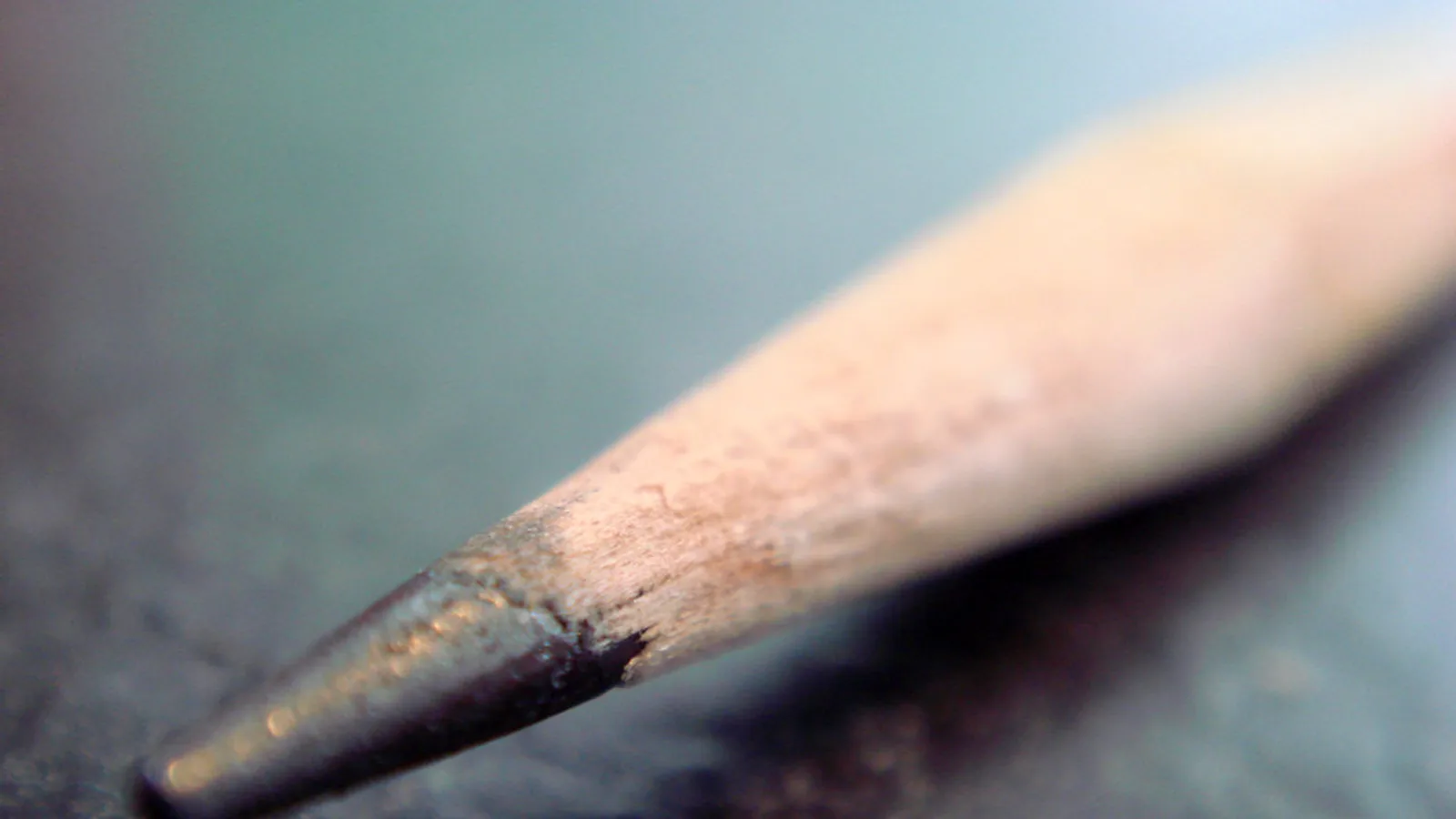
Most of the time the English you want is plain: *tip*, *point*, *end*, *tack*, *nib*. A pencil has a punta. So does a knife, a peninsula, an iceberg, a spear, and your tongue when a name is stuck on it.
The word turns slippery in exactly two places. One is music, where *punta* stops being a shape and becomes a rhythm played on Garífuna drums. The other is regional idiom, where *una punta de* can mean a crowd of people rather than the end of anything.
Nothing about *punta* is obscene on its own. Its resemblance to *puta*, a vulgar word for a prostitute, is a coincidence of spelling that trips up beginners every day. Say the n clearly and you are safe.
The core meaning: tip, point, end — and how the RAE defines it
Start with the authority. The Real Academia Española’s *Diccionario de la lengua española* gives the first sense of *punta* as ‘extremo de algo’ — the end or tip of something — and illustrates it with *la punta del pie*, the tip of the foot. This is the sense you will meet most often.
The second RAE sense narrows it to a sharp end: the dictionary lists the pointed extremity of an object, using the point of a sword and the point of a pencil as its examples. English splits this job across several words, which is why a single gloss never works.
Here is the usual mapping:
| Spanish | Natural English |
|---|---|
| la punta del lápiz | the pencil point / the lead |
| la punta del cuchillo | the knife tip |
| la punta de la lengua | the tip of my tongue |
| las puntas del pelo | the ends of the hair (split ends) |
| la punta de la isla | the point / headland |
| punta de lanza | spearhead |
Pick the English noun that an English speaker would actually use for that object. Translating every *punta* as ‘point’ produces sentences that are technically right and quietly wrong.
How ‘punta’ stretches: three stages from physical tip to place name to figure of speech
The whole family of meanings grows outward in three stages, and knowing the order makes new uses easy to decode.
- Physical tip. A real pointed end you could touch: a nail, a nib, a horn, a shoe.
- Geographic point. Land that comes to a tip in the sea becomes a *punta*, which is why so many coastal names begin with the word — Punta Cana, Punta Arenas, Punta del Este, Punta Gorda.
- Figurative edge. Abstract extremes borrow the shape: *de punta a punta* (from end to end), *estar de punta con alguien* (to be at odds with someone), *ponerle a alguien los pelos de punta* (to make someone’s hair stand on end).
The geographic layer is the one travelers meet first, and it is heavily trafficked. Punta Cana International Airport, whose name uses *punta* in its geographic sense of a point of land, handled more than 11 million passenger movements in 2025, a 9.9% rise over 2024, according to the airport’s own year-end report.
When you hit an unfamiliar phrase, ask which stage you are in. If something physically ends, stage one. If it sits on a coastline, stage two. If a feeling or relationship is involved, stage three, and translate the idea rather than the noun.
Punta the music: Garifuna rhythm, punta rock and the dance
Search *punta* on a streaming service and you will not get pencils. You will get drums, turtle-shell percussion, call-and-response vocals in the Garífuna language, and dancers moving fast from the hips down while the upper body stays nearly still.
The culture behind it has a documented history. UNESCO records that the Garífuna settled along the Atlantic coast of Central America after being forced to flee the Caribbean island of Saint Vincent in the eighteenth century.
UNESCO proclaimed the language, dance and music of the Garífuna a Masterpiece of the Oral and Intangible Heritage of Humanity in 2001, and incorporated it into the Representative List in 2008. That listing covers the wider tradition in which punta sits, not a single song style.
The electrified version has a named inventor and a date. The modern genre punta rock was created by Belizean musician Pen Cayetano in 1978 at his studio in Dangriga, Belize, according to his account published by the University of the West Indies.
The holiday at which punta is most publicly performed is Garifuna Settlement Day in Belize, which became a public holiday in Belize’s southern districts in 1943 and a national holiday in 1977.
Punta vs. pico: ‘hora punta’ or ‘hora pico’, and other near-synonyms
This is the single most useful regional split in the whole entry, and it decides which phrase sounds native in your mouth. The RAE’s *Diccionario panhispánico de dudas* records *hora punta* — rush hour — as the usage of Spain, Peru and Chile, defining it as the hour of greatest crowding on transport and greatest demand for certain services.
Everywhere else, swap the noun. The same RAE source states that speakers in the rest of Latin America say *hora pico* rather than *hora punta*.
| Expression | Where it is used | English |
|---|---|---|
| hora punta | Spain, Peru, Chile (per the RAE) | rush hour, peak hour |
| hora pico | the rest of Latin America (per the RAE) | rush hour, peak hour |
| pico | general | beak, peak, sharp projection; ‘and a bit’ in time |
| punto | general | dot, period, point in an argument |
| extremo | general | the far end, the extreme |
The nearest confusable word is *punto*, not *pico*. *Punto* is an abstract dot or item — *punto de vista*, *dos puntos*, *punto final* — while *punta* is a physical tip you could prick yourself on. Change the vowel and you change the whole category.
Slang, regional and vulgar uses of ‘punta’ (and why it isn’t ‘puta’)
Regional senses are where dictionaries earn their keep. Sense 19 of *punta* in the RAE dictionary is marked as Cuban Spanish and means a small tobacco leaf of exquisite aroma and superior quality — a reading no beginner would guess from ‘tip’.
Beyond the dictionary, two colloquial patterns are worth flagging as regional observations rather than documented senses. In parts of Mexico, Central America and the Southern Cone, *una punta de* is heard as a quantifier: *una punta de gente* for a crowd, *una punta de mentiras* for a pile of lies. The tone is usually dismissive, so ‘a bunch of’ serves better than ‘several’. And *sacarle punta a algo*, literally to sharpen something, is commonly used for reading too much into a remark. Neither appears in the RAE entries cited here, so treat them as usage you will hear rather than senses you can cite.
The anatomical reading of ‘tip’ does fuel crude jokes in some countries, the way ‘tip’ and ‘head’ can in English. Context and tone of voice will tell you; the word itself carries no vulgarity.
Keep *punta* and *puta* apart. They differ by one consonant, they share no root, and the second is genuinely offensive. Pronounce the n and lengthen nothing — *PUN-ta*, two clean syllables.
Everyday phrases with ‘punta’ and how to translate them in context
Fixed expressions rarely survive word-for-word. One pattern is worth memorizing because it appears constantly in news reports about crime and coercion: the RAE documents the prepositional phrase *a punta de*, in which the object named is the pointed instrument used to carry out an action, as in *a punta de machete*.
English handles that with ‘at knifepoint’, ‘at gunpoint’, or ‘by means of’. *A punta de pistola* is at gunpoint. *A punta de trabajo*, stretched figuratively, is ‘through sheer hard work’.
| Phrase | Literal | What you should write |
|---|---|---|
| lo tengo en la punta de la lengua | on the tip of the tongue | it’s on the tip of my tongue |
| de punta a punta | from tip to tip | from end to end, all the way across |
| se me pusieron los pelos de punta | hair went to tips | it gave me goosebumps |
| estamos de punta | we are at tips | we’re at odds, we’re not speaking |
| a punta de pistola | at pistol point | at gunpoint |
| sacar punta | to sharpen | to read too much into it |
Read the whole clause before choosing. If a person is the subject and a feeling is involved, the phrase is almost certainly idiomatic, and the pointed object has disappeared from the meaning entirely.
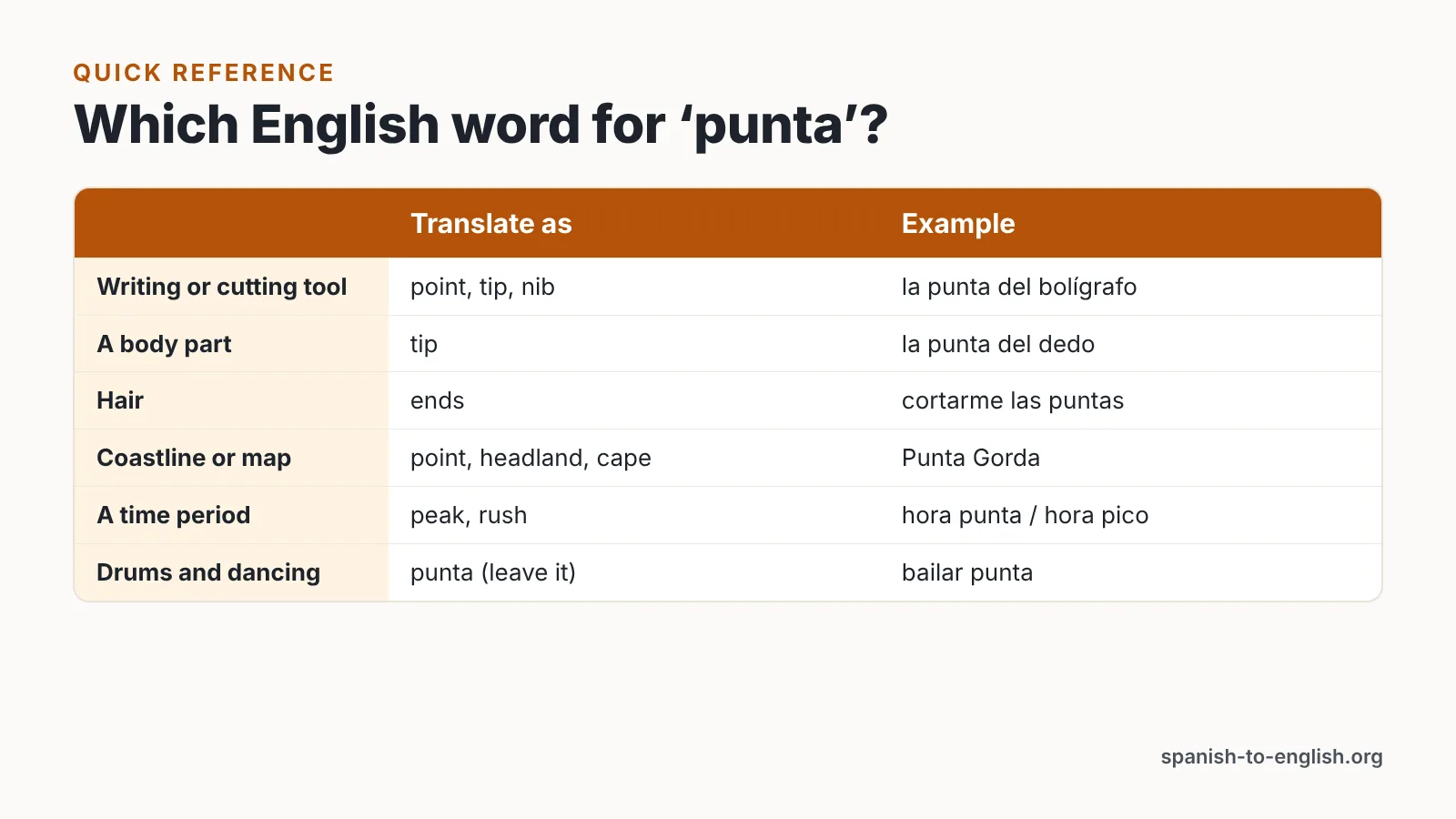
Quick reference: choosing the right English word for ‘punta’
Use this order when a sentence stalls. Ask what kind of thing the *punta* belongs to, then pick the English noun a native speaker would use for that object’s end.
| If the punta belongs to… | Translate as | Example |
|---|---|---|
| a writing or cutting tool | point, tip, nib | la punta del bolígrafo |
| a body part | tip | la punta del dedo |
| hair | ends | cortarme las puntas |
| a coastline or map | point, headland, cape | Punta Gorda |
| a time period | peak, rush | hora punta / hora pico |
| drums and dancing | punta (leave it) | bailar punta |
| a quantity, informally | a bunch of | una punta de gente |
| a weapon in a phrase with ‘a punta de’ | at …point | a punta de cuchillo |
Leave the word untranslated in two cases: place names and the music. Writing ‘Cane Point International Airport’ or ‘Garífuna tip music’ helps nobody.
For everything else, resist the urge to find one English equivalent. *Punta* is a shape, and English names that shape differently depending on what is wearing it.
Frequently asked questions
Is ‘punta’ a bad word in Spanish?
No. ‘Punta’ simply means tip, point or end, and it appears in neutral phrases like ‘la punta del lápiz’ and ‘hora punta’. The confusion comes from ‘puta’, a vulgar word for a prostitute that differs by one letter. Pronounce the n clearly and there is no risk.
What is the difference between ‘hora punta’ and ‘hora pico’?
Both mean rush hour. The RAE’s Diccionario panhispánico de dudas records ‘hora punta’ as the usage of Spain, Peru and Chile, defining it as the hour of greatest crowding on transport, and states that the rest of Latin America says ‘hora pico’ instead. Match whichever your audience uses.
What kind of music is punta?
Punta is a drum-driven Garífuna rhythm and dance from the Caribbean coast of Central America, with call-and-response singing and fast hip movement. UNESCO proclaimed Garífuna language, dance and music a Masterpiece of the Oral and Intangible Heritage of Humanity in 2001 and added it to the Representative List in 2008.
Who invented punta rock?
Belizean musician Pen Cayetano created punta rock in 1978 at his studio in Dangriga, Belize, according to his account published by the University of the West Indies. The genre adds electric guitar and band instrumentation to the traditional Garífuna punta rhythm played on drums and turtle shells.
Why do so many Spanish place names start with ‘Punta’?
Because ‘punta’ names a point of land that juts into water, the same way English uses Point or Cape. Punta Cana, Punta Arenas, Punta del Este and Punta Gorda all follow that pattern, and Punta Cana International Airport reported more than 11 million passenger movements in 2025, a 9.9% rise over 2024.
Sources
- punta | Diccionario de la lengua española (RAE)
- punta | Diccionario panhispánico de dudas (RAE)
- Honduras – UNESCO Intangible Cultural Heritage
- Language, dance and music of the Garifuna – UNESCO Intangible Cultural Heritage
- The Beginning of Punta Rock – Pen Cayetano (University of the West Indies)
- Garifuna Settlement Day – Wikipedia
- Punta Cana Airport Sets a Historic Milestone and Closes 2025 with Consecutive Records
AI tools helped write this guide. The Spanish to English Editorial Team published it after checking every figure against the sources linked above.