The most common slang words for money in Spanish are plata, lana, pasta, guita, feria, varo, chavos, pisto and luca — each tied to specific countries rather than spoken everywhere.
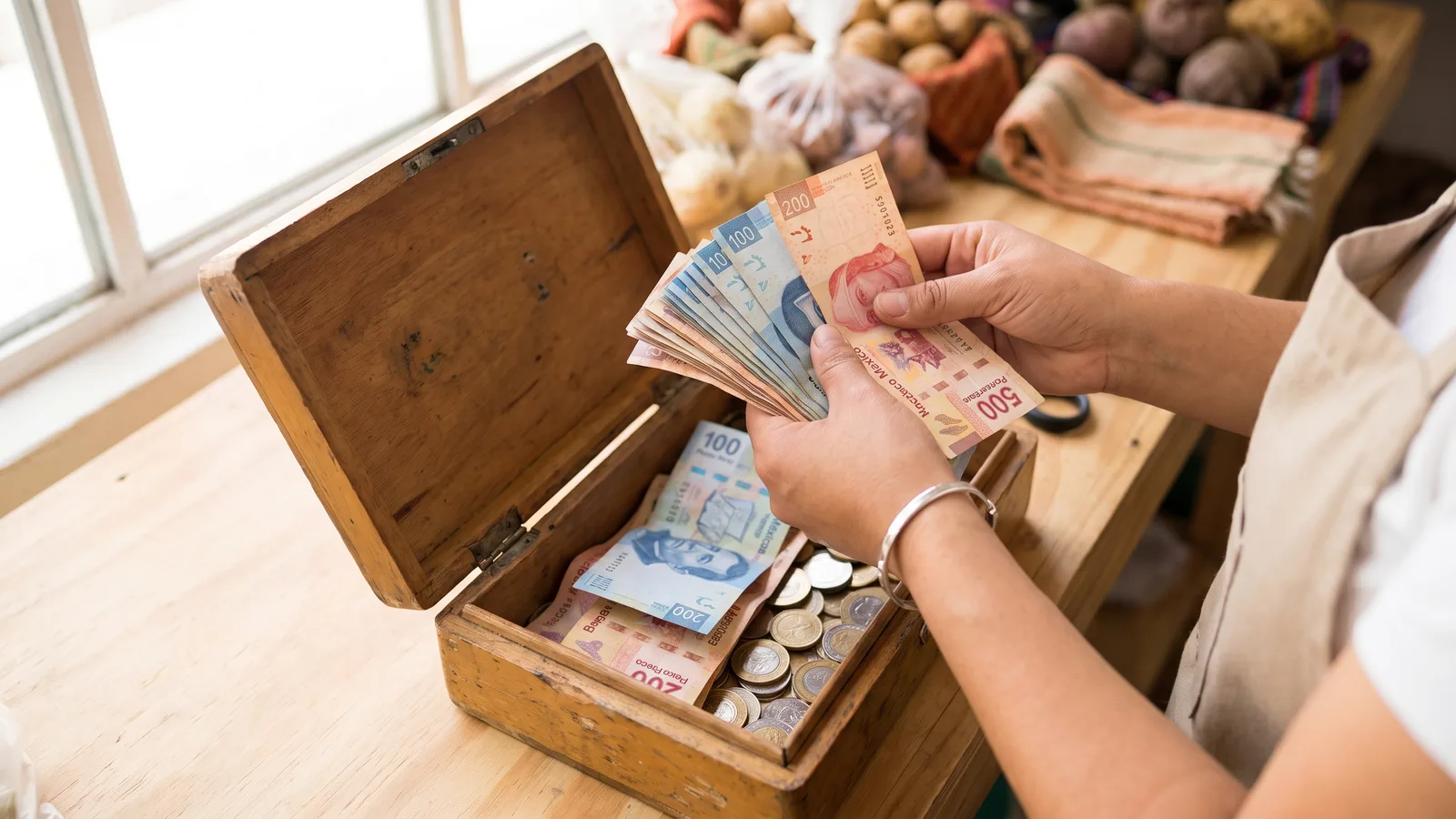
What Counts as a Spanish Slang Word for Money?
Definition: A Spanish money slang word is an informal noun used in place of dinero — lana, guita, pasta, plata — usually tied to one country or region and out of place in formal writing.
Three things have to be true before a word earns that label:
- It substitutes for dinero without changing the grammar around it. No tengo lana and no tengo dinero behave identically.
- It travels with a passport. Lana reads as Mexican, guita as Argentine or Spanish, pisto as Central American.
- It lowers the register. You say it to a cousin, a friend, a taxi driver — not in a mortgage application.
The Instituto Cervantes yearbook El español en el mundo 2024 puts Spanish at more than 600 million speakers worldwide, of whom almost 500 million are native speakers. No central authority pushes a casual word for cash across all of that territory. Each country keeps its own favorite, and those favorites rarely line up.
Money slang also does something most slang never does: it counts. Several of these words don’t mean "money" in the abstract — they name a precise sum, and that is where English translations fall apart.
The Core List: Slang for Money by Country and Region
Mexico is the country with the most Spanish speakers, more than 120 million of the 600 million people who speak the language worldwide, according to the Instituto Cervantes 2024 yearbook. That weight shows up in what you hear. Mexican terms reach English speakers through music, telenovelas and streaming far more often than Honduran or Uruguayan ones.
| Term | Where you’ll hear it | Origin / literal sense or amount | Closest English |
|---|---|---|---|
| plata | Argentina, Chile, Colombia, Peru, Venezuela | silver | money, cash |
| lana | Mexico | wool | dough |
| varo / baro | Mexico | one peso | buck |
| feria | Mexico | fair, market | loose change, cash |
| billete | Mexico, Caribbean | banknote | bills, cash |
| pasta | Spain | paste, dough | dough |
| pelas | Spain (older speakers) | from pesetas | quid, bucks |
| parné | Spain (Caló origin) | — | dosh |
| guita | Argentina, Uruguay, Spain | hemp cord | cash |
| mango | Argentina, Uruguay | one peso | buck |
| luca | Argentina, Chile, Colombia, Uruguay | a thousand | a grand |
| chavos | Puerto Rico | small coins | bucks, money |
| cuartos | Puerto Rico, Dominican Republic, Spain | quarters, coins | money |
| chele(s) | Dominican Republic | copper coin | pennies, cash |
| pisto | Guatemala, El Salvador, Honduras | a vegetable sauté | cash |
| fula | Cuba | — | dollars |
Except where an RAE entry is cited further down, the senses and regions in this table reflect commonly reported usage rather than dictionary labels. For luca in particular, the RAE labels only Argentina, Colombia and Uruguay; Chilean use is widely attested but not in that entry.
Plata has the widest reach of any item on the list and is the default informal word for money across most of South America. In the Caribbean the picture shifts fast: a Dominican asks for cuartos and counts chele, which is one of many patterns covered in this guide to what Dominican Spanish slang words mean in English. Mexican speech stacks three or four of these in a single conversation — lana for money generally, varo for pesos, feria for change — and you can see the rest of that vocabulary in this roundup of common Mexican Spanish slang and its English meanings.
Spain keeps pelas alive decades after the peseta disappeared, mostly among older speakers, the way some English speakers still say "quid."
How Money Slang Forms: Three Routes
Almost every term above arrived by one of three routes. Knowing which one applies tells you whether a word means cash in general or a fixed number.
Route 1: the borrowed object
A physical thing gets handed over to mean money. Lana is wool, pasta is paste or dough, plata is silver, feria is a market fair, pisto is a vegetable sauté. The Real Academia Española defines guita first as thin hemp cord and only in sense 3 as colloquial dinero contante, ready cash — the cord came first, the money meaning later.
Route 2: the shrunken amount
A number gets a nickname. Luca stands in for a thousand, and — as commonly reported usage rather than dictionary-labeled senses — palo for a million, gamba for a hundred in Argentina, mango for a single peso. These are countable: tres lucas, dos palos.
Route 3: the imported term
Words cross a border and stay. Parné and baro are commonly reported as arriving through Caló, the Romani-influenced vocabulary of Spain; moni is English money respelled; cora in Puerto Rico and northern Mexico is usually traced to the American quarter. Border contact keeps producing new ones.
Money Slang vs. Standard Spanish for Money (dinero, efectivo, plata)
The confusion worth clearing up is efectivo versus slang. Efectivo is not informal at all — it is the neutral banking term for cash as opposed to card, printed on receipts and ATM screens.
| Word | Register | What it points to | Safe in formal writing |
|---|---|---|---|
| dinero | neutral | money in general | Yes |
| efectivo | neutral, technical | cash, not card | Yes |
| plata | neutral to informal in South America | money | Depends on country |
| lana, guita, pasta, pisto | colloquial | money | No |
The RAE entry for guita lists money synonyms that are themselves regional slang, including pasta, cuartos, moni, lana, parné, plata, morlacos, feria, pisto, mango and guano. Notice plata sitting in that company. In Buenos Aires or Bogotá it passes as ordinary speech; in a Madrid business meeting it sounds borrowed.
Use dinero when you need a word that offends nobody anywhere, and efectivo when the point is the payment method rather than the tone.
Counting in Slang: Words That Mean a Specific Amount
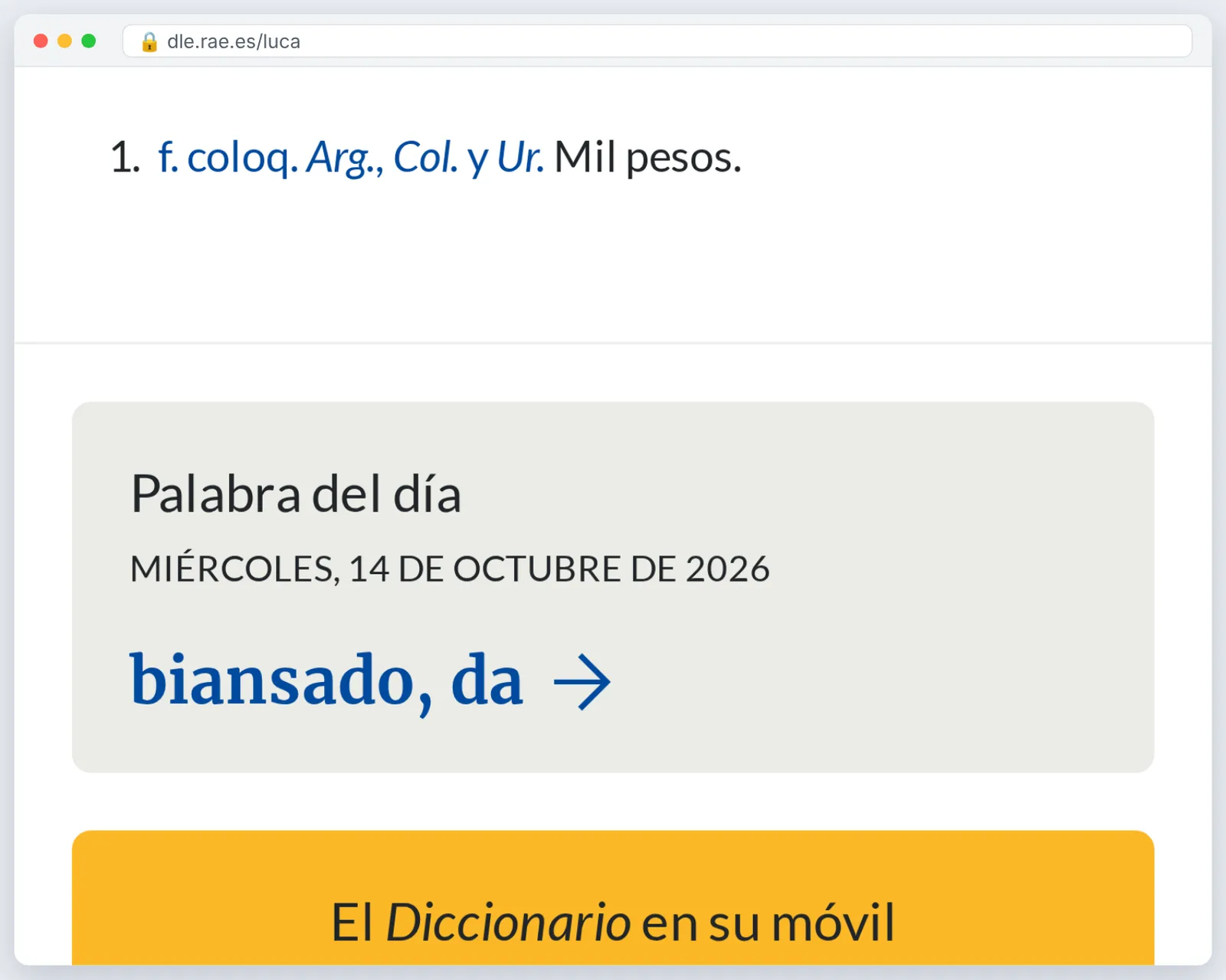
The Real Academia Española dictionary records luca in a single sense as a colloquial word used in Argentina, Colombia and Uruguay meaning mil pesos, a thousand pesos. That single entry explains a lot of mistranslated song lyrics.
| Term | Amount | Where |
|---|---|---|
| luca | a thousand pesos (RAE) | Argentina, Colombia, Uruguay (RAE); also Chile |
| palo | a million | Argentina, Spain |
| gamba | a hundred pesos | Argentina |
| mango | one peso | Argentina, Uruguay |
| varo | one peso | Mexico |
| melón | a million | Spain |
Only the luca row comes from a dictionary entry, and the RAE labels it for Argentina, Colombia and Uruguay; Chilean use is widely attested but not in that entry. The other rows record commonly reported usage.
The currency is never stated, which is the trap. Dos lucas in Santiago and dos lucas in Buenos Aires are both two thousand pesos, but the two pesos are different currencies with different buying power.
Translate the number and keep the currency vague unless the context names it. "Two grand" works for dos lucas in dialogue; "two thousand dollars" invents a fact the Spanish never gave you.
Which Terms the RAE Actually Recognises (and Which It Doesn’t)
In the Real Academia Española dictionary, sense 6 of lana is the colloquial meaning dinero (moneda corriente), money as currency. Dictionary recognition is a useful signal: it tells you the word is established and widely documented, not that it is neutral enough for a formal email.
What the RAE records for these words:
- lana — colloquial money sense, listed as sense 6.
- guita — colloquial dinero contante in sense 3, after the hemp-cord senses.
- luca — one sense only, mil pesos, flagged for Argentina, Colombia and Uruguay.
- pasta, cuartos, parné, pisto, feria, mango, moni, guano, morlacos — all appear as money synonyms in the RAE’s own cross-references.
The RAE also keeps online the text of the 22nd edition of the Diccionario de la lengua española, published in 2001, so you can check whether a money sense such as lana was already recorded back then. Newer street terms — fula, cora, local coinages that trend for a season — often have no entry at all, so what this article says about them is reported usage. Absence from the dictionary makes a word undocumented, not wrong.
How to Use Money Slang Without Sounding Off: Register, Region and Risk
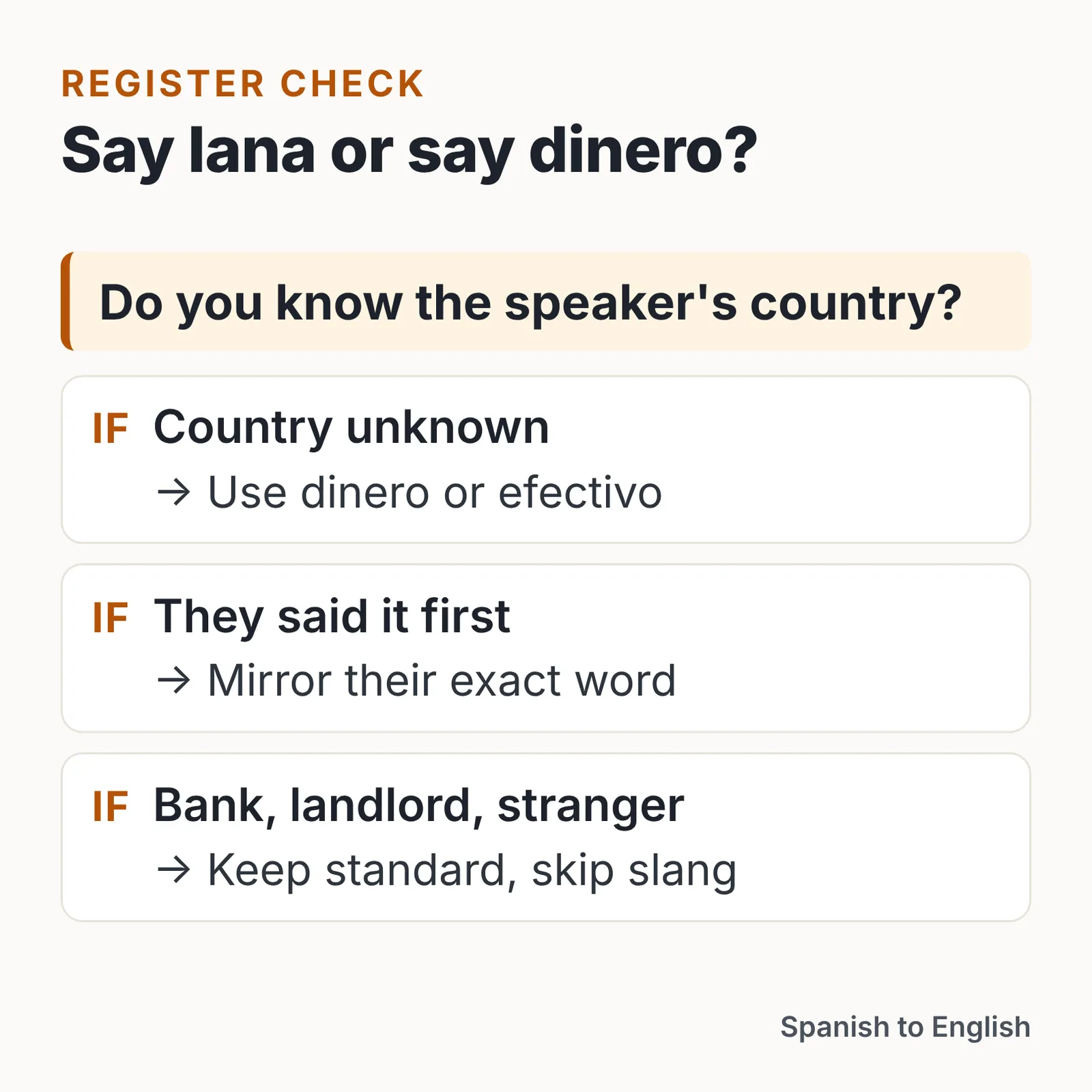
The safest rule is mirroring. Let the other person use the word first, then reuse their exact term — if they say plata, you say plata, not lana.
When you don’t know someone’s country, fall back on dinero. Dropping pisto on a Chilean or chavos on a Spaniard produces a half-second of confusion that costs you more than the slang gains you. Register mistakes cluster the same way with greetings, intensifiers and fillers, which is the pattern behind the Spanish slang words English speakers hear most.
Three situations call for standard vocabulary every time: writing to a bank or landlord, speaking to anyone older whom you’ve just met, and any sentence where a precise sum matters. Slang amounts invite misunderstandings that neutral numbers avoid.
Watch tone, too. Some money terms carry an edge of boasting or of illicit cash depending on who says them, so copying a reggaetón lyric into a work conversation lands badly.
Putting It to Work: Translating Money Slang in Songs, TV and Conversation
Work through three questions in order. Which country is the speaker from? Does the word name an amount or money in general? What English register matches — "cash," "dough," "bucks," "a grand"?
The RAE’s Diccionario del estudiante gives guita as colloquial money, a set of coins or banknotes, with the example Paga tú, que yo no tengo guita. In English that is "You pay, I’m broke" — not "I do not have money," which flattens a casual line into a formal one.
Subtitles squeeze this further, since you have a line length to respect and no room for a footnote. Choose the shortest English word that keeps the tone, and drop the regional color rather than the meaning. The workflow for catching these terms across a full episode is laid out in this walkthrough of how to translate Spanish video into English subtitles.
When a lyric depends on the pun — lana as wool and cash at once — keep the money reading and let the image go.
Frequently asked questions
What is the most common slang word for money in Spanish?
Plata has the widest reach, serving as the everyday informal word for money across Argentina, Chile, Colombia, Peru and Venezuela. Mexico prefers lana, varo and feria, and Spain prefers pasta and guita, so no single term covers all Spanish-speaking countries.
Does lana really mean wool?
Yes, wool is the primary meaning. In the Real Academia Española dictionary, sense 6 of lana is the colloquial meaning dinero (moneda corriente), money as currency, which is the sense Mexican speakers use in phrases like no traigo lana.
How much is una luca?
The Real Academia Española dictionary records luca in a single sense as a colloquial word used in Argentina, Colombia and Uruguay meaning mil pesos. Chilean use is widely reported but not covered by that entry, and the currency depends on the country, so two lucas in Santiago and Buenos Aires are different real amounts.
Is plata slang or standard Spanish?
It sits on the line. Plata passes as ordinary conversational Spanish in most of South America, yet the RAE entry for guita lists it among money synonyms alongside pasta, cuartos, moni, lana, parné, morlacos, feria, pisto and guano. Use dinero in formal writing.
What is the English equivalent of guita or pasta?
Cash or dough fits both. The Real Academia Española defines guita first as thin hemp cord and only in sense 3 as colloquial dinero contante, ready cash, so translate it as a casual word for money on hand rather than wealth in general.
Sources
- CVC. Anuario 2024. Presentación. Carmen Pastor Villalba — Instituto Cervantes
- El anuario «El español en el mundo 2024» radiografía el estado de la lengua en los países de América Latina — Instituto Cervantes
- El español en el mundo 2024. Anuario del Instituto Cervantes (PDF)
- luca | Diccionario de la lengua española (RAE-ASALE)
- lana | Diccionario de la lengua española (RAE-ASALE)
- guita | Diccionario de la lengua española (RAE-ASALE)
- lana | Diccionario de la lengua española (2001) — RAE
- guita | Diccionario del estudiante — RAE
AI tools helped write this guide. The Spanish to English Editorial Team published it after checking every figure against the sources linked above.