"Dale" literally means "give it to him/her/it," but in everyday Spanish it works as "okay," "go ahead," or "let’s go." Argentines use it to agree, Puerto Ricans to hype, Mexicans to urge someone on.

What does ‘dale’ mean in Spanish? The short answer in English
A dictionary entry cannot carry this word on its own. Spoken, "dale" lands somewhere between "go ahead," "okay" and "let’s go." Typed into a WhatsApp thread, it usually just means yes.
Four English renderings cover almost everything you will hear:
| Use | Closest English | Typical setting |
|---|---|---|
| Agreement | "okay," "sure," "deal" | Plans, chat replies, Argentina and Uruguay |
| Permission or push | "go ahead," "do it" | Someone hesitating before acting |
| Hype | "come on!," "let’s go!," "hit it!" | Music, stadiums, dance floors |
| Literal command | "give it to him/her/it" | Sports, handing something over |
Scale explains why this one word keeps showing up in your feed. USAFacts, citing U.S. Census American Community Survey data, reports that about 44.9 million people aged 5 and over speak Spanish at home in the United States, roughly one in every seven.
Tone decides the reading. A flat, quick "dale" is agreement. A stretched, loud "daaale" is encouragement, and a clipped one with raised eyebrows is impatience.
The practical rule for English speakers: translate the function, never the grammar. If you render every "dale" as "give it to him," you will produce subtitles that nobody recognizes as English.
Where ‘dale’ comes from: ‘dar’ + ‘le’ and the literal ‘give it’
The word is a command with a pronoun stuck to the end. Take dar (to give), put it in the informal tú imperative — da — and attach the indirect object pronoun le (to him, to her, to it). You get dale: "give it to him."
That base meaning is plain in the source verb. The Real Academia Española’s Diccionario de la lengua española defines dar first as donar, to donate, and second as entregar, to hand over.
Spanish builds dozens of these fused forms the same way:
- dame — give me
- dales — give to them
- déjalo — leave it
- dile — tell him/her
Only dale escaped its grammar and became a free-standing word. You can tell because it no longer needs an object, a listener who is "him," or even a thing being given. A friend says dale to accept a dinner invitation; nothing is handed to anyone.
That frozen quality matters for translation. Once a form stops conjugating and starts working as a noise of agreement, treat it as vocabulary, not as a verb you need to parse.
How ‘dale’ works: three stages from command to agreement to hype
Think of three stages, each one layered on the one before it.
Stage 1 — the literal order. Dale la pelota a Juan means "give the ball to Juan." Pure grammar, no attitude.
Stage 2 — permission and agreement. The object disappears and the word becomes a green light. ¿Te paso a buscar a las ocho? — Dale. That is "sure," "works for me," "go ahead."
Stage 3 — pure interjection. Nothing is being given or agreed to; the word is energy. Academic work on interjections citing the Nueva gramática de la lengua española (2009) published by the RAE and ASALE classifies dale as an interjection formed from a verbal base, in the same family as vale.
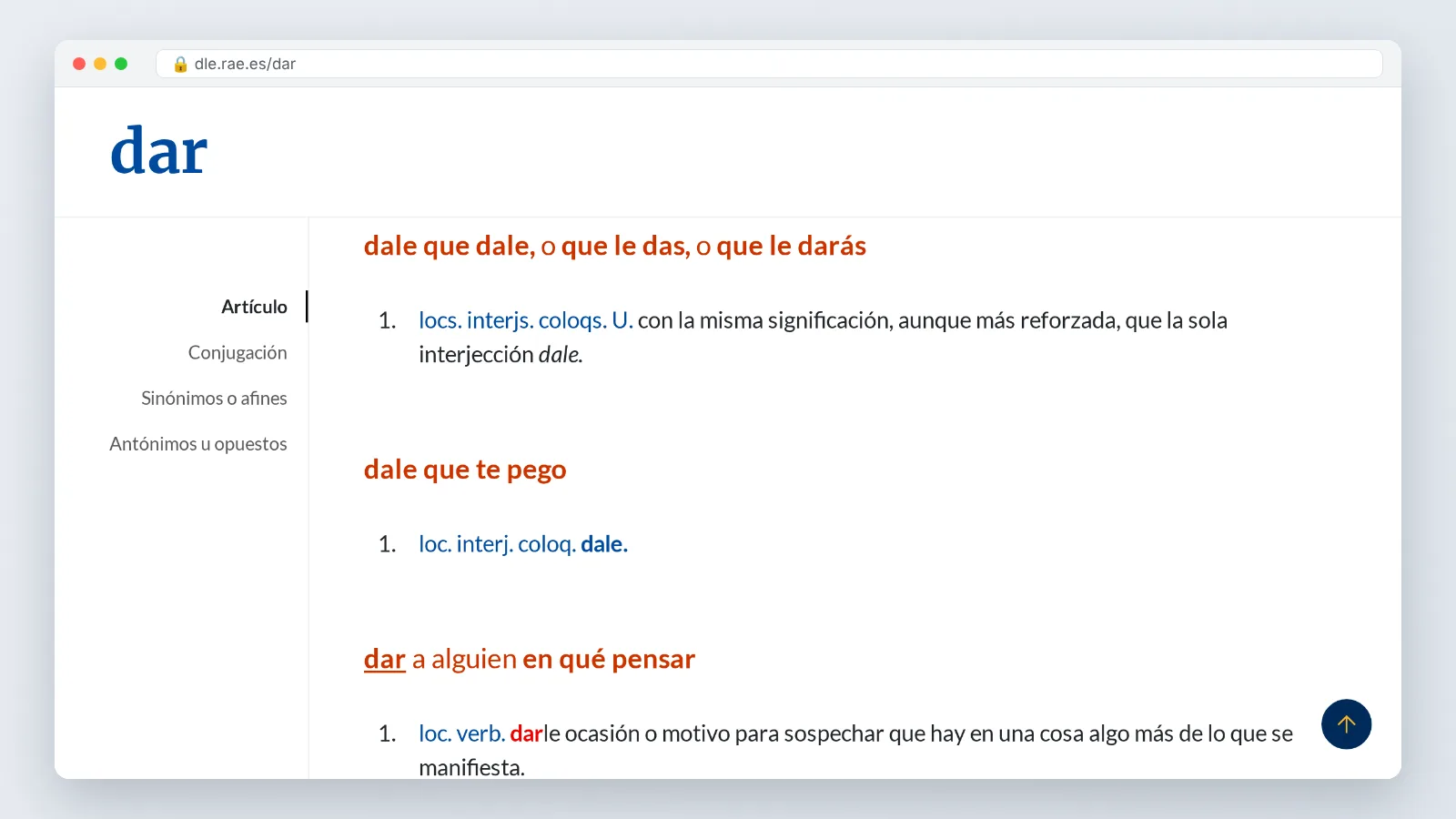
A fourth reading sits off to the side, and it is the one most learners miss: annoyance. The Real Academia Española lists dale inside the entry for dar as a colloquial interjection used to reprove someone angrily, and notes it is often repeated. The RAE also records the reinforced variants dale que dale, dale que le das and dale que le darás, defined as carrying the same meaning as plain dale but stronger.
The RAE’s Diccionario del estudiante illustrates an exasperated ¡Y dale! with a line that translates as "I’ve told you I don’t want to keep talking about that." English equivalent: "Enough already."
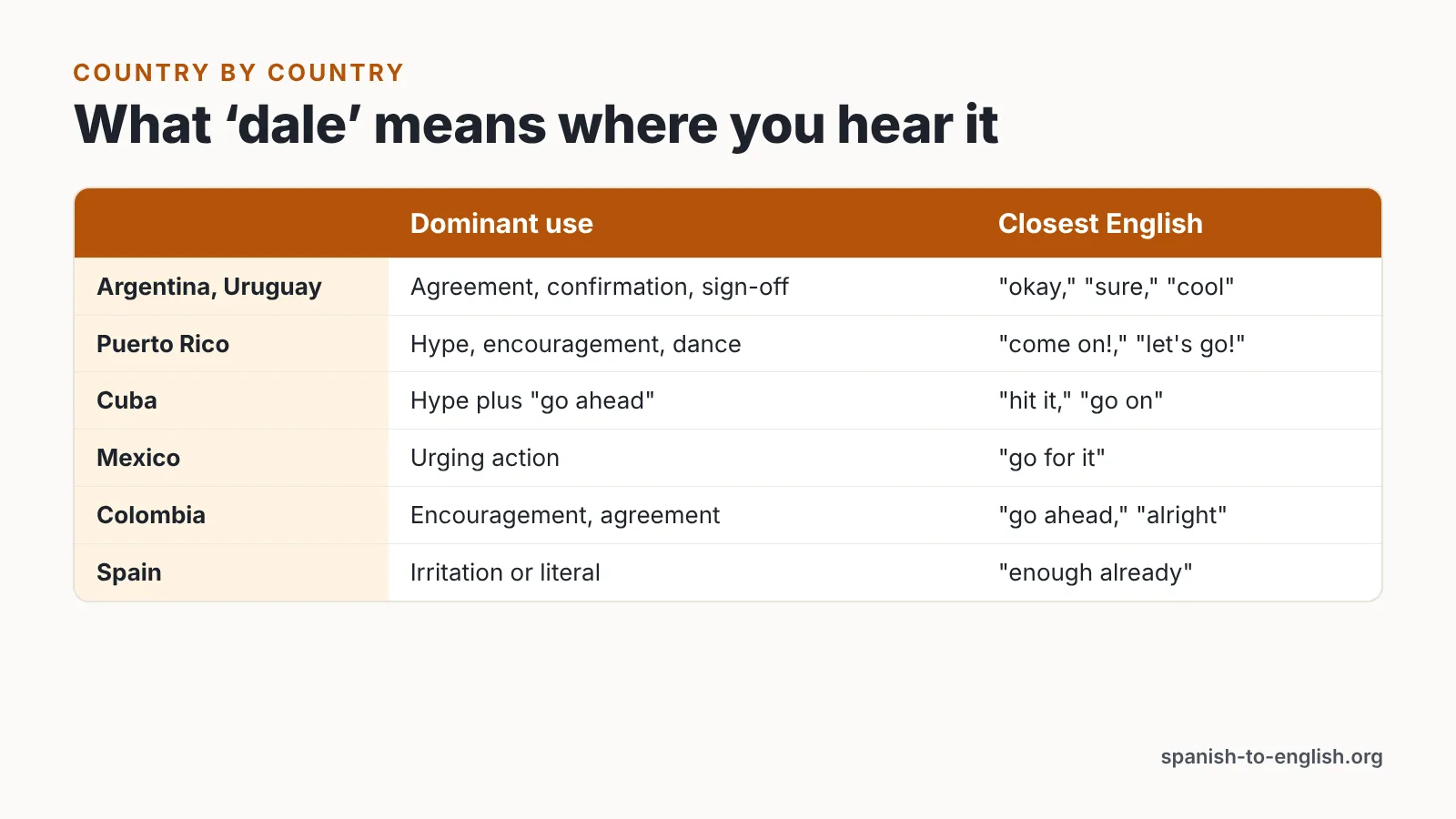
‘Dale’ country by country: Argentina, Puerto Rico, Mexico, Colombia, Spain
The same four letters carry different default meanings depending on where the speaker grew up.
| Country | Dominant use | Closest English |
|---|---|---|
| Argentina, Uruguay | Agreement, confirmation, sign-off | "okay," "sure," "cool" |
| Puerto Rico | Hype, encouragement, dance | "come on!," "let’s go!" |
| Cuba | Hype plus "go ahead" | "hit it," "go on" |
| Mexico | Urging action; less common than órale | "go for it" |
| Colombia | Encouragement, agreement in some regions | "go ahead," "alright" |
| Spain | Mostly irritation (¡y dale!) or literal | "enough already" |
In Buenos Aires and Montevideo, dale is conversational glue. It opens plans, closes them, and fills the space where an English speaker would say "yeah, no worries." Argentines also stack it: dale, dale, nos vemos.
Mexico leans on órale and ándale, though dale appears constantly in sports and music. The Instituto Cervantes yearbook El español en el mundo 2024 reports that Mexico has the largest Spanish-speaking population of any country, with more than 120 million speakers out of the 600 million worldwide, which is why Mexican usage dominates what most Americans hear.
Spain is the outlier. A Spaniard hearing dale as "okay" will understand it, but will almost certainly answer vale.
‘Dale’ vs ‘vale’, ‘órale’ and ‘venga’: picking the closest English word
Four interjections compete for the same conversational space, and they are not interchangeable.
| Word | Main region | Core meaning | English |
|---|---|---|---|
| dale | Argentina, Uruguay, Caribbean | agree, encourage, hype | "okay," "let’s go" |
| vale | Spain | agree, acknowledge | "okay," "got it" |
| órale | Mexico | agree, urge, express surprise | "alright," "whoa" |
| venga | Spain | urge, wrap up a call | "come on," "alright then" |
The cleanest distinction is between dale and vale. Both answer a proposal with yes, but vale is passive acknowledgment while dale pushes the action forward. Vale says "understood." Dale says "do it."
Órale carries a surprise reading that dale does not: a Mexican speaker seeing a huge plate of food may say órale where an English speaker says "whoa." Venga is the Spanish way to end a phone call, roughly "alright then, bye."
Pick your English word by function. If the Spanish speaker is accepting, use "okay" or "sure"; if they are pushing, use "come on" or "go ahead."
How to translate ‘dale’ in lyrics, subtitles, WhatsApp and chants
Context changes the right answer more than the country does.
Reggaeton and Latin pop. Here dale is rhythm, not instruction, and translators usually go with "come on," "let’s go" or "hit it." Pitbull named his ninth studio album — his second Spanish-language one — Dale, a title commonly glossed in English as "Hit it," according to the album’s Wikipedia entry. The Caribbean weight behind that usage is real: USAFacts reports that Puerto Rico, excluded from the U.S. national count, adds about 3 million Spanish speakers at home, roughly 95% of the territory’s population.
Subtitles. Space is tight, so use the shortest natural English: "Okay." "Go ahead." "Come on." Dropping dale entirely is often the better call when the actor’s tone already carries the meaning.
WhatsApp and texting. Argentine chat dale is almost always "ok" or "sounds good." A doubled dale dale reads as enthusiasm, not repetition.
Football chants. ¡Dale campeón! is "Let’s go, champs!" Keep the exclamation and the team name; literal translation kills the chant.
Quick reference: ‘dale’ cheat sheet, pronunciation and common mistakes
Pronunciation first, because this is where English speakers give themselves away. Say DAH-leh, two syllables, stress on the first. The Spanish d is softer than the English one, the a is the vowel in "father," and the final e is short — never the English word "dale" that rhymes with "pale."
The translation shortlist, in order of how often you will need it:
- "Okay" / "sure" — replying to a plan
- "Go ahead" — giving permission
- "Come on" / "let’s go" — encouragement
- "Hit it" — music and performance cues
- "Enough already" — the irritated ¡y dale!
- "Give it to him" — literal, sports and objects
Mistakes worth avoiding:
- Translating every dale literally, which turns casual agreement into nonsense.
- Confusing dale with dame ("give me") — one letter, completely different request.
- Using it in Spain as "okay" and sounding foreign; vale is the local choice.
- Reading an impatient ¡y dale! as encouragement when the speaker is fed up.
- Writing it with an accent. Dale carries no written accent mark.
When you are unsure, listen to the pitch. Rising and short means yes; loud and stretched means go.
Frequently asked questions
Is ‘dale’ rude or offensive in Spanish?
No, it is informal but not offensive in ordinary use. The one sharp reading is the repeated form: the Real Academia Española lists ‘dale’ in the entry for ‘dar’ as a colloquial interjection used to reprove someone angrily, and notes it is often repeated, as in ‘¡y dale!’
What does ‘dale’ mean in reggaeton lyrics?
In reggaeton and Latin pop it functions as hype rather than instruction, closest to "come on," "let’s go" or "hit it." Pitbull named his ninth studio album, his second Spanish-language one, ‘Dale’, a title commonly glossed in English as "Hit it."
What is the difference between ‘dale’ and ‘vale’?
Both can answer a proposal with yes, but ‘vale’ is Spain’s acknowledgment word, closer to "got it," while ‘dale’ pushes the action forward, closer to "go ahead." Academic work citing the RAE and ASALE’s Nueva gramática de la lengua española classifies both as interjections formed from a verbal base.
Do Mexicans say ‘dale’ or ‘órale’?
Both, though ‘órale’ is the more distinctly Mexican agreement and surprise word while ‘dale’ usually urges someone to act. The Instituto Cervantes yearbook El español en el mundo 2024 reports Mexico has more than 120 million Spanish speakers out of 600 million worldwide, so Mexican usage shapes much of what Americans hear.
How do you pronounce ‘dale’ correctly?
Say DAH-leh with stress on the first syllable, a soft Spanish ‘d’, the ‘a’ of "father" and a short final ‘e’. Never rhyme it with the English words "pale" or "sale," and never add a written accent mark — ‘dale’ has none.
Sources
- dar | Diccionario de la lengua española (DLE), RAE-ASALE
- dar | Diccionario del estudiante, Real Academia Española
- Las propiedades pragmáticas de las interjecciones (TFM, Universidad de Oviedo)
- El anuario «El español en el mundo 2024» radiografía el estado de la lengua en los países de América Latina — Instituto Cervantes
- How many people speak Spanish at home? | USAFacts (U.S. Census ACS data)
- Dale (album) — Wikipedia
AI tools helped write this guide. The Spanish to English Editorial Team published it after checking every figure against the sources linked above.