The most common Mexican slang words are güey (dude), chido (cool), no manches (no way), neta (really/truth), chamba (work), padre (awesome), fresa (preppy), crudo (hungover) and órale (okay, wow).
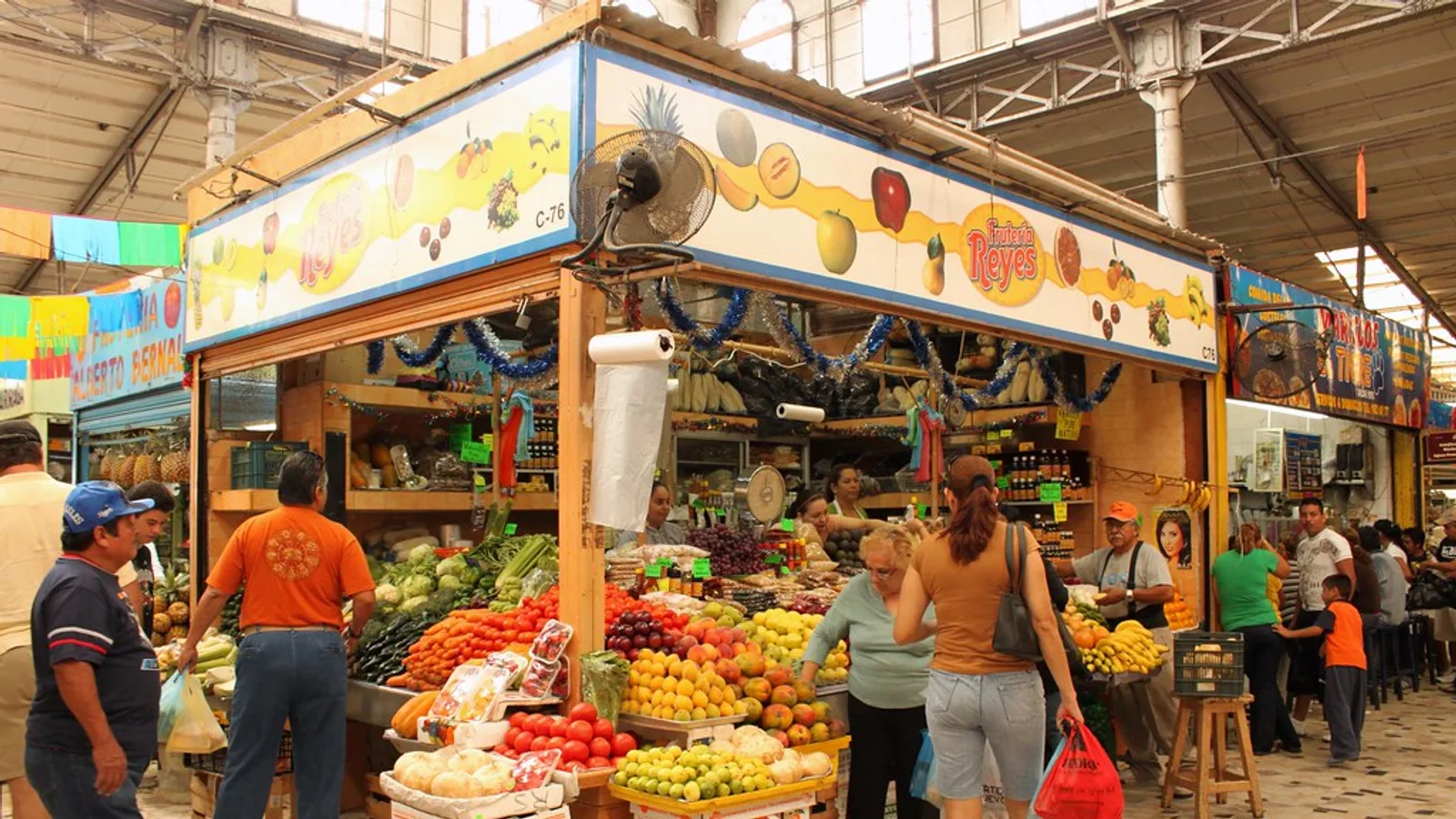
What Is Mexican Spanish Slang? A Plain-English Definition
Definition: Mexican Spanish slang is the informal, regionally marked vocabulary used in Mexico, where a word’s everyday meaning drifts away from the sense a standard Spanish dictionary gives it.
Mexico is the country with the most Spanish speakers in the world, with more than 120 million of the roughly 600 million people who speak the language globally, according to the Instituto Cervantes yearbook presented in December 2024. That weight is why Mexican slang travels. You hear it in Netflix dramas, reggaetón features, TikTok audio and in a WhatsApp message from a coworker in Monterrey.
Slang is not broken Spanish. It is a second vocabulary layer that sits on top of the standard one and signals who you are talking to and how close you are. A Mexican lawyer will say buenos días in a hearing and qué onda, wey in the parking lot an hour later.
Three features separate slang from ordinary informal speech. It changes faster than standard vocabulary, it marks group membership, and it often carries a meaning that cannot be guessed from the parts of the word. Echar aguas literally means "to throw waters" and actually means "keep a lookout."
The Most Common Mexican Slang Words and Their English Meanings
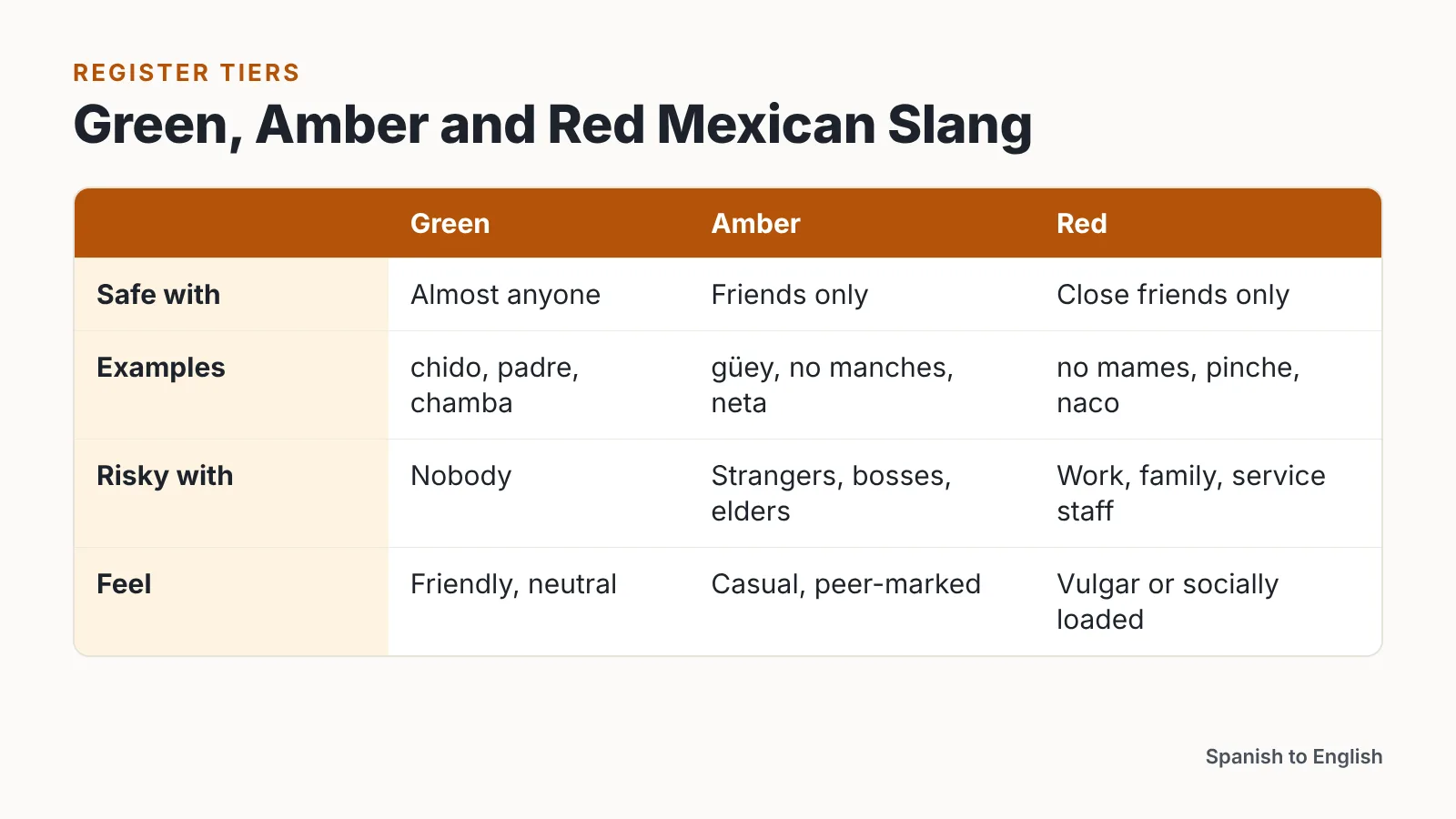
Start with the words that show up in almost every conversation, series and comment thread. The register column uses the same green, amber and red scale as the register section further down: green is safe with almost anyone, amber is for friends, red is vulgar or socially loaded.
| Slang | Literal sense | English meaning | Register |
|---|---|---|---|
| güey / wey | ox | dude, man, bro | amber |
| chido | — | cool, great | green |
| padre / padrísimo | father | awesome / amazing | green |
| no manches | don’t stain it | no way, you’re kidding | amber |
| no mames | (crude) | no freaking way | red |
| neta | — | the truth; for real? | amber |
| chamba / chambear | — | job / to work | green |
| lana, varo | wool | money, a buck | green |
| fresa | strawberry | preppy, posh | amber |
| naco | — | tacky, low-class | red |
| crudo / cruda | raw | hungover / hangover | green |
| órale | — | okay, wow, go ahead | green |
| ándale | — | that’s it, hurry up | green |
| ¿qué onda? | what wave | what’s up? | green |
| carnal | of flesh | brother, close friend | green |
| cuate | twin (from Nahuatl coatl) | buddy, pal | green |
| morro / morra | — | kid, young guy or girl | amber |
| chavo / chava | — | guy / girl | green |
| antro | cave | nightclub | green |
| botana | — | snack, bar food | green |
| chafa | — | cheap, shoddy | green |
| codo | elbow | stingy, tight-fisted | amber |
| pedo | fart | problem, drunk, situation | amber |
| ni pedo | — | oh well, nothing to be done | amber |
| chingón | — | badass, excellent | red |
| pinche | kitchen hand | damn, lousy (intensifier) | red |
| a huevo | — | hell yeah; by force | red |
| echar aguas | throw waters | keep watch, warn someone | green |
| sale | it comes out | okay, deal | green |
| ahorita | right now (diminutive) | in a bit — or never | green |
| mande | command me | pardon? / yes? | green |
| güero / güera | — | fair-haired or light-skinned person | green |
| chilango | — | someone from Mexico City | green |
| jefe / jefa | boss | dad / mom | green |
Treat the literal senses and etymologies in this table — güey from buey, cuate from Nahuatl, pinche from the kitchen-hand sense, antro from the word for a cave — as the origins commonly cited for these words, and check them in the Academia Mexicana de la Lengua’s Diccionario de mexicanismos and the RAE’s Diccionario de la lengua española before repeating them in print.
Learn ahorita properly, because it fools more English speakers than any other word. It looks like "right now" and in practice covers anything from thirty seconds to never.
How Mexican Slang Is Made: Three Stages from Root to Everyday Word
Stage 1 — the root
A slang word starts from somewhere concrete: an indigenous language, English, or an ordinary Spanish noun. Nahuatl, the indigenous language behind many everyday Mexican Spanish words, is spoken by 853,625 women, who make up 51.67% of its total speakers, according to Mexico’s 2020 census as reported by INALI. That matters for vocabulary because it shows Nahuatl is a living language with hundreds of thousands of current speakers rather than a purely historical source, which is why its words keep circulating in everyday Spanish. Cuate, escuincle, chamaco and popote all trace back to that root stock.
Stage 2 — the semantic jump
The word then takes a metaphorical turn and stops meaning what it says. Güey comes from buey, an ox, and went from "idiot" to a neutral "dude" that friends use dozens of times an hour. Antro meant a cave or a dive; now it is simply the club you went to on Saturday.
Stage 3 — the spread and the record
Use widens from one group to a generation, then to television, then to print. The Academia Mexicana de la Lengua documents an Índice de mexicanismos from 2000 containing 76,663 entries compiled from 138 word lists dating back to 1761, which shows how long this recording process has been running. A word that survives all three stages is no longer slang in the narrow sense — it is simply Mexican Spanish.
Mexican Slang vs. Spain’s Spanish Slang: Same Word, Very Different Meaning
The Instituto Cervantes 2024 yearbook reports more than 600 million Spanish speakers worldwide, of whom almost 500 million are native speakers, so no single slang inventory covers the language. A word that is harmless in Madrid can be obscene in Guadalajara.
| Word | In Mexico | In Spain |
|---|---|---|
| coger | vulgar: to have sex | to take, to catch (fully neutral) |
| pinche | damn, lousy (swear) | kitchen assistant (a job) |
| torta | sandwich on a bolillo roll | cake; also a slap |
| chaqueta | crude sexual slang | jacket |
| camión | bus | truck |
| tío | uncle, literal only | dude, guy |
| fresa | preppy, snobby | strawberry only |
| chavo / chaval | chavo = guy | chaval = kid, young guy |
The practical rule for reading or subtitling: identify the country first, then the decade, then the social class of the speaker. A 1970s Mexican film uses chavo and cuate where a 2026 teenager uses morro and wey. Treating "Spanish slang" as one bucket is how translators end up with a line that reads as a sex joke in Mexico and a shopping errand in Spain.
Register and Risk: Which Words Are Friendly, Which Are Rude
Sort everything you learn into the same three tiers used in the table above.
Green — safe with almost anyone: chido, padre, chamba, botana, órale, ándale, qué onda, sale, antro, crudo, plus every other word marked green in the table.
Amber — fine with friends, risky with strangers, bosses or elders: güey, no manches, neta, fresa, codo, morro, and pedo and ni pedo, which stay amber in the sense of "problem" and get cruder in their other uses.
Red — vulgar or socially loaded: no mames, pinche, chingón and the whole chingar family, a huevo, and naco, which insults people on class and often racial lines.
Who says a word matters as much as the word. Mexicans swap güey constantly among peers, and a foreign visitor who deploys it at a first meeting sounds like someone performing a stereotype. Listen for a week before you join in.
Family settings, service encounters and job interviews stay in the green tier. If a Mexican colleague uses red-tier language with you, that is an invitation to relax your Spanish, not a license to copy their strongest words back.
Using Mexican Slang in Practice: Streaming, Travel, Texting and Translation
More than 24 million people were studying Spanish as a foreign language worldwide in 2024, per the Instituto Cervantes Observatorio Global del Español report, and most of them meet Mexican slang through screens rather than classrooms. Subtitles compress it. A character says no mames, wey and the English line reads "dude, seriously," which is accurate in force but strips the vulgarity.
For texting, learn the written shortcuts: wey for güey, q onda, xq for porque, tqm for te quiero mucho, ntp for no te preocupes. Mexicans also write jajaja, never "hahaha."
For travel, the highest-value words are the quiet ones. Mande answers someone who calls your name, ahorita buys time, sale closes a deal, and provecho is what you say passing a table of people eating.
For translation work, match register before you match meaning. Decide whether the English reader should feel warmth, rudeness or sarcasm, then pick the English phrase that produces that feeling, and keep a note of any term you softened so an editor can check it.
How to Verify a Mexican Slang Word: Sources That Cover Mexicanisms
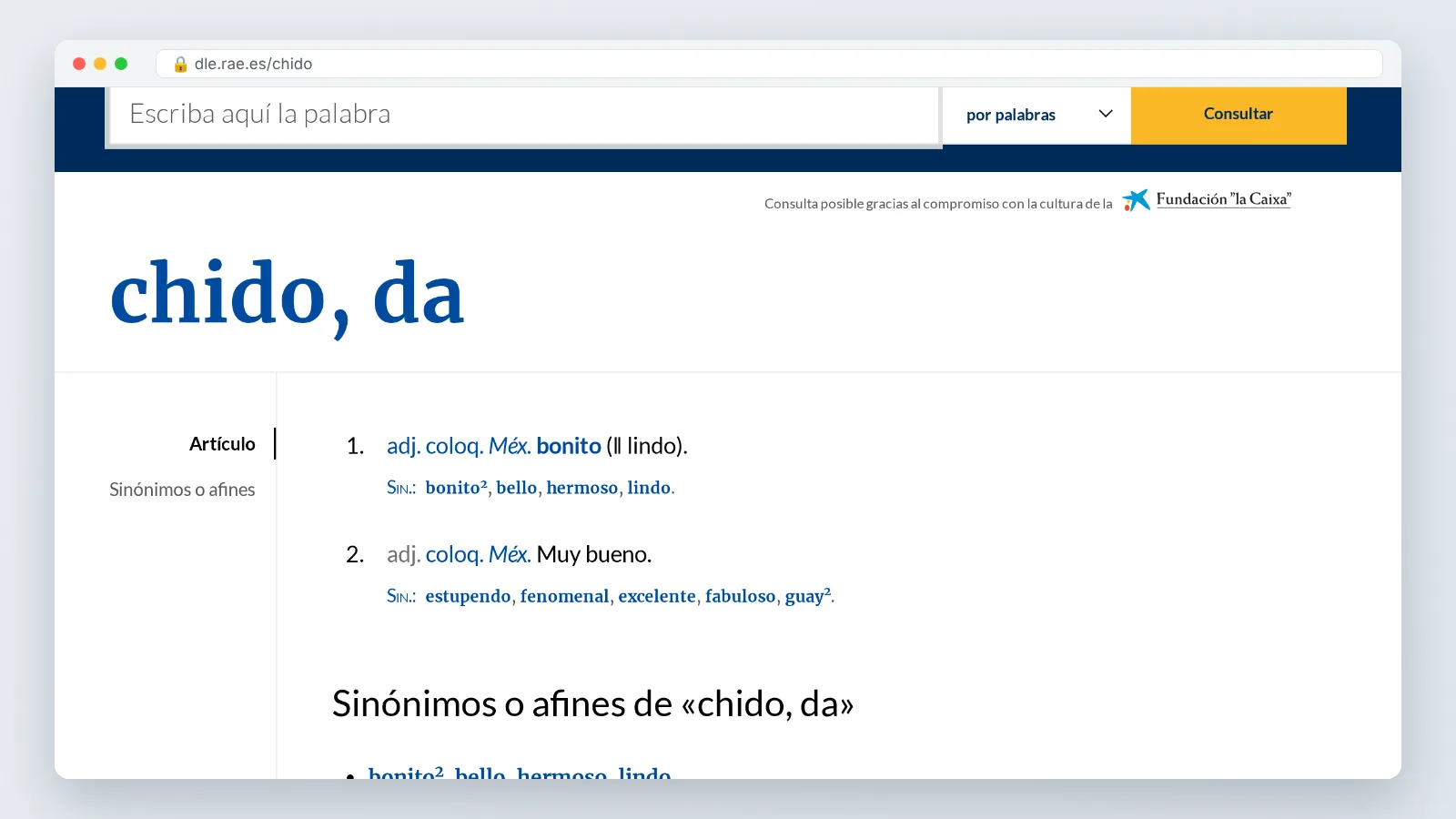
The Academia Mexicana de la Lengua’s current reference work on Mexican vocabulary, Diccionario de mexicanismos. Propios y compartidos, was published in Mexico City in 2023 and runs to 832 pages. It is the first stop for any word a general Spanish dictionary ignores or marks only as "colloquial," and it is also where you confirm the etymologies and literal senses listed earlier in this article.
Check the Real Academia Española dictionary second, for the standard sense and the regional labels. The Real Academia Española presented update 23.8 of the Diccionario de la lengua española on 10 December 2024, which is the kind of versioned record you can cite in a translation memo.
A four-step check that works for any term:
- Look the word up in the Mexicanisms dictionary and note the regional label.
- Compare the RAE entry to see whether the standard meaning differs.
- Search a corpus or recent Mexican media for the word in real sentences from the last few years.
- Ask a Mexican speaker about register — dictionaries record meaning far better than they record who may safely say it.
Skip crowd-edited slang sites as a sole source. They are useful for spotting a new term, unreliable for register, and frequently mix Mexican, Argentine and Caribbean uses in one entry.
Frequently asked questions
What are the 10 most useful Mexican slang words for a beginner?
Start with güey (dude), chido (cool), padre (awesome), no manches (no way), neta (really), chamba (work), órale (okay or wow), qué onda (what’s up), ahorita (in a bit) and crudo (hungover). All ten are common and none will embarrass you in a normal conversation.
Is güey an insult?
Not between friends. Among peers it functions like "dude" and carries no sting; aimed at a stranger in an argument, it reverts to its older sense of "idiot." That is why it sits in the amber tier rather than the green one.
What is the difference between no manches and no mames?
Same function, different strength. No manches is the amber-tier, family-safe version you can say to a coworker; no mames is red tier, crude, and belongs with close friends only.
Why is Mexican slang so influential compared with other varieties?
Audience size and media output. Mexico is the country with the most Spanish speakers in the world, with more than 120 million of the roughly 600 million people who speak the language globally, according to the Instituto Cervantes yearbook presented in December 2024, and its films, series and music circulate across the Americas.
Where does Mexican slang come from?
Three sources feed it: indigenous languages, mainly Nahuatl, which is commonly cited as the origin of cuate, escuincle and popote; English borrowings reshaped in Spanish; and ordinary Spanish nouns that take a metaphorical turn, as buey became güey and cave-word antro became nightclub.
Does Mexican slang work in other Latin American countries?
Partly. Chido, chamba and órale read as clearly Mexican elsewhere, and words like pedo or padre carry different weight in Argentina, Colombia and Spain, so check before you reuse them.
Which Mexican slang words should I never use?
Avoid naco, which attacks people on class and often racial grounds, and keep pinche, chingón, a huevo and no mames out of work, family and service settings. They are extremely common among friends and still read as vulgar to anyone you have just met.
What dictionary should I check for a Mexican slang word?
Use the Academia Mexicana de la Lengua’s Diccionario de mexicanismos. Propios y compartidos, published in Mexico City in 2023 and running to 832 pages, then cross-check the Real Academia Española dictionary, which presented update 23.8 on 10 December 2024, for the standard sense and regional labels.
Sources
- El anuario «El español en el mundo 2024» radiografía el estado de la lengua en los países de América Latina — Instituto Cervantes
- CVC. Anuario 2024. Presentación. Carmen Pastor Villalba
- El español: lengua para el mundo 2024 — Observatorio Global del Español, Instituto Cervantes
- La RAE presenta las novedades del Diccionario de la lengua española (DLE) en su actualización 23.8 — Real Academia Española (nota de prensa)
- Academia Mexicana de la Lengua — Diccionario de mexicanismos
- Diccionario de mexicanismos. Propios y compartidos — review, Journal of Spanish Language Teaching, Vol. 11, No. 1 (2024)
- Lengua Nawatlahtolli (náhuatl) — Instituto Nacional de Lenguas Indígenas (INALI)
AI tools helped write this guide. The Spanish to English Editorial Team published it after checking every figure against the sources linked above.